Skip to content

Localising the Energy Transition

Advancing a Just Energy Transition: Localisation, Decent Work, and Sustainable Livelihoods is a multi-country research project examining the energy sectors of Ghana, Kenya, and South Africa in the context of global decarbonisation. Focusing on solar modules, wind turbine towers, and battery storage systems, the project assesses how localisation, through local production, ownership, SME participation, and firm upgrading, can move beyond simple assembly toward higher value-added industrialisation.

It investigates how decent work, gender equity, and sustainable livelihoods can be embedded in renewable energy national and global production networks, generating evidence to inform public policy that strengthens local manufacturing and avoids reproducing unequal global economic patterns. The project is implemented through a partnership of policy institutes, civil society organisations, labour bodies, researchers, and industry actors across the three countries.

Project Partners

South Africa

Institute for Economic Justice (IEJ) | Lead Partner

The Institute for Economic Justice is a South African economic policy think tank advancing alternatives to austerity, inequality, and climate injustice through rigorous research, advocacy, and public engagement. IEJ leads the overall project and undertakes research and coordination in South Africa.

Congress of South African Trade Unions (COSATU)

Congress of South African Trade Unions (COSATU)

COSATU is South Africa’s largest trade union federation, representing workers across key sectors of the economy. Within this project, COSATU brings organised labour into the heart of the just energy transition, ensuring that worker interests, job security, and decent work shape policy and investment decisions.

Ghana

Africa Centre for Energy Policy (ACEP)

The Africa Centre for Energy Policy (ACEP), A Rocha Ghana, and the World Energy Council’s Future Energy Leaders—Ghana (FEL—Ghana) jointly lead the Ghana research stream as a consortium. Together, they analyse how renewable energy industrialisation can drive local economic development and inclusive growth, drawing on their complementary expertise in energy governance, environmental sustainability, and emerging energy leadership.

A Rocha Ghana

The Africa Centre for Energy Policy (ACEP), A Rocha Ghana, and the World Energy Council’s Future Energy Leaders—Ghana (FEL—Ghana) jointly lead the Ghana research stream as a consortium. Together, they analyse how renewable energy industrialisation can drive local economic development and inclusive growth, drawing on their complementary expertise in energy governance, environmental sustainability, and emerging energy leadership.
World Energy Council’s Future Energy Leaders—Ghana (FEL—Ghana)

World Energy Council’s Future Energy Leaders—Ghana (FEL—Ghana)

The Africa Centre for Energy Policy (ACEP), A Rocha Ghana, and the World Energy Council’s Future Energy Leaders—Ghana (FEL—Ghana) jointly lead the Ghana research stream as a consortium. Together, they analyse how renewable energy industrialisation can drive local economic development and inclusive growth, drawing on their complementary expertise in energy governance, environmental sustainability, and emerging energy leadership.

Kenya

Africa Centre for Technology Studies (ACTS)

The Africa Centre for Technology Studies (ACTS) is an intergovernmental policy research institution headquartered in Nairobi, Kenya, specialising in science, technology, innovation, and sustainable development. ACTS leads the Kenya component of the project, examining how clean energy value chains can support decent work, localisation, and technological upgrading.
Related Resources

Browse research and resources on localisation, decent work, and a just energy transition.

Project Timeline

Project Inception Workshop

Introduced the project to all project partners, aligned on project goals and ambitions, and clarified the project’s relevance, expected impact, and implementation approach.

Kenya Stakeholder Meeting

Introduced the project to key stakeholders, including labour, policymakers and Small, Medium, and Micro Enterprises (SMMEs); gathered feedback; and strengthened stakeholder relationships.

Ghana Stakeholder Meeting

Introduced the project to key stakeholders, including labour, policymakers and SMMEs; gathered feedback; and strengthened stakeholder relationships.

South Africa Stakeholder Meeting

Introduced the project to key stakeholders, including labour, policymakers and SMMEs; gathered feedback; and strengthened stakeholder relationships.

Global Production Network Capacity-Building Workshop

Built the project team’s capacity to apply the Global Production Network analytical framework.

Project Opening Symposium

Presented the project and emerging findings, and enabled engagement with relevant stakeholders working on the just energy transition.

F20/G20 Side Event Panel Participation

Contributed IEJ perspectives to the F20/G20 side event in Cape Town, South Africa.

Fieldwork Launch in Ghana, Kenya, and South Africa

Commenced fieldwork across Ghana, Kenya, and South Africa to support the project’s research and evidence-gathering process.

Kenya Sub-National Policy Dialogues in Central, Coastal, and Western Kenya

Sub-national policy dialogues in Mombasa, Nairobi, and Kisumu to share emerging research findings and gather stakeholder perspectives. The dialogues brought together county and national government representatives, industry actors, labour, civil society, communities, and researchers to generate region-specific priorities and recommendations.

COSATU/NALEDI Research Workshop Panel Participation

Shared IEJ research insights and contributed to discussions at the COSATU/NALEDI Research Workshop in Johannesburg, South Africa.

G20 ETWG Panel Participation

Contributed to the G20 3rd Energy Transitions Working Group (ETWG) discussion on the ingredients for a just, affordable, and inclusive energy transition in South Africa.

Kenya National Just Energy Transition Dialogue

Positioned the research to support coalition strengthening and prepare for the development and pursuit of potential policy recommendations.

Team building and MEAL workshop

Strengthened project partnerships, supported team alignment, and advanced monitoring, evaluation, accountability and learning processes in Naivasha, Kenya.

South Africa Wind Energy Windaba Panel Participation

Contributed IEJ perspectives to the 2025 South Africa Wind Energy Windaba.

Firm survey fieldwork launch

Began firm survey fieldwork as part of the project’s research and evidence-gathering process.

Publication: Conceptual Framework for the Just Energy Transition

Published the project’s conceptual framework, setting out how renewable energy localisation can support economic and social transformation, with attention to decent work, gender equity, sustainable livelihoods and domestic productive capacity.

Read more.

Publication: Gender Equity and Sustainable Livelihoods in Renewable Energy Value Chains

Published a conceptual framework applying a social reproduction lens to gender equity and sustainable livelihoods in renewable energy value chains, with relevance for South Africa, Kenya and Ghana.

Read more.

Publication: Continental Overview of Renewable Energy in Sub-Saharan Africa

Published a continental overview establishing the structural and empirical context for analysing localisation, employment, energy access, renewable energy deployment and value chains across sub-Saharan Africa.

Read more.

Publication: Ghana Renewable Energy Policy Scan: Critical insights and questions for localisation and decent employment

Published a policy scan assessing whether Ghana’s renewable energy policy framework supports localisation, SMME participation, decent work, gender inclusion and inclusive green industrialisation.

Read more.

Publication: South African Renewable Energy Policy Scan: Critical insights and questions for localisation and decent employment

Published a policy scan reviewing South Africa’s renewable energy, climate, electricity and industrial policy frameworks, with a focus on localisation, decent work and inclusive economic participation.

Read more.

Publication: Kenya Renewable Energy Policy Scan: Critical insights and questions for localisation and decent employment

Published a policy scan assessing how Kenya’s policy and regulatory frameworks support, or constrain, an inclusive, employment-generating and industrially transformative renewable energy transition.

Read more.

Submission: Renewable Energy Tariffs: Supporting local manufacturing and decent work

Published a submission recommending tariff measures that support South African renewable energy manufacturing, alongside stronger local-content enforcement, fairer procurement practices, and commitments to decent work and gender equity. It also calls for differentiated battery tariffs to protect domestic producers without raising essential input costs.

Read more.

Publication: Kenya Solar and Wind Manufacturing in the Renewable Energy Transition

Published a discussion paper examining whether Kenya’s solar and wind transition is generating deeper industrial, employment and social benefits, using a Global Production Networks framework.

Read more.

Internal Advocacy Strategy Workshop

An internal workshop to draft an advocacy strategy. The session enabled the team to refine advocacy outcomes, map priority stakeholders and their influence, co-create policy-brief topics, and identify practical advocacy actions on policy coherence, renewable-energy localisation and decent work.

Climate Action Dialogue 2026: Building Local Value in Ghana’s Energy Transition

Held in Accra, Ghana, on 2 June 2026, the dialogue convened stakeholders from Ghana’s solar PV industry, government, academia, and civil society to explore how the country can move beyond viewing solar development solely as an energy solution and use it to advance local value creation, industrial growth, decent work, and enterprise development. It also shared the project’s key findings with a broader audience.

COSATU and Labour Centre IEJ Workshop

The workshop was primarily to implement and test the advocacy strategy that the IEJ formulated with labour partners. During the workshop, the IEJ and stakeholders gave and received feedback on the advocacy strategy. In addition, further insights on potential steps to be taken on the ground to advance the project objectives and influence policy were shared.

Submission: General Public Procurement Regulations of 2026

Published a submission calling for enforceable local-content requirements in South Africa’s procurement regulations to support domestic manufacturing, decent work, and industrial development.

Read more.

Publication: Global Production Network for Solar PV Panels in Ghana

Published a background paper mapping Ghana’s participation in global solar production networks and examining opportunities to strengthen local manufacturing, technological capabilities, and inclusive employment.

Read more.

Publication: Value, Power, and Embeddedness in the South African Wind Turbine Towers Manufacturing Sector: Implications for Industrial Policy

Published a background paper examining how global production networks and power relations shape South Africa’s wind turbine tower manufacturing, with recommendations for industrial policy that strengthens domestic capabilities, local value capture, and decent work.

Read more.

Publication: Solar Panels and Inverters: Potential and obstacles in South Africa

Published a background paper examining opportunities and barriers to expanding South Africa’s solar-panel and inverter manufacturing, with attention to industrial policy, decent work, and gender equity.

Read more.

Publication: A Case Study Analysis of Localisation, Decent Work, and Gender Equity in Kenya’s Renewable Energy Sector

Published a case study assessing local participation in Kenya’s solar and wind industries, job quality, and barriers to women’s participation, with recommendations for a more inclusive energy transition.

Read more.

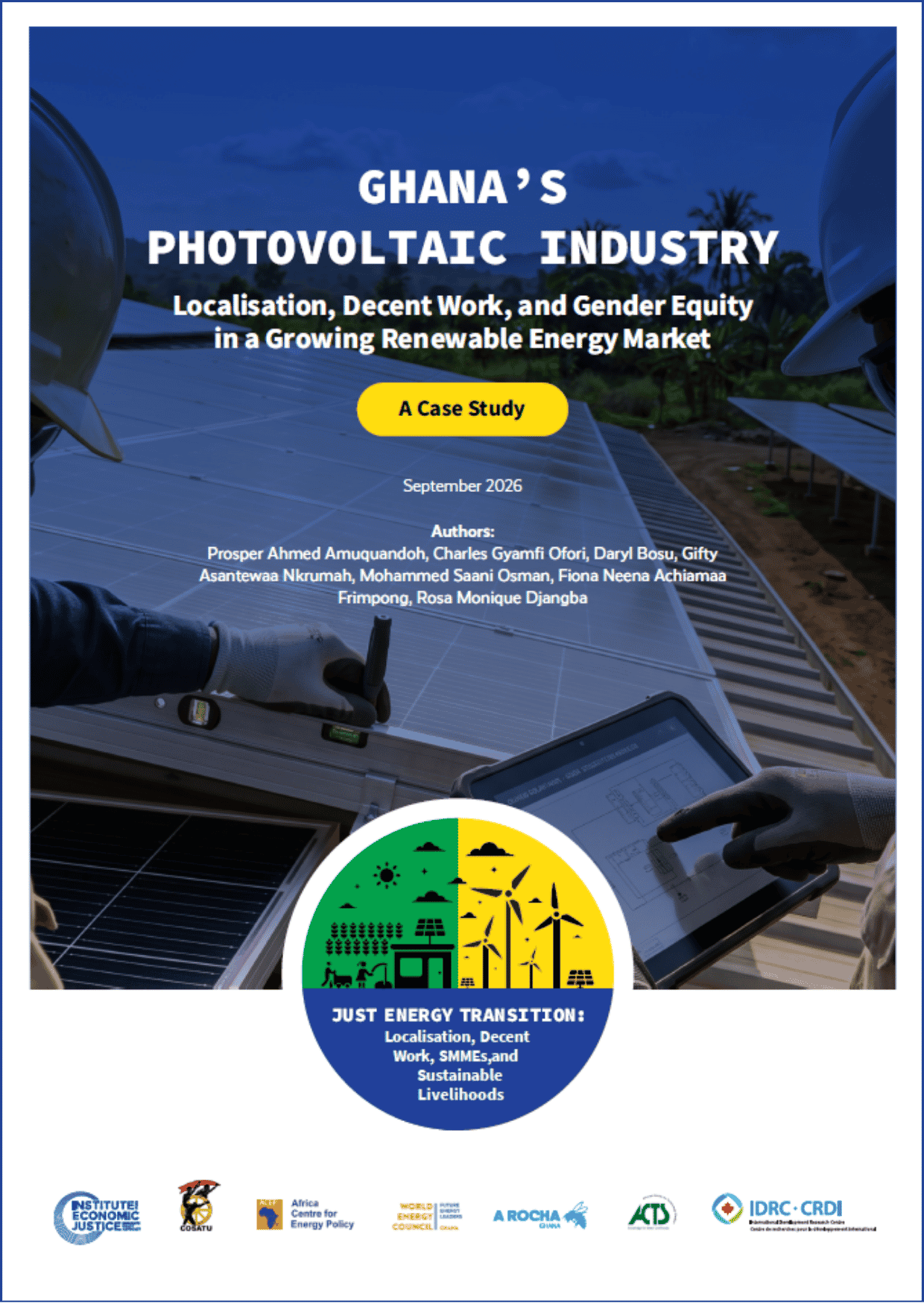
Publication: Ghana’s Photovoltaic Industry: Localisation, decent work, and gender equity in a growing renewable energy market
Published a case study examining how Ghana’s growing solar industry can build domestic productive capabilities, improve employment conditions, and expand women’s participation through stronger industrial policies.

Read more.

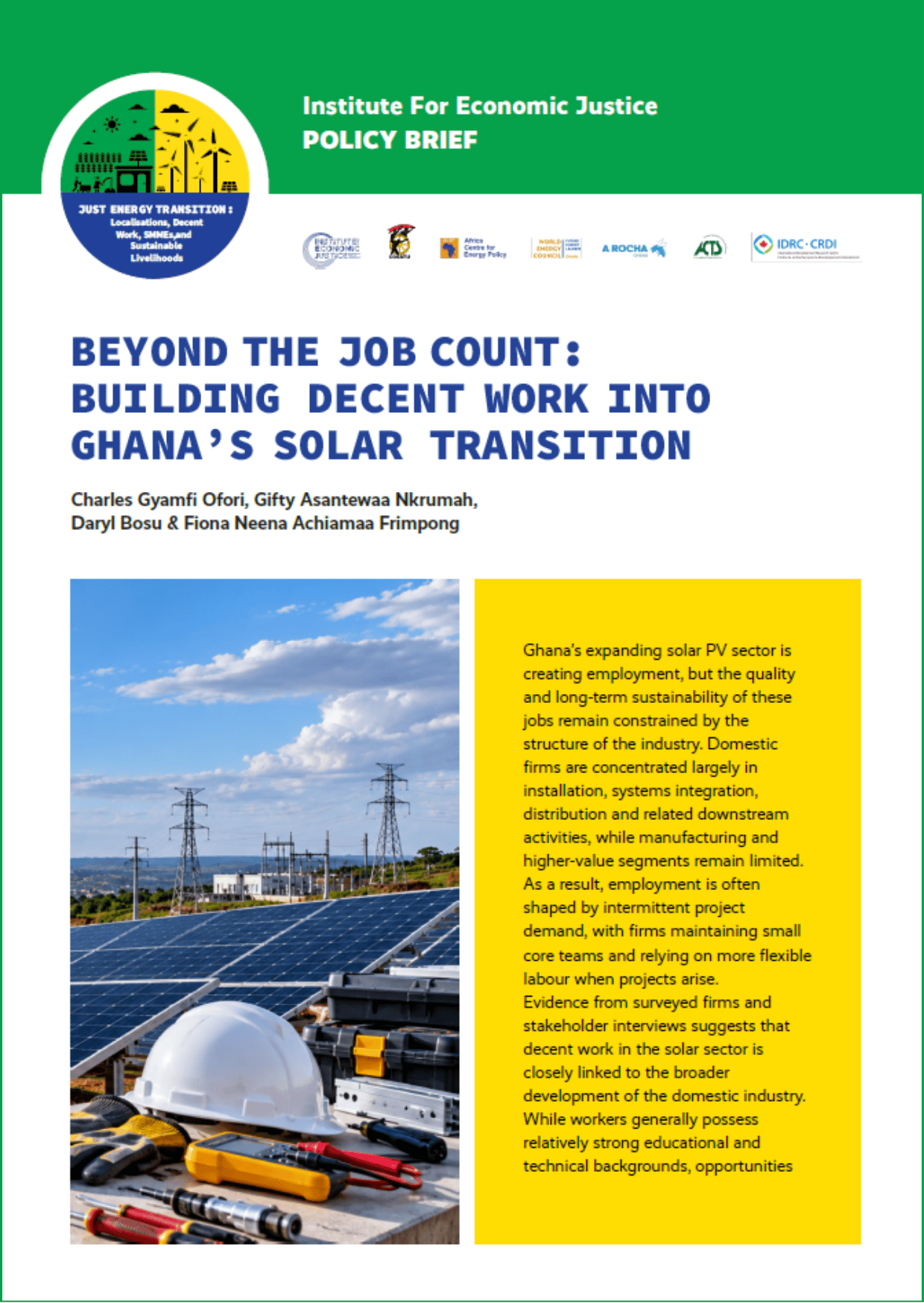
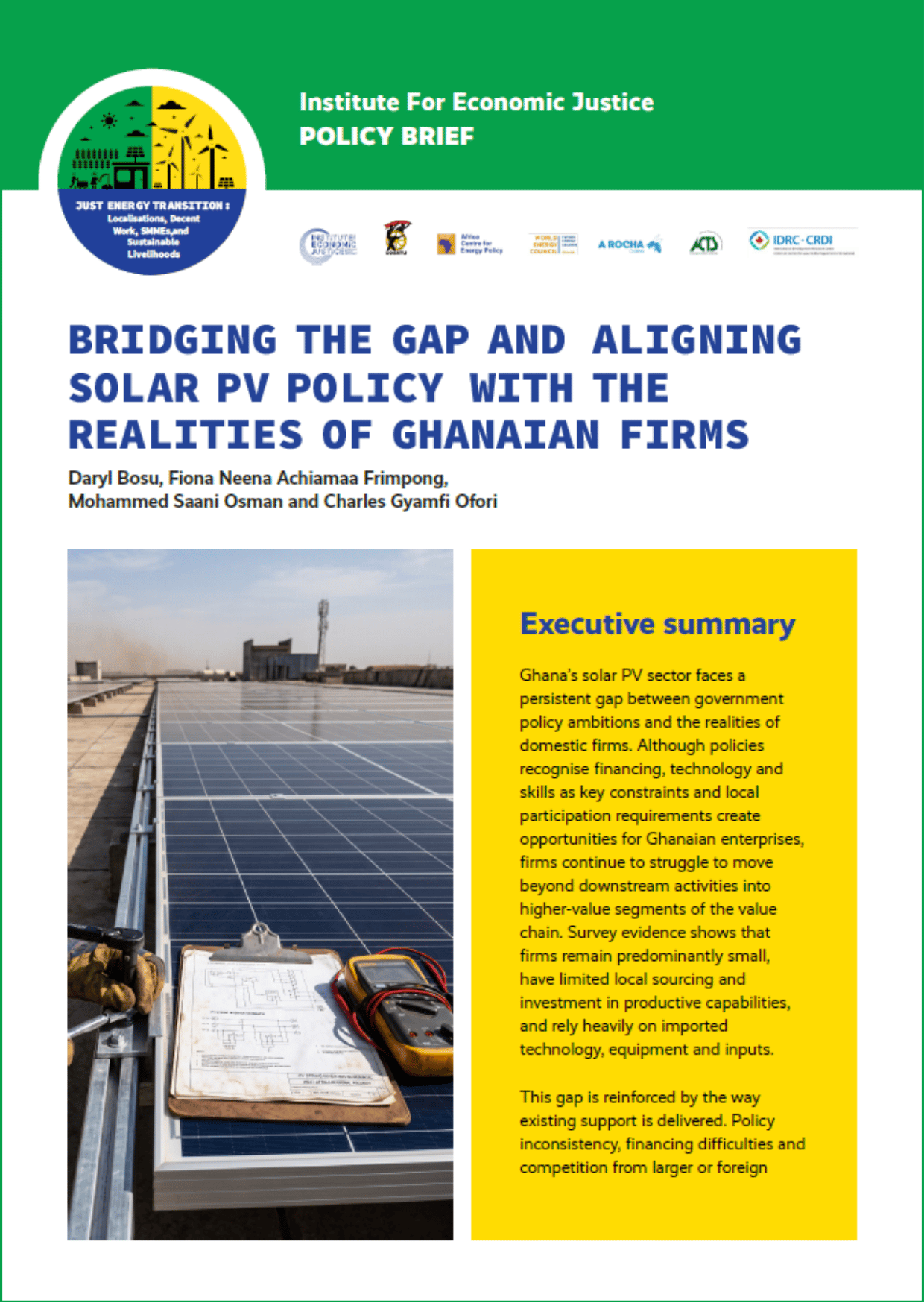
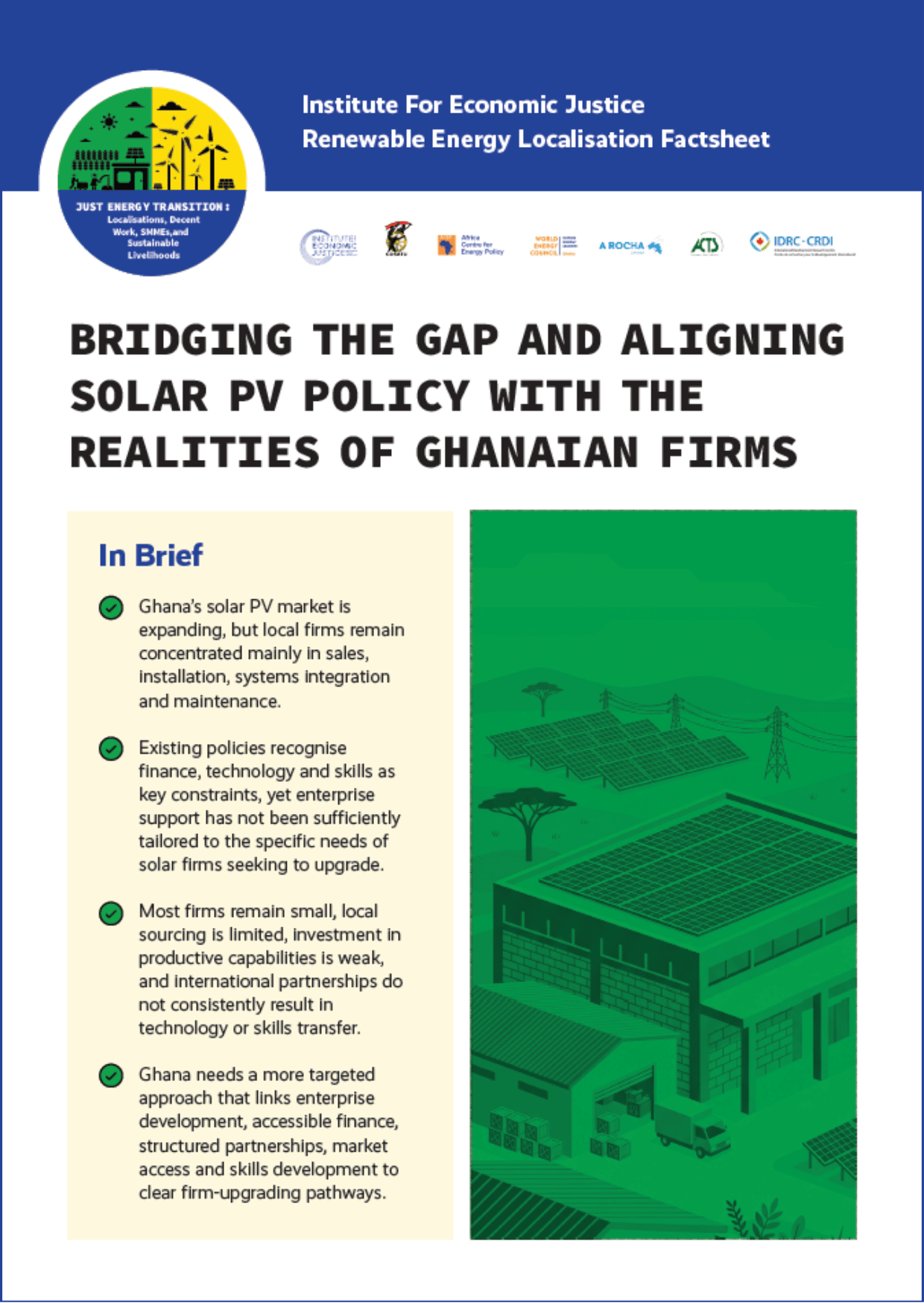
Publication: Bridging the Gap and Aligning Solar PV Policy with the Realities of Ghanaian Firms

Published three policy briefs proposing a phased approach to solar localisation, targeted support for domestic enterprises, and stronger links between industrial development and worker protection. Together, they outline how finance, technology transfer, skills, procurement, and labour standards can strengthen Ghana’s solar industry:

Publications: South Africa factsheets on renewable energy localisation and decent work

Published two factsheets examining how sustained demand, stronger local-content enforcement, and inclusive industrial policy can strengthen South Africa’s renewable energy manufacturing, create decent jobs, and advance gender equality:

Publications: Kenya factsheets on renewable energy localisation and decent work

Published four factsheets outlining practical measures to strengthen Kenya’s renewable energy manufacturing, improve employment conditions in small firms, expand access to affordable long-term finance, and coordinate national and county-level implementation:

Conference: Making Africa’s Energy Transition Work

Convened researchers, trade unionists, policymakers, manufacturers, and civil society in Johannesburg on 8–9 October to share findings from Ghana, Kenya, and South Africa, and discuss policies and advocacy strategies for local manufacturing, decent work, gender equity, and sustainable livelihoods.

Read more and access the conference presentations.

Publication: Using Policy to Build South Africa’s Renewable Energy Industry and Create Decent, Equitable Jobs

Published a detailed case study examining how coordinated public policy can strengthen localisation across South Africa’s solar, wind, and battery storage industries, build domestic manufacturing capabilities, improve job quality, and advance gender equity.

Read more.

Publications: Ghana factsheets on solar industrial development and decent work

Published three factsheets outlining how Ghana can connect solar expansion with domestic industrial development, stronger enterprises, recognised skills pathways, and better labour protections to create decent jobs and sustainable livelihoods:

Publications: Kenya policy briefs on renewable energy finance and decent work
Publications: South Africa policy briefs on renewable energy localisation and decent work

Published two policy briefs examining how predictable procurement, stronger local-content enforcement, coordinated industrial policy, and support linked to labour standards can strengthen domestic manufacturing, create decent jobs, and advance gender equity:

In The media

See how our work is shaping public debates, informing policy, and driving conversations across South Africa and beyond.

Business Day

Previous & Upcoming Events

Join our briefings, workshops and policy dialogues.

08 Oct Thursday
Thursday, 8 October 2026 - Friday, 9 October 2026
View Details
Making Africa’s Energy Transition Work: Local Manufacturing, Decent Work, and Sustainable Livelihoods

A successful conclusion to the conference

Making Africa’s Energy Transition Work: Local Manufacturing, Decent Work, and Sustainable Livelihoods concluded on 9 October 2026 after two days of focused discussion and exchange in Johannesburg.

The highly successful conference brought together researchers, trade unionists, policymakers, manufacturers, small and medium enterprises, civil society organisations, and project partners from Ghana, Kenya, South Africa, and beyond. Across eight sessions, participants examined how Africa’s energy transition can build local and regional manufacturing capabilities, create decent and equitable work, support sustainable livelihoods, and strengthen cooperation between organised labour, industry, government, and civil society.

Participants at Making Africa’s Energy Transition Work, held at Southern Sun Rosebank in Johannesburg on 8 and 9 October 2026.

Event details

Dates: Thursday, 8 October–Friday, 9 October 2026
Venue: Southern Sun Rosebank, Johannesburg
Format: In person, with selected plenary sessions available online

About the conference

Africa’s energy transition could expand access to sustainable energy while supporting industrial development, employment creation, and more resilient local economies. The conference examined the deliberate policy interventions required to realise these outcomes.

Without such intervention, African countries risk remaining exporters of raw materials and importers of high-value technologies, while much of the manufacturing value, productive capacity, and profit associated with the transition is retained elsewhere.

The first day opened with a trade union roundtable on organised labour’s role in advancing renewable energy localisation. Participants then considered country case studies on renewable energy manufacturing and productive capabilities in Kenya, South Africa, and Ghana. The day concluded with a discussion on how organised labour and industry can work together to advance a transformative green industrial agenda.

The second day examined coordination between energy, industrial, trade, and environmental policy; lessons from China’s emergence as a major renewable energy manufacturing power; and the advocacy and organising strategies needed to advance green industrial policy.

Across the two days, participants considered:

  • the role of organised labour in promoting renewable energy localisation;
  • opportunities to build local and regional manufacturing capabilities;
  • the barriers confronting local enterprises entering renewable energy value chains;
  • whether localisation can create decent work and advance gender equity;
  • how African countries can retain more of the value generated by growing renewable energy markets;
  • coordination between energy, industrial, trade, and environmental policy;
  • cooperation between organised labour and domestic industry; and
  • lessons from international energy and industrial transitions.

Conference insights: a graphic harvest

Created live during the conference, this graphic harvest captures the key themes, discussions, and proposals that emerged over the two days—from localisation and productive capabilities to decent work, gender equity, and sustainable livelihoods.

Explore the graphic below or download the PDF version for a closer look.

DOWNLOAD THE GRAPHIC HARVEST (PDF)

Opening address

In his opening address, IEJ Executive Director Dr Gilad Isaacs reflected on the development of the multi-country project and the importance of building productive capacity around Africa’s energy transition. He argued that energy sovereignty requires more than installed generating capacity: it also requires skills, domestic productive capabilities, and the ability to shape the industries supplying the continent.

READ THE OPENING ADDRESS

Conference presentations

The following presentations share research findings, country evidence, and industry perspectives discussed during the conference.

1. Localisation, Decent Work and Gender Equity in Kenya’s Renewable Energy Sector 🔗

Joan Andega, African Centre for Technology Studies

This presentation examines whether the expansion of Kenya’s solar and wind sectors is translating into greater domestic value creation, decent work, and meaningful opportunities for women.

2. Using Policy to Build South Africa’s Renewable Energy Industry and Create Decent, Equitable Jobs 🔗

Seutame Maimele, Institute for Economic Justice

This presentation considers the market, institutional, trade, and policy barriers confronting South Africa’s renewable energy manufacturing sector, alongside proposals for building a more inclusive and localised industry.

3. Ghana Case Study: Localisation, Decent Work and Gender Inclusion in Ghana’s Solar PV Sector 🔗

Charles Gyamfi Ofori, African Centre for Energy Policy

This presentation examines where value is created and retained in Ghana’s growing solar photovoltaic sector, the quality of the work being created, and the opportunities for local assembly, manufacturing, maintenance, recycling, and greater participation by women.

4. Local Content Policy, Renewable Energy Manufacturing and a Just Transition in South Africa 🔗

Gerald Nienaber, Mode Tech Services and the South African Renewable Energy Masterplan Task Team

This presentation considers how local content and trade policies have shaped South Africa’s renewable energy manufacturing industry, including their implications for domestic production, industrial capacity, and employment.

5. Does China’s Role in Africa’s Energy Sector Support or Threaten Industrialisation?🔗

Dr Frangton Chiyemura, Associate Professor of International Development, The Open University

This presentation examines China’s role in Africa’s energy sector and considers what African countries can learn from China’s emergence as the dominant manufacturer of renewable energy technologies while strengthening their own industrial capabilities.

6. Every Imported Fastener Is a Job We Didn’t Keep🔗

Bryce Neumann, Director of Technology and Information, CBC Fasteners, and Vice-Chairman, South African Fastener Manufacturers’ Association

This presentation offers a manufacturer’s perspective on employment losses, competition from Chinese imports, local-content enforcement, and the policy measures needed to support South African manufacturing.

7. Driving Local Storage Manufacturing and Productive Capabilities in South Africa 🔗

Rizqah MacGirlley, Solar MD

This presentation examines how the expansion of battery energy storage systems can support domestic manufacturing, industrial development, decent work, and greater value creation in South Africa.

Further analysis

Published ahead of the conference, the Daily Maverick opinion piece, How to fix the hamstrung renewable energy sectors in SA, Ghana and Kenya, draws on the project’s research to examine how unstable demand, weak localisation enforcement, precarious employment, and persistent gender inequality have limited the developmental potential of renewable energy expansion.

READ THE DAILY MAVERICK OPINION PIECE

About the project

The conference formed part of the Just Energy Transition: Localisation, Decent Work, Small and Medium Enterprises, and Sustainable Livelihoods project.

The project is undertaken by the Institute for Economic Justice, the Congress of South African Trade Unions, the African Centre for Technology Studies, the African Centre for Energy Policy, A Rocha Ghana, and World Energy Council: Future Energy Leaders Ghana, with funding from the International Development Research Centre.

For further background, read the conference concept note outlining the project’s context, purpose, scope, and objectives.

READ THE CONFERENCE CONCEPT NOTE

LEARN MORE ABOUT THE PROJECT

Conference highlights in pictures

Our Other Projects
Back To Top