
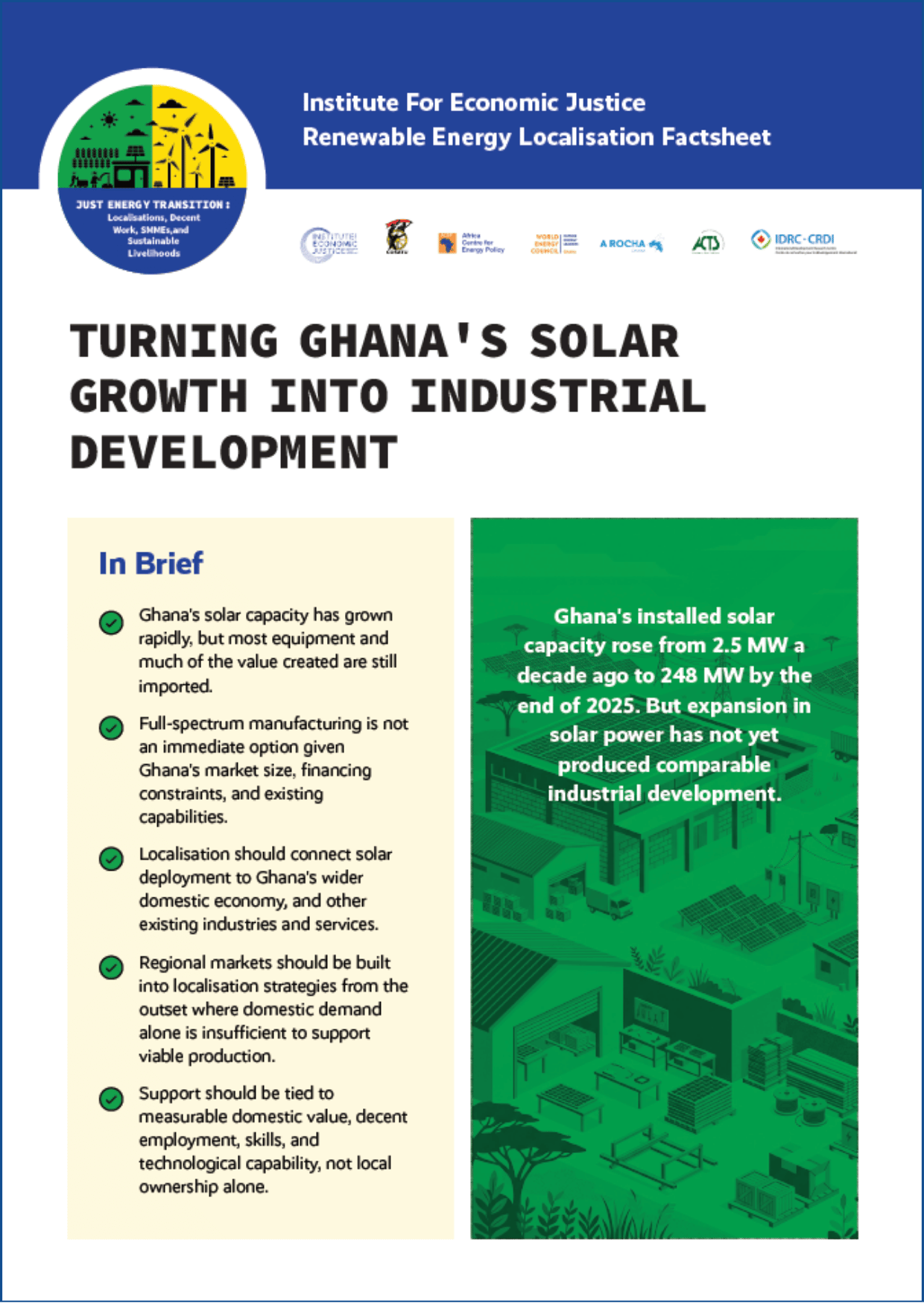
Ghana’s solar growth offers an opportunity to build domestic industries, create skilled jobs, and retain more economic value within the country. Installed solar capacity rose from 2.5 MW a decade ago to 248 MW by the end of 2025. Yet this expansion has not produced comparable industrial development, with most major components still imported.
This factsheet examines how Ghana can connect growing solar demand to domestic production, stronger supply chains, and technological learning. Drawing on research into the country’s solar photovoltaic sector, it proposes a phased approach to localisation grounded in existing capabilities and realistic opportunities for industrial upgrading.
Connecting solar deployment to the domestic economy
Ghanaian firms are concentrated in distribution, system design, installation, and maintenance. These activities provide important entry points, but retain less value domestically and offer fewer opportunities for technological learning than advanced manufacturing and component production.
Localisation involves progressively expanding domestic participation across the solar production network. This includes procurement, engineering, component production, testing, skills development, refurbishment, and recycling. Success should be measured through the value retained and productive capabilities developed in Ghana.
Building a complete domestic manufacturing industry is not an immediate option. Market size, financing constraints, technology requirements, and established global competition shape what is commercially viable. Targeted support should help firms develop a credible path to competitiveness.
A phased pathway to industrial development
The factsheet identifies five areas through which Ghana can capture more value:
- Strengthen services: Develop capabilities in system design, energy audits, engineering, installation, maintenance, monitoring, and asset management.
- Build local supply chains: Connect solar projects to domestic suppliers of mounting structures, support frames, enclosures, fabrication, construction, logistics, and packaging.
- Begin selected production: Support module assembly and component production where demand, technology, capital, and industrial capabilities make these activities viable.
- Build enabling capacities: Expand testing, certification, specialised finance, applied research, training, and professional services.
- Develop circular economy activities: Build capabilities in refurbishment, battery and panel recycling, material recovery, and specialised end-of-life services.
Regional markets should support every stage. Access to the Economic Community of West African States (ECOWAS) and African Continental Free Trade Area (AfCFTA) markets can help firms achieve the scale needed for viable production.
Turning policy into measurable results
The factsheet calls for a phased localisation roadmap with time-bound priorities, regularly reviewed as markets and capabilities develop. Public procurement and fiscal policy should support supplier development, local participation, and technology transfer.
A dedicated renewable energy industrial facility could provide equipment finance, guarantees, blended finance, and patient capital. Support should be tied to credible plans and measurable outcomes, including domestic production, local purchasing, decent employment, skills, and technological capability.
Effective coordination between government, industry, and finance is essential. Publishing annual results would help track progress, identify bottlenecks, and ensure that solar expansion builds lasting domestic capabilities and sustainable livelihoods.
About the project
This publication is an output of Advancing a Just Energy Transition: Localisation, Decent Work, and Sustainable Livelihoods, a multi-country research project examining the energy sectors of Ghana, Kenya, and South Africa in the context of global decarbonisation. The project investigates how localisation, decent work, gender equity, SMME participation, and sustainable livelihoods can be embedded in renewable energy production networks to strengthen local manufacturing and avoid reproducing unequal global economic patterns.