Skip to content

Global Economic Governance

This project advances bold, progressive reforms to global economic governance to better serve social, economic, and climate justice. It develops practical policy proposals on sovereign debt, international taxation, global monetary and payment systems, and multilateral governance, while combining rigorous research with strategic advocacy to influence agenda-setting and negotiations in key international forums. The focus is on strengthening South–South institutional capacity, expanding policy space for developmental transformation, and advancing a more democratic and rights-based global financial system.

 

Related Resources

Explore more of our work connected to this topic.

In The media

See how our work is shaping public debates, informing policy, and driving conversations across South Africa and beyond.

Channel Africa
Financial Mail
TimesLIVE
Devex

Previous & Upcoming Events

Join our briefings, workshops and policy dialogues.

20 Nov Thursday
Thursday, 20 November 2025
DTIC
View Details
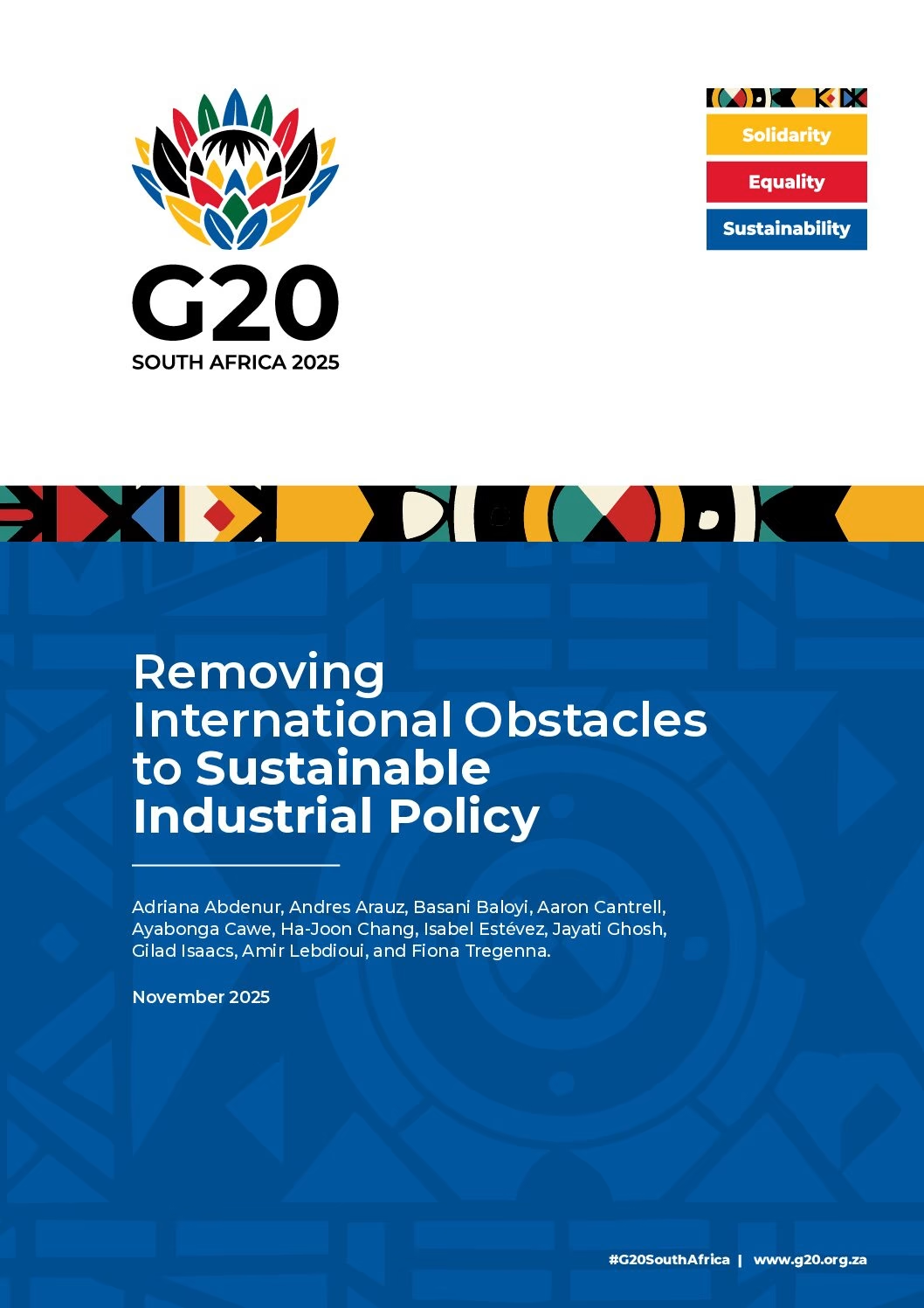
Report Launch | G20 Principles for Sustainable Industrial Policy

Across the world, governments face interconnected ecological, social and economic crises. Climate change, widening inequality, debt distress and unstable global supply chains are increasing the urgency of building productive systems that are more resilient, inclusive and environmentally sustainable.

The Institute for Economic Justice (IEJ), the Department of International Relations and Cooperation (DIRCO), and the Department of Trade, Industry and Competition (the DTIC) co-hosted the official launch of the G20 report Removing International Obstacles to Sustainable Industrial Policy. The launch took place shortly before the G20 Leaders’ Summit and formed part of South Africa’s contribution to advancing sustainable industrial policy during its G20 Presidency.

The report brings together leading global experts to examine how international trade, investment, intellectual property and financial rules constrain the policy space available to developing countries. It argues that these obstacles make it harder for countries, particularly in Africa and the wider Global South, to diversify their economies, develop higher-value industries, create decent work and pursue a just transition.

Deputy Minister of Trade, Industry and Competition Zuko Godlimpi presided over the launch. Discussions highlighted the need for coordinated international action to ensure that developing countries have access to the finance, technology and policy tools required to build sustainable industrial ecosystems. Participants also emphasised that the transition must benefit workers and communities while supporting inclusive development and respecting planetary boundaries.

The event reinforced a central message of the report: sustainable industrial policy is essential, but countries cannot achieve it under unequal global rules or with inadequate access to resources.

Watch the report launch

Read and download the report

Read the IEJ’s statement on the outcomes of South Africa’s G20 Presidency

Explore the IEJ’s G20 research and policy engagement

19 Nov Wednesday
Wednesday, 19 November 2025
Birchwood Hotel, Johannesburg
View Details
Report Launch | The G20 at a Crossroads

Since becoming a leaders’ forum in 2008, the Group of Twenty (G20) has established itself as a central platform for responding to financial crises and coordinating global economic policy. However, its record on addressing inequality, sovereign debt, ecological breakdown and social insecurity has been far less effective.

The Institute for Economic Justice (IEJ), the New Economics Foundation, the Center for Economic and Social Rights, the Institute for Policy Studies, and Transforma co-hosted a side event at the G20 Social Summit to launch The G20 at a Crossroads. The report provides an independent assessment of the G20’s impact and considers what must change if the forum is to contribute to a more equitable and sustainable global economy.

The event brought together researchers, policymakers and civil society representatives to reflect on the G20’s record across five areas: reform of the international financial architecture; sovereign debt and development; international taxation; climate finance and the just energy transition; and labour markets and employment.

Discussions considered the gap between the G20’s stated commitment to “strong, sustainable, balanced and inclusive growth” and its limited progress in addressing structural inequalities. Participants also reflected on how successive Global South presidencies have broadened the G20’s agenda, while remaining constrained by unequal power relations, consensus-based decision-making and weak implementation.

The dialogue highlighted the need to place economic justice and sustainability at the centre of global crisis coordination; strengthen accountability; support coalitions advancing structural reform; and expand the meaning of economic stability to include human and planetary wellbeing. These shifts are essential if the G20 is to respond more effectively to debt distress, inequality, climate disruption and insecure work.

Watch the report launch

Read the full report
Read more about the report and its findings
Explore the IEJ’s G20 research and policy engagement

18 Nov Tuesday
Tuesday, 18 November 2025
Birchwood Hotel, Johannesburg
View Details
G20 Social Summit side event | Taxation and global inequality

Economic inequality has reached extreme levels globally, concentrating wealth and political power while limiting governments’ ability to finance quality public services, climate action and social protection. Under its theme of solidarity, equality and sustainability, South Africa’s G20 Presidency placed these challenges more firmly on the international agenda.

Partners in the South African Tax Justice Working Group—including Oxfam South Africa, Friedrich-Ebert-Stiftung South Africa, the Institute for Economic Justice (IEJ), the Independent Commission for the Reform of International Corporate Taxation (ICRICT), and the Alternative Information and Development Centre (AIDC)—hosted a high-level dialogue on taxation and global inequality alongside the G20 Social Summit.

The dialogue examined the findings and recommendations of the G20 Extraordinary Committee of Independent Experts on Global Inequality. Commissioned during South Africa’s G20 Presidency and chaired by Nobel Prize-winning economist Professor Joseph Stiglitz, the Committee produced the G20’s first report dedicated to global inequality.

Professor Jayati Ghosh, a member of the Extraordinary Committee and Co-Chair of ICRICT, delivered the keynote address. She emphasised that inequality is shaped by economic policies, laws and institutions—and can therefore be reversed through deliberate policy choices.

The subsequent panel featured Dr Gilad Isaacs, Executive Director of the IEJ; Bodo Ellmers, Director of the Financing for Development and International Financial Architecture Programme at Global Policy Forum; Susana Ruiz, Global Lead on Tax Justice at Oxfam International; and Tengo Tengela, Trade and Industrial Policy Coordinator at COSATU.

Discussions explored whether the G20 can help advance a more progressive international tax system and address the concentration of wealth and corporate power. Participants highlighted the importance of taxing extreme wealth and multinational corporations more effectively, advancing debt relief, supporting the proposed International Panel on Inequality, and strengthening negotiations towards a UN Framework Convention on International Tax Cooperation.

The dialogue also underscored the need for progressive organisations and movements to build alliances across borders and use more inclusive multilateral institutions to carry forward the commitments made during South Africa’s G20 Presidency.

Read the G20 Global Inequality Report
Read about the outcomes of the dialogue
Explore the IEJ’s G20 research and policy engagement

Our Other Projects
Back To Top