A successful conclusion to the conference
Making Africa’s Energy Transition Work: Local Manufacturing, Decent Work, and Sustainable Livelihoods concluded on 9 October 2026 after two days of focused discussion and exchange in Johannesburg.
The highly successful conference brought together researchers, trade unionists, policymakers, manufacturers, small and medium enterprises, civil society organisations, and project partners from Ghana, Kenya, South Africa, and beyond. Across eight sessions, participants examined how Africa’s energy transition can build local and regional manufacturing capabilities, create decent and equitable work, support sustainable livelihoods, and strengthen cooperation between organised labour, industry, government, and civil society.
Participants at Making Africa’s Energy Transition Work, held at Southern Sun Rosebank in Johannesburg on 8 and 9 October 2026. Event details
Dates: Thursday, 8 October–Friday, 9 October 2026Venue: Southern Sun Rosebank, JohannesburgFormat: In person, with selected plenary sessions available online
About the conference
Africa’s energy transition could expand access to sustainable energy while supporting industrial development, employment creation, and more resilient local economies. The conference examined the deliberate policy interventions required to realise these outcomes.
Without such intervention, African countries risk remaining exporters of raw materials and importers of high-value technologies, while much of the manufacturing value, productive capacity, and profit associated with the transition is retained elsewhere.
The first day opened with a trade union roundtable on organised labour’s role in advancing renewable energy localisation. Participants then considered country case studies on renewable energy manufacturing and productive capabilities in Kenya, South Africa, and Ghana. The day concluded with a discussion on how organised labour and industry can work together to advance a transformative green industrial agenda.
The second day examined coordination between energy, industrial, trade, and environmental policy; lessons from China’s emergence as a major renewable energy manufacturing power; and the advocacy and organising strategies needed to advance green industrial policy.
Across the two days, participants considered:
the role of organised labour in promoting renewable energy localisation;
opportunities to build local and regional manufacturing capabilities;
the barriers confronting local enterprises entering renewable energy value chains;
whether localisation can create decent work and advance gender equity;
how African countries can retain more of the value generated by growing renewable energy markets;
coordination between energy, industrial, trade, and environmental policy;
cooperation between organised labour and domestic industry; and
lessons from international energy and industrial transitions.
Conference insights: a graphic harvest
Created live during the conference, this graphic harvest captures the key themes, discussions, and proposals that emerged over the two days—from localisation and productive capabilities to decent work, gender equity, and sustainable livelihoods.
Explore the graphic below or download the PDF version for a closer look.
DOWNLOAD THE GRAPHIC HARVEST (PDF)
Opening address
In his opening address, IEJ Executive Director Dr Gilad Isaacs reflected on the development of the multi-country project and the importance of building productive capacity around Africa’s energy transition. He argued that energy sovereignty requires more than installed generating capacity: it also requires skills, domestic productive capabilities, and the ability to shape the industries supplying the continent.
READ THE OPENING ADDRESS
Conference presentations
The following presentations share research findings, country evidence, and industry perspectives discussed during the conference.
Joan Andega, African Centre for Technology Studies
This presentation examines whether the expansion of Kenya’s solar and wind sectors is translating into greater domestic value creation, decent work, and meaningful opportunities for women.
Seutame Maimele, Institute for Economic Justice
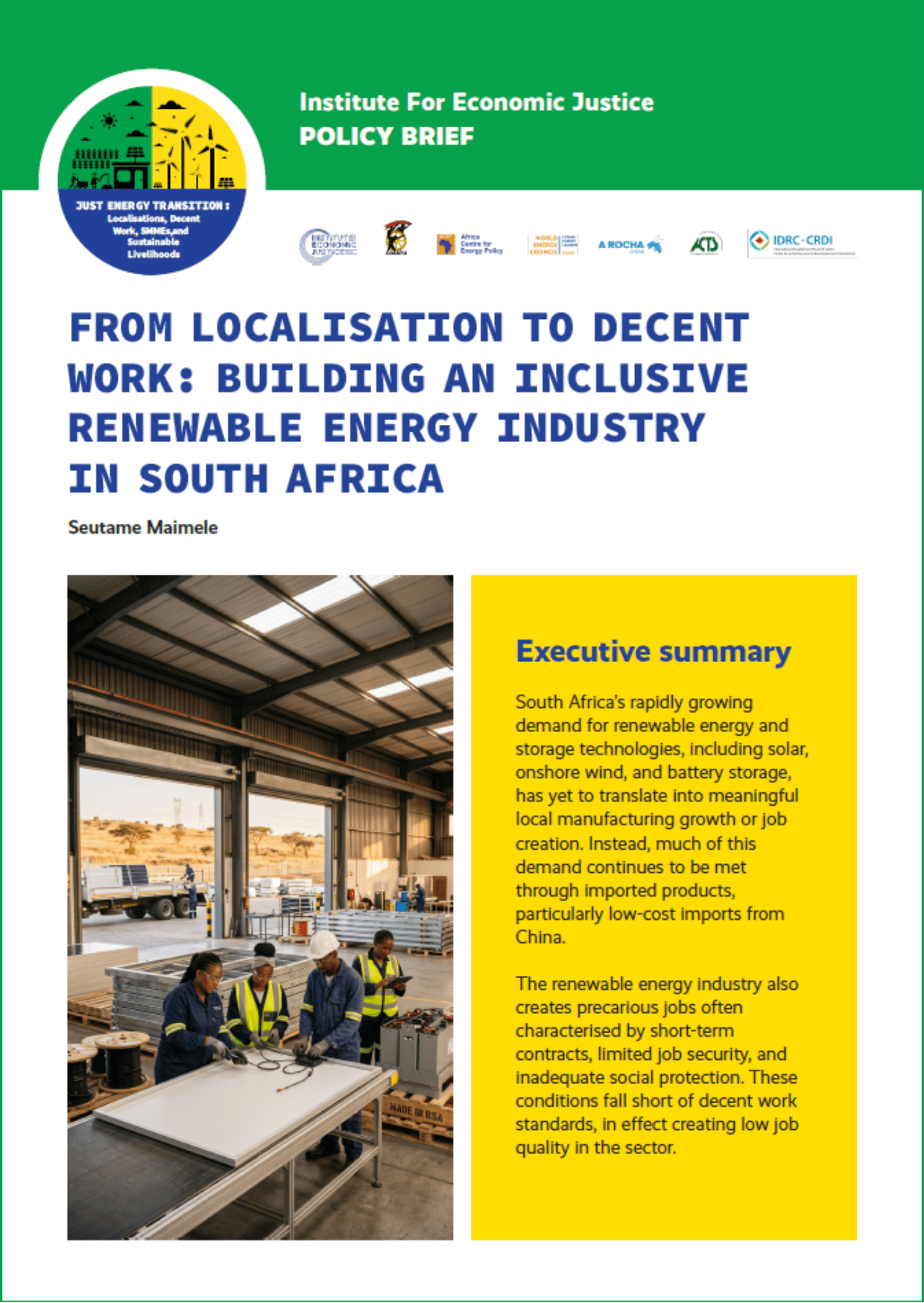
This presentation considers the market, institutional, trade, and policy barriers confronting South Africa’s renewable energy manufacturing sector, alongside proposals for building a more inclusive and localised industry.
Charles Gyamfi Ofori, African Centre for Energy Policy
This presentation examines where value is created and retained in Ghana’s growing solar photovoltaic sector, the quality of the work being created, and the opportunities for local assembly, manufacturing, maintenance, recycling, and greater participation by women.
Gerald Nienaber, Mode Tech Services and the South African Renewable Energy Masterplan Task Team
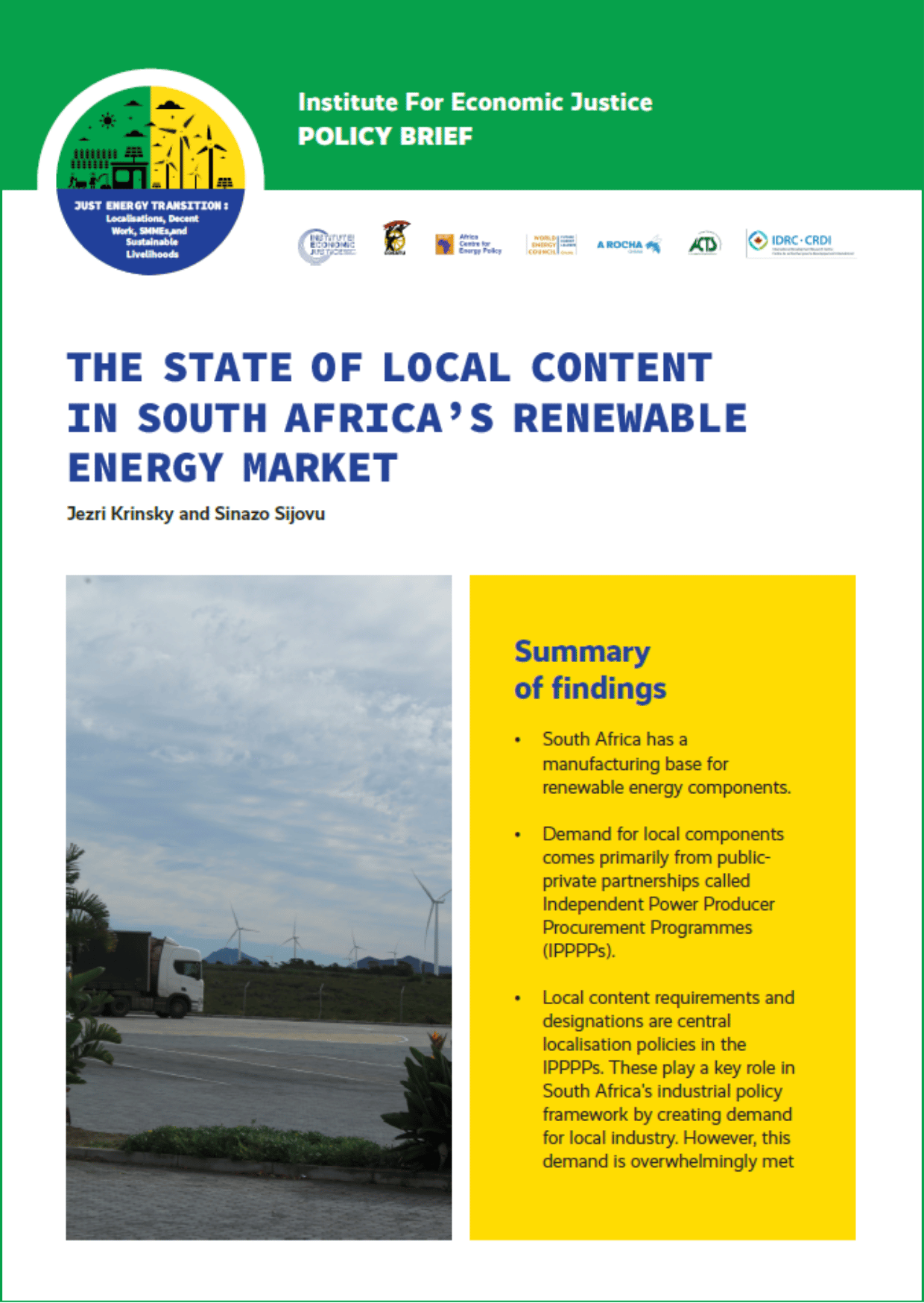
This presentation considers how local content and trade policies have shaped South Africa’s renewable energy manufacturing industry, including their implications for domestic production, industrial capacity, and employment.
Dr Frangton Chiyemura, Associate Professor of International Development, The Open University
This presentation examines China’s role in Africa’s energy sector and considers what African countries can learn from China’s emergence as the dominant manufacturer of renewable energy technologies while strengthening their own industrial capabilities.
Bryce Neumann, Director of Technology and Information, CBC Fasteners, and Vice-Chairman, South African Fastener Manufacturers’ Association
This presentation offers a manufacturer’s perspective on employment losses, competition from Chinese imports, local-content enforcement, and the policy measures needed to support South African manufacturing.
Rizqah MacGirlley, Solar MD
This presentation examines how the expansion of battery energy storage systems can support domestic manufacturing, industrial development, decent work, and greater value creation in South Africa.
Further analysis
Published ahead of the conference, the Daily Maverick opinion piece, How to fix the hamstrung renewable energy sectors in SA, Ghana and Kenya , draws on the project’s research to examine how unstable demand, weak localisation enforcement, precarious employment, and persistent gender inequality have limited the developmental potential of renewable energy expansion.
READ THE DAILY MAVERICK OPINION PIECE
About the project
The conference formed part of the Just Energy Transition: Localisation, Decent Work, Small and Medium Enterprises, and Sustainable Livelihoods project.
The project is undertaken by the Institute for Economic Justice, the Congress of South African Trade Unions, the African Centre for Technology Studies, the African Centre for Energy Policy, A Rocha Ghana, and World Energy Council: Future Energy Leaders Ghana, with funding from the International Development Research Centre.
For further background, read the conference concept note outlining the project’s context, purpose, scope, and objectives.
READ THE CONFERENCE CONCEPT NOTE
LEARN MORE ABOUT THE PROJECT
Conference highlights in pictures