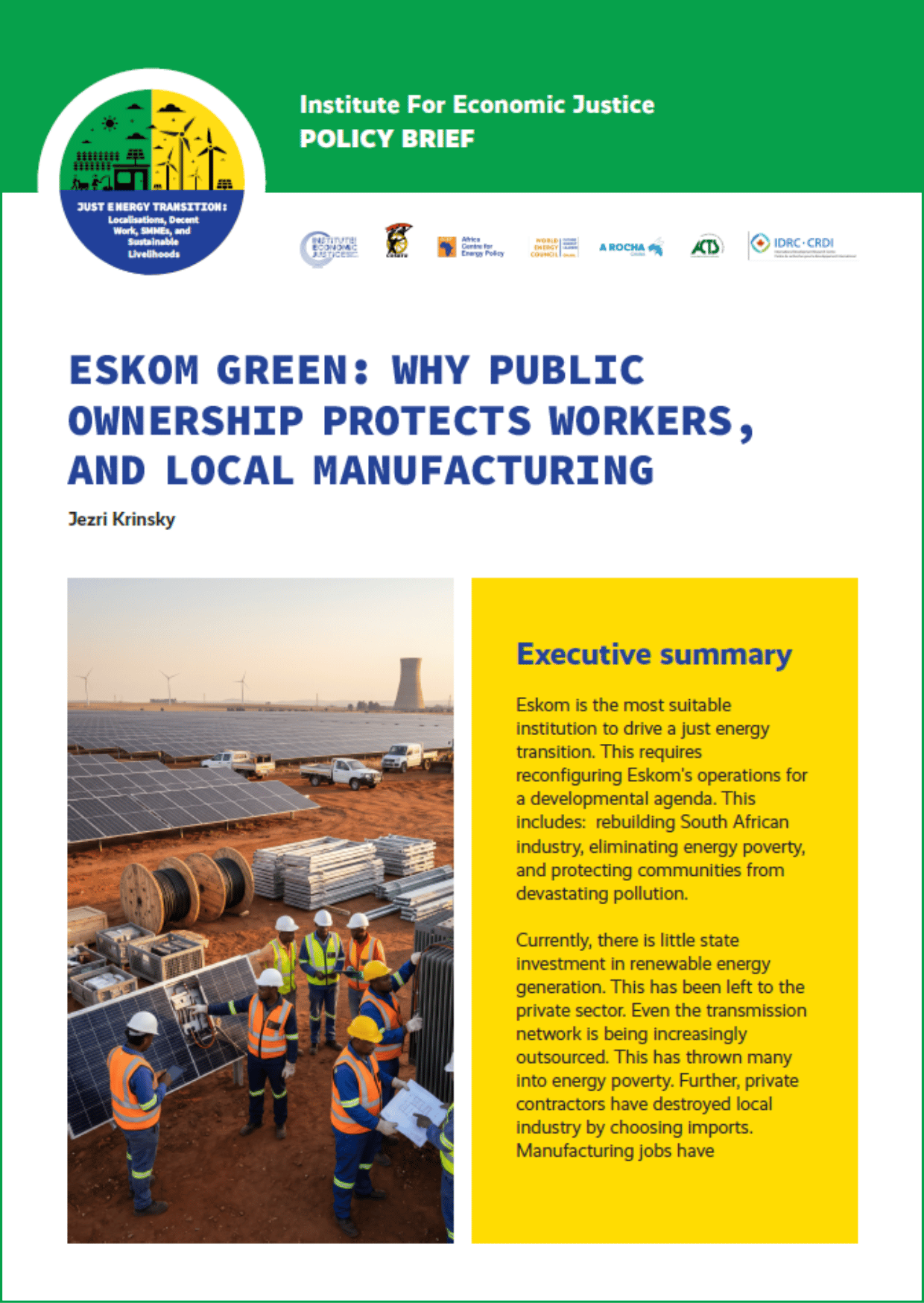
Eskom Green offers an opportunity to expand publicly owned renewable energy while rebuilding South African manufacturing, protecting workers, and reducing energy poverty. Achieving these goals requires adequate public investment, enforceable local-content commitments, and coordination across Eskom’s operations.
This policy brief by Jezri Krinsky examines how public ownership could support a developmental approach to South Africa’s energy transition. It argues that a capable, well-financed Eskom can connect renewable generation to industrial development and affordable electricity, while identifying constraints within Eskom Green’s proposed financing and operating model.
Turning renewable investment into local manufacturing
South African firms can manufacture solar panels, steel structures, battery systems, and other renewable energy components. However, erratic demand, procurement delays, and weak enforcement of localisation measures have undermined their ability to sustain production and employment.
Local manufacturers also face demanding certification and financing requirements, late orders, and established relationships between developers and international suppliers. These conditions can exclude firms with the technical capacity to produce equipment but insufficient financial or administrative resources to secure contracts.
Eskom Green’s target of 6,000 MW of new generating capacity by 2030 could create a substantial market for domestic producers. The brief argues that this opportunity needs explicit procurement commitments, transparent reporting, and effective contractor oversight.
Public finance and a wider developmental mandate
Eskom Green’s initial focus is supplying large industrial customers. The brief calls for a broader programme of publicly owned renewable generation that also serves energy-poor households and smaller, labour-intensive industries.
It raises concerns about reliance on private finance through special purpose vehicles. Such arrangements can increase financing costs, constrain policy choices, and transfer risks to the state or electricity buyers. Private lenders may also discourage local sourcing where they perceive domestic components as riskier.
The brief therefore calls for public financing options that preserve the freedom to pursue localisation, affordable electricity, and decent employment.
Preserving coordination, skills, and decent work
The proposed separation of Eskom Green from Eskom Holdings could weaken coordination across generation, transmission, storage, and maintenance. Coordinated planning could support renewable expansion alongside a managed decline of the coal fleet.
Eskom Rotek provides an existing base of maintenance expertise and comparatively strong employment conditions. Insourcing renewable energy maintenance to Rotek could retain technical knowledge, build long-term public capacity, and support more secure employment.
Five priorities for action
The brief recommends:
- Monitor programme delivery. Track implementation and financing challenges to ensure that Eskom Green meets its ambitions.
- Enforce ambitious local-content requirements. Verify procurement commitments, monitor designated products, and coordinate with measures addressing tariff evasion.
- Insource maintenance to Eskom Rotek. Build public technical capabilities while supporting better wages, working conditions, and job security.
- Mobilise public finance. Examine alternatives to dependence on private lenders and special purpose vehicles.
- Plan affordable renewable electricity for wider public benefit. Develop subsidised provision that reduces household energy poverty and supports strategic, labour-intensive industries.
These measures would help turn public ownership into a practical instrument for industrial development and worker protection. Eskom Green’s developmental contribution depends on how its financing, procurement, and institutional arrangements support sustained local production, decent work, and affordable energy.
About the project
This publication is an output of Advancing a Just Energy Transition: Localisation, Decent Work, and Sustainable Livelihoods, a multi-country research project examining the energy sectors of Ghana, Kenya, and South Africa in the context of global decarbonisation. The project investigates how localisation, decent work, gender equity, SMME participation, and sustainable livelihoods can be embedded in renewable energy production networks to strengthen local manufacturing and avoid reproducing unequal global economic patterns.