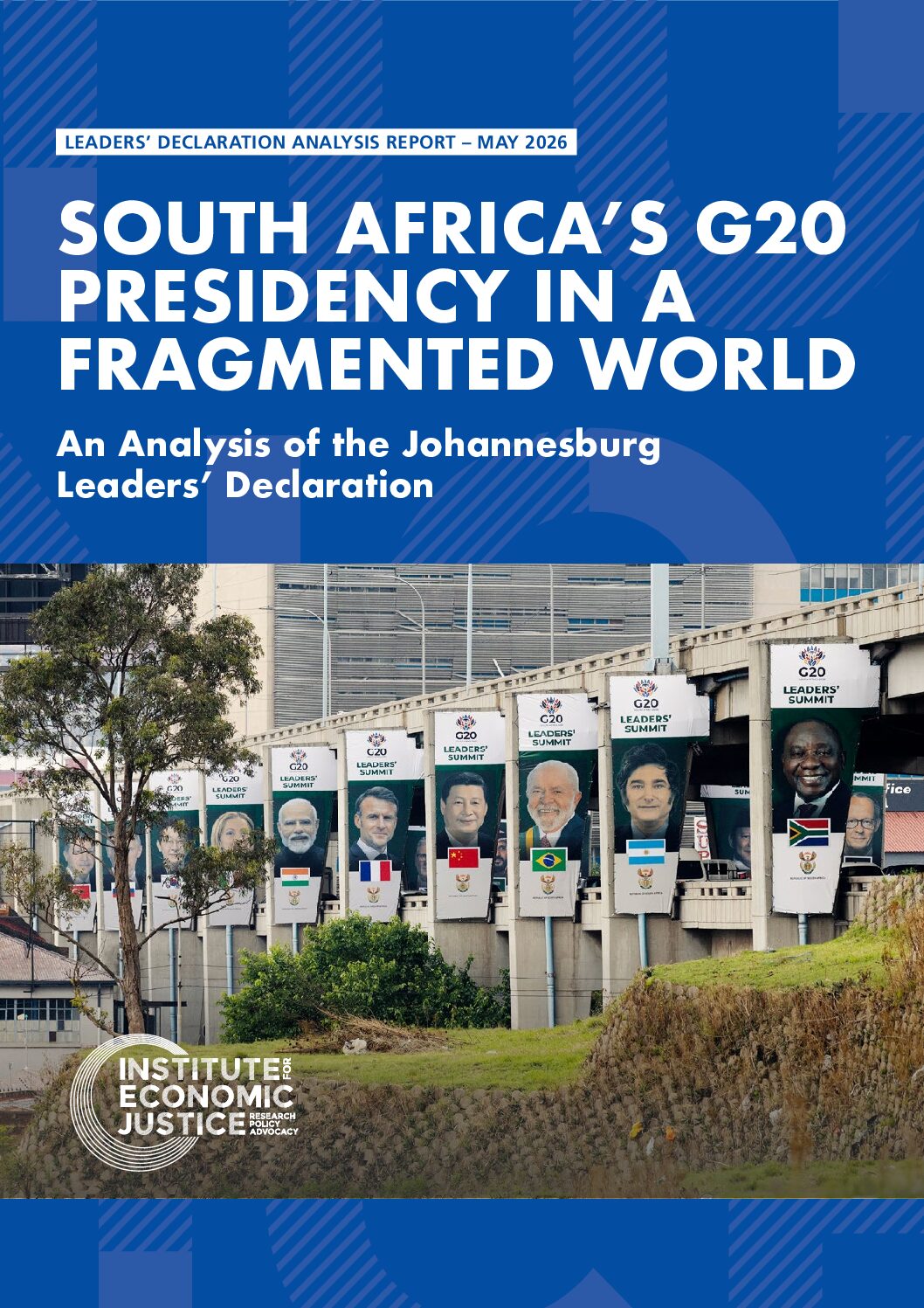
South Africa’s G20 Presidency in a Fragmented World: An Analysis of the Johannesburg Leaders’ Declaration examines the outcomes, tensions, and political compromises that shaped the 2025 G20 Leaders’ Declaration under South Africa’s Presidency.
Produced by the Institute for Economic Justice, the report analyses how escalating geopolitical tensions, weakening multilateralism, debt distress, climate crises, inequality, and growing ideological divisions influenced both the negotiation process and the final Declaration. It reflects on the opportunities, breakthroughs, and limitations of pursuing progressive global economic reform in an increasingly fragmented international order.
The report assesses South Africa’s efforts to advance priorities linked to debt sustainability, climate finance, industrialisation, food security, social protection, disaster resilience, energy transitions, gender equality, and reform of the international financial architecture. It also explores the tensions between ambition and consensus in multilateral diplomacy, particularly within a forum shaped by competing national interests and shifting geopolitical alliances.
What the report covers
- General takeaways from South Africa’s G20 Presidency
The report evaluates where South Africa achieved substantive breakthroughs and where proposals faced resistance or dilution. It examines the geopolitical dynamics that shaped negotiations and reflects on the limits of consensus-based multilateralism in the current global context. - Debt, development finance, and global economic governance
The report analyses the shortcomings of current debt restructuring mechanisms, the limitations of the G20 Common Framework, and the broader failures of the international financial architecture to support equitable development and climate resilience in the Global South. - Industrialisation, trade, and sustainable development
The report explores how industrial policy, beneficiation, technology access, and sustainable development featured in the Leaders’ Declaration. It assesses the growing importance of industrialisation for economic transformation and the constraints imposed by global trade and financial systems. - Climate, energy transitions, and food security
The report examines debates around climate finance, just energy transitions, food sovereignty, disaster resilience, and ecological sustainability. It highlights both advances and setbacks in efforts to secure developmental and climate justice priorities within the G20 framework. - Gender, inequality, and social protection
The report reflects on the extent to which the Declaration advanced commitments on care work, social protection, gender equality, redistribution, and inclusive development, while also documenting areas where progressive language faced pushback. - The future of multilateralism
The report concludes by considering the role of the G20 in a rapidly changing geopolitical landscape and reflects on the future of multilateral cooperation, South-South solidarity, and alternative global governance pathways.
Together, the report offers a critical reflection on South Africa’s G20 Presidency and the broader challenges of pursuing social, economic, and climate justice within an increasingly contested global order.