
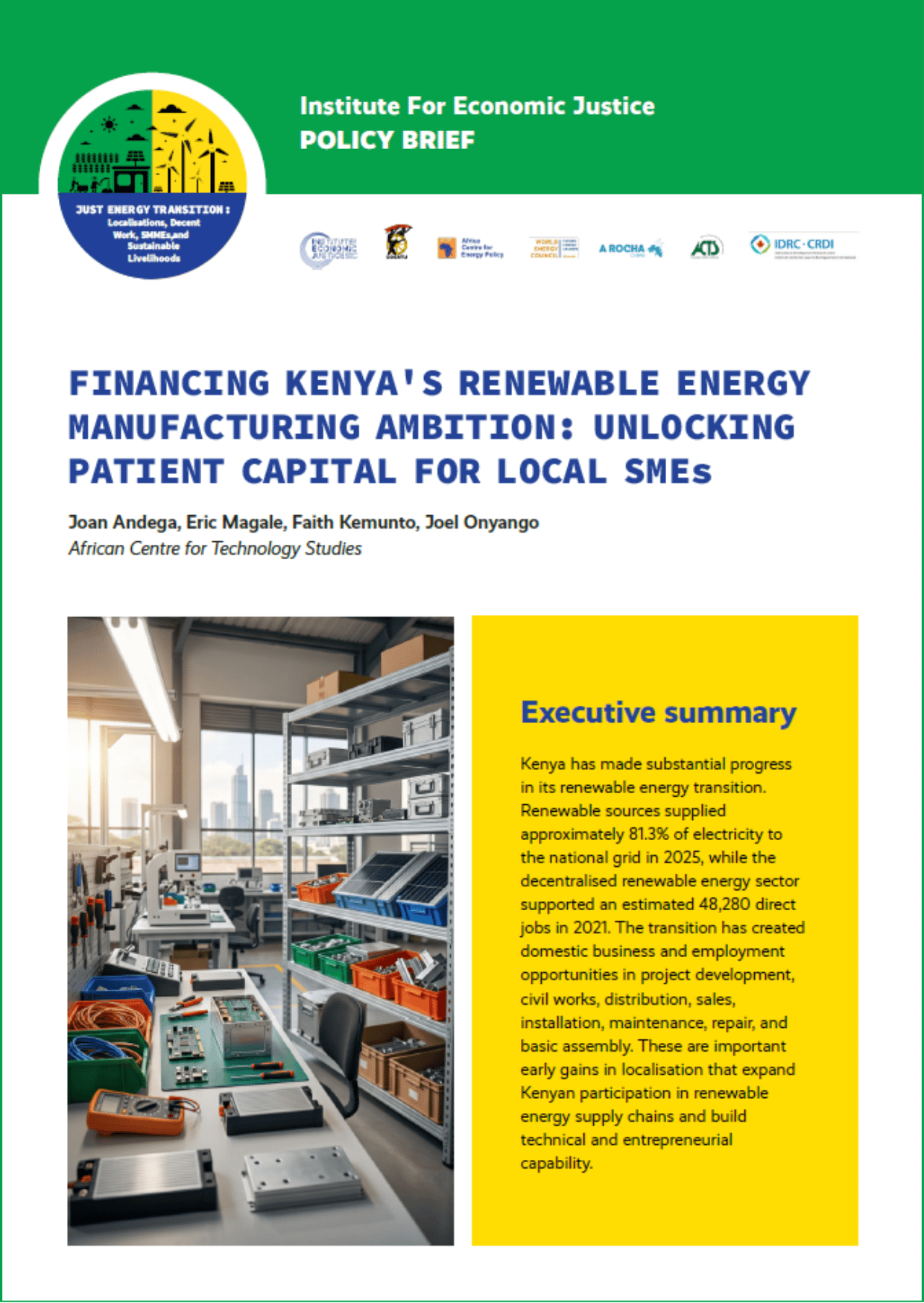
Kenya’s renewable energy manufacturing ambition requires affordable, long-term finance that enables local firms to invest, develop technical capabilities, and enter higher-value activities. Renewable sources supplied approximately 81.3% of electricity to the national grid in 2025, but this progress has not translated into substantial domestic manufacturing of advanced components.
This policy brief, written by Joan Andega, Eric Magale, Faith Kemunto, and Joel Onyango of the African Centre for Technology Studies, examines the financing barriers facing renewable energy small and medium-sized enterprises (SMEs). It proposes a dedicated patient-finance facility linking investment to technical support, skills, standards, and market opportunities.
Why conventional finance falls short
Kenyan firms participate in project development, civil works, distribution, installation, maintenance, repair, and basic assembly. These activities build local capability and employment, while most high-value components and technologies continue to be manufactured abroad.
Moving into manufacturing requires substantial upfront investment in machinery, product development, testing, certification, and skilled personnel. Returns may take several years to materialise. Yet commercial finance commonly involves high interest rates, short repayment periods, and demanding collateral requirements.
Drawing on research across Central, Coastal, and Western Kenya, the brief shows how these financing conditions restrict firms’ ability to invest and grow. Smaller, locally owned businesses also face irregular cash flow, imported input costs, and currency fluctuations.
Patient capital for industrial upgrading
Patient capital offers longer repayment periods, grace periods, and financing terms aligned with production and revenue cycles. This gives firms more time to develop products, improve quality, and establish reliable markets.
The brief recommends a facility combining concessional loans, partial credit guarantees, equipment finance, and targeted grants. Initial support should focus on products and components that can feasibly be manufactured locally, including solar mounting structures, metal frames, electrical enclosures, cables, and batteries.
Four priorities would guide implementation:
- Establish a dedicated facility. Relevant ministries should design the scheme within 12 months, with the first pilot financing provided within 18 months.
- Tailor finance to different firms. Commercial banks and development finance institutions should offer lower-cost funding, longer repayment periods, reduced collateral requirements, and grants for product development, testing, and certification.
- Connect finance to industrial support. Participating firms should receive coordinated production assistance, testing, certification, and skills training, alongside links to procurement and supply opportunities.
- Ensure equitable access and accountability. Simplified applications, regional outreach, and proposal support should reach smaller businesses, women-led enterprises, and firms outside Central Kenya.
Measuring access and results
Annual reporting should track applications, approvals, financing, and repayments, disaggregated by firm size, ownership, gender, and location. Monitoring should also assess local production, movement into higher-value activities, skilled employment, and compliance with labour and safety standards.
A phased pilot, milestone-based disbursement, and transparent reporting would help manage financial risks and prevent larger firms from dominating access. By connecting finance with industrial development, Kenya can use renewable energy investment to strengthen domestic supply chains, skilled employment, and inclusive participation in its energy transition.
About the project
This publication is an output of Advancing a Just Energy Transition: Localisation, Decent Work, and Sustainable Livelihoods, a multi-country research project examining the energy sectors of Ghana, Kenya, and South Africa in the context of global decarbonisation. The project investigates how localisation, decent work, gender equity, SMME participation, and sustainable livelihoods can be embedded in renewable energy production networks to strengthen local manufacturing and avoid reproducing unequal global economic patterns.