
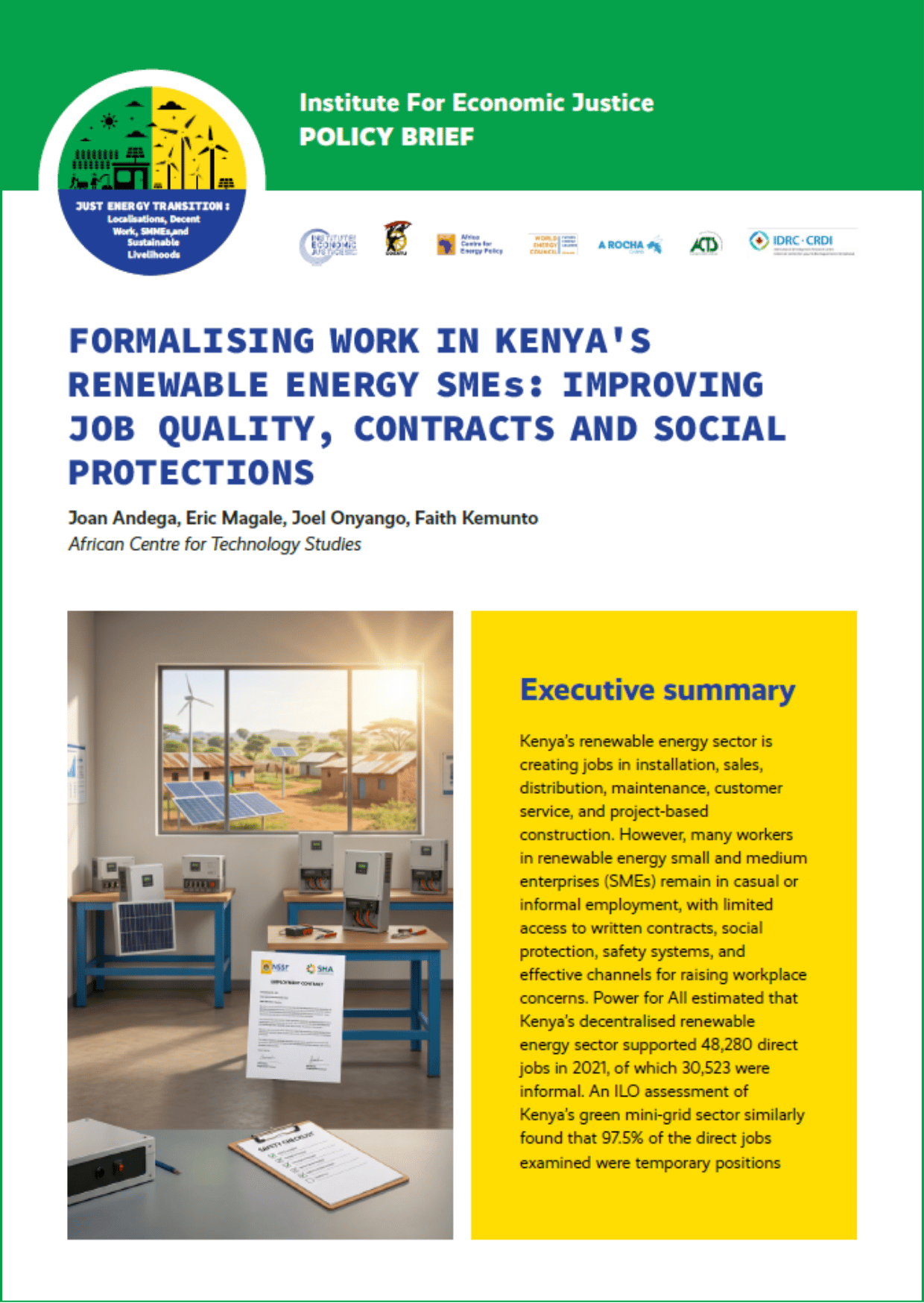
Formalising work in Kenya’s renewable energy SMEs is essential to ensuring that the energy transition delivers secure employment, safer workplaces, and sustainable livelihoods. Employment is growing in installation, sales, distribution, maintenance, and construction, but many workers remain in casual or informal arrangements with limited protection.
This policy brief, written by Joan Andega, Eric Magale, Joel Onyango, and Faith Kemunto of the African Centre for Technology Studies, proposes a supported approach to formalisation. It combines clear minimum employment standards with practical assistance that helps small and medium-sized enterprises (SMEs) improve working conditions.
Employment growth with uneven protection
Power for All estimated that Kenya’s decentralised renewable energy sector supported 48,280 direct jobs in 2021, of which 30,523 were informal. Research across Central, Coastal, and Western Kenya highlights substantial differences in job quality between firms.
Workers in larger, better-capitalised businesses are more likely to receive written contracts, training, protective equipment, and employment benefits. Smaller firms and installation teams rely more heavily on casual and project-based labour, often offering limited income security or career progression.
Many workers lack health insurance, pension contributions, paid leave, and formal safety systems. Installation and maintenance can involve electrical hazards, physical risks, remote travel, and irregular hours. Union membership was below 5% across the three study regions, limiting workers’ ability to negotiate over pay, safety, contracts, and benefits.
Young people are strongly represented in technical and field-based roles but often face insecure employment. Women and persons with disabilities encounter additional barriers to secure technical work.
Making formalisation practical for smaller firms
The brief identifies weak implementation, limited monitoring, and insufficient sector-specific guidance as central obstacles. Many SMEs also operate with thin margins, irregular cash flow, and limited administrative capacity.
A supported formalisation framework would help firms meet employment standards through simplified tools, registration assistance, phased timelines, and targeted enforcement for serious or repeated violations.
The brief recommends four priorities:
- Develop practical sector guidance. Provide simple contract templates, employment records, and safety checklists covering wages, working hours, social-protection registration, injury reporting, grievance procedures, and worker representation.
- Introduce phased compliance assistance. Combine awareness programmes, self-assessment tools, advisory inspections, and training, alongside support for health and pension registration.
- Link public support to decent work. Include employment standards in renewable energy tenders, grants, and SME support programmes, covering written agreements, social protection, protective equipment, safety measures, and grievance procedures.
- Strengthen worker voice and accountability. Support worker awareness, representation, and safe reporting channels. Monitor outcomes using data disaggregated by gender, age, disability, region, and employment type.
Building a stronger renewable energy sector
The proposed approach requires investment in guidance, outreach, training, and monitoring, alongside improvements in firms’ employment and safety practices.
Workers would gain clearer employment terms, safer conditions, and stronger channels for raising concerns. Firms could benefit from improved staff retention, fewer accidents, more reliable services, and greater eligibility for public procurement. Supported formalisation can therefore advance worker protection while strengthening the businesses delivering Kenya’s energy transition.
About the project
This publication is an output of Advancing a Just Energy Transition: Localisation, Decent Work, and Sustainable Livelihoods, a multi-country research project examining the energy sectors of Ghana, Kenya, and South Africa in the context of global decarbonisation. The project investigates how localisation, decent work, gender equity, SMME participation, and sustainable livelihoods can be embedded in renewable energy production networks to strengthen local manufacturing and avoid reproducing unequal global economic patterns.