
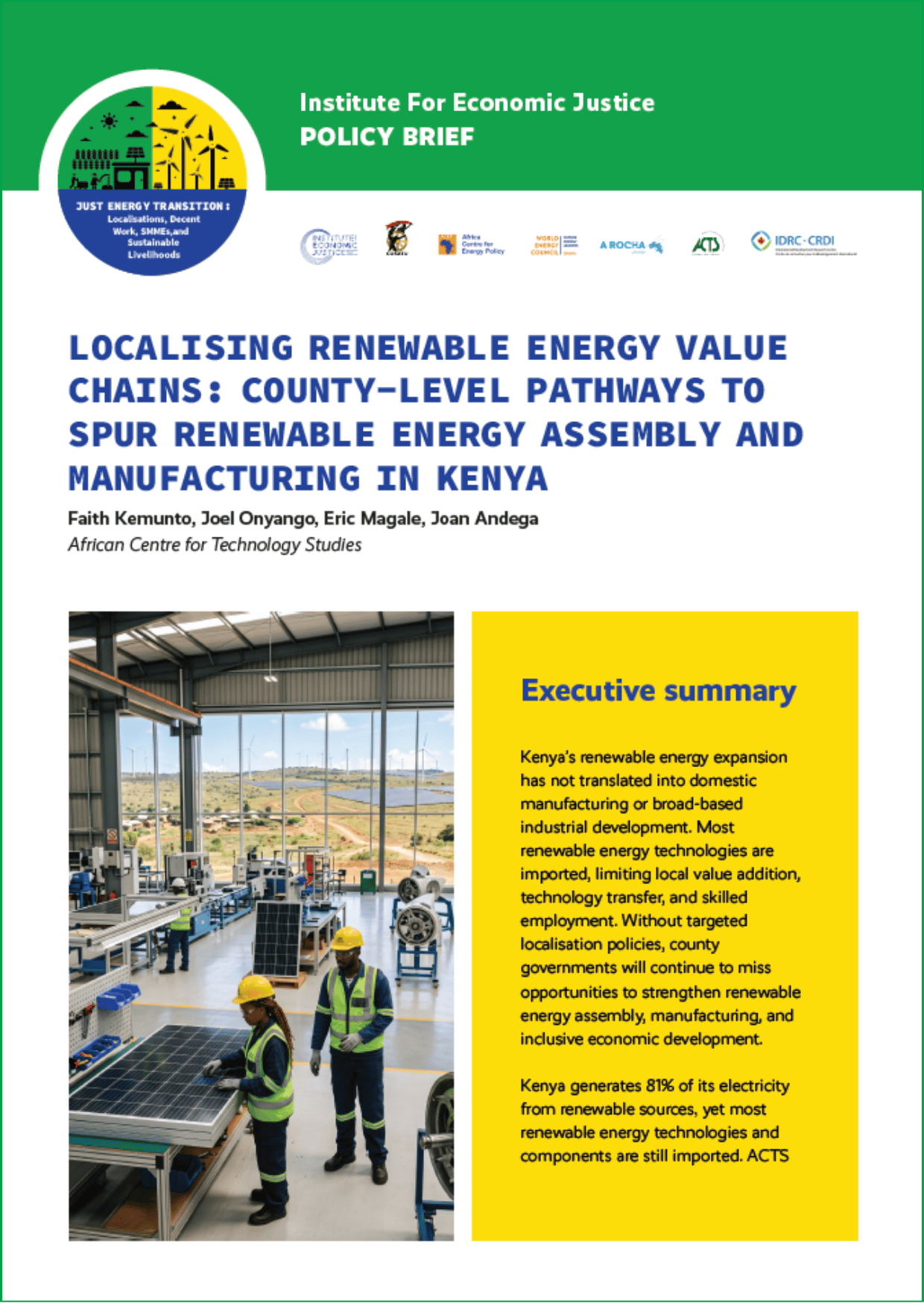
Localising renewable energy value chains can help Kenya turn expanding clean energy investment into domestic manufacturing, skilled employment, and inclusive economic development. Most renewable energy technologies and components are still imported, limiting the value retained locally and opportunities for technological learning.
This policy brief, written by Faith Kemunto, Joel Onyango, Eric Magale, and Joan Andega of the African Centre for Technology Studies (ACTS), proposes a county-led approach to renewable energy assembly and manufacturing. It examines how coordinated investment, local-content measures, enterprise support, and skills development can strengthen domestic participation in the energy transition.
Closing the localisation gap
Kenyan firms remain concentrated in distribution, installation, and maintenance, with limited participation in higher-value manufacturing. Counties with substantial renewable energy potential, including Turkana, Garissa, Kajiado, Nakuru, and Makueni, capture limited industrial value from energy investments.
An ACTS survey of five firms, conducted in January and February 2026, illustrates these constraints. Three were concentrated in low-skill assembly or supplying basic materials, while participation in manufacturing, design, research, and development was limited. Four reported that existing policies were largely ineffective in supporting their businesses.
The survey and stakeholder consultations identified inadequate finance, industrial infrastructure, technology transfer, and specialised technical skills as barriers to upgrading. Women and youth face additional obstacles to accessing training, finance, and enterprise opportunities.
Four priorities for county-led industrial development
The brief recommends coordinated action across four areas:
- Establish county assembly and manufacturing clusters. Embed localisation targets in County Integrated Development Plans, industrial strategies, and procurement frameworks. Finance these initiatives through national and county allocations, public–private partnerships, and development-partner support.
- Strengthen local content and SME competitiveness. Introduce phased local-content requirements for publicly funded renewable energy projects, alongside finance, investment incentives, and technical assistance that enable small and medium-sized enterprises (SMEs) to supply these markets.
- Develop skills and technology transfer. Build partnerships between technical and vocational institutions, universities, research organisations, and industry to develop specialised manufacturing capabilities and support lasting technological learning.
- Improve national–county coordination. Align renewable energy, industrialisation, and investment policies, monitor localisation targets, publish annual county progress reports, and share learning across counties.
Local-content requirements need to be matched by the finance, skills, infrastructure, and supplier support that firms require to deliver. Coordinating these interventions can help counties build viable production capabilities and stronger domestic supply chains.
Ensuring communities share the benefits
The brief also highlights the importance of community ownership and benefit-sharing. Drawing on research into the Lake Turkana Wind Power project, it cautions that local employment and contracting alone do not guarantee meaningful community benefits.
County-led clusters should therefore incorporate community ownership stakes and benefit-sharing agreements alongside employment and enterprise development.
Localisation requires upfront public investment and sustained institutional coordination. The proposed approach aims to increase domestic value addition, reduce import dependence, strengthen supply-chain resilience, and expand opportunities for SMEs, women, and youth across Kenya’s counties.
About the project
This publication is an output of Advancing a Just Energy Transition: Localisation, Decent Work, and Sustainable Livelihoods, a multi-country research project examining the energy sectors of Ghana, Kenya, and South Africa in the context of global decarbonisation. The project investigates how localisation, decent work, gender equity, SMME participation, and sustainable livelihoods can be embedded in renewable energy production networks to strengthen local manufacturing and avoid reproducing unequal global economic patterns.