
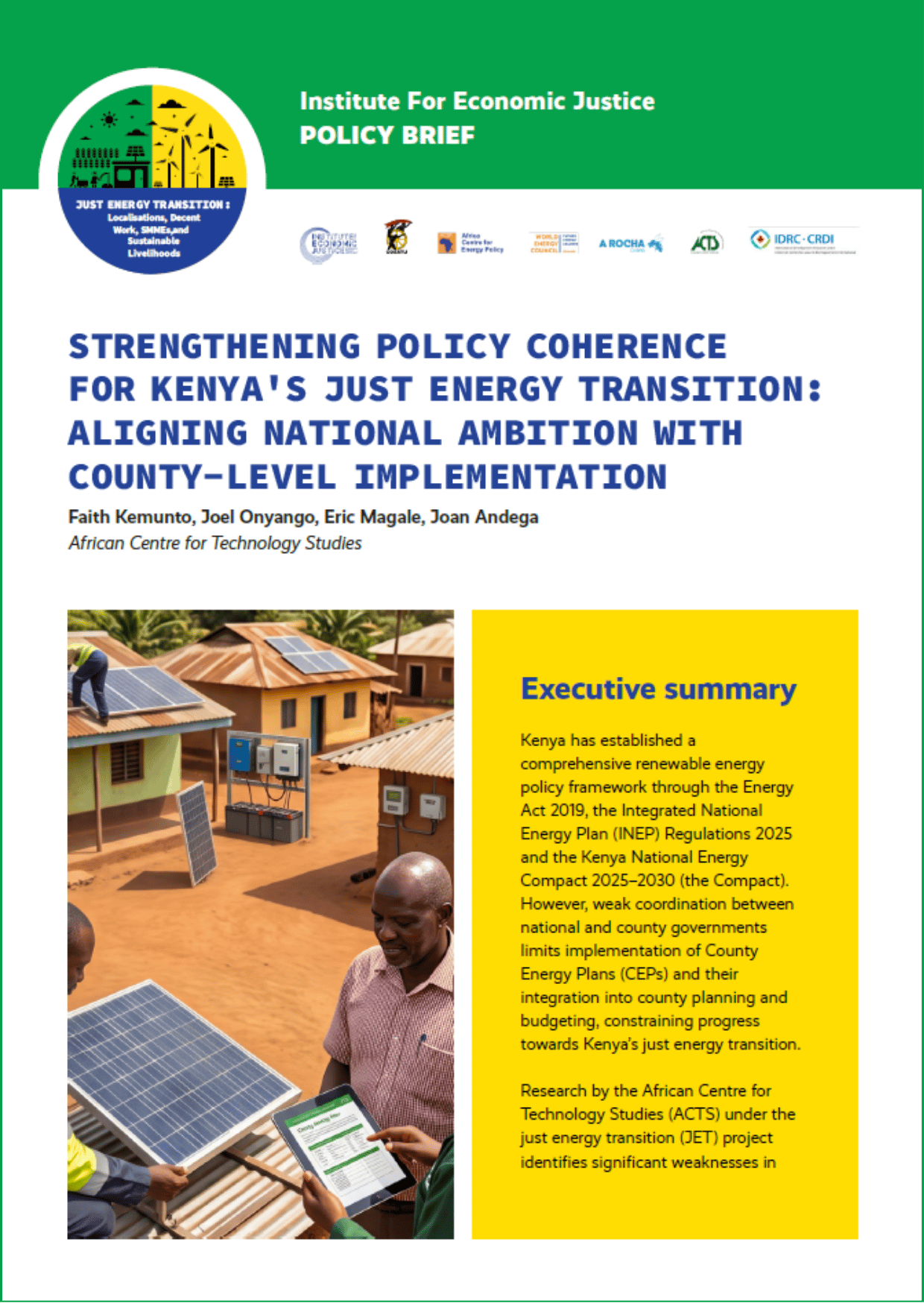
Policy coherence for Kenya’s just energy transition is essential to connecting national renewable energy ambitions with county-level planning, budgets, and implementation. Kenya has developed an extensive energy policy framework, but weak coordination between national and county governments limits its translation into local investment, industrial development, and inclusive economic opportunities.
This policy brief, written by Faith Kemunto, Joel Onyango, Eric Magale, and Joan Andega of the African Centre for Technology Studies (ACTS), examines these implementation gaps. It proposes a formal coordination framework to align responsibilities, strengthen accountability, and ensure that County Energy Plans influence spending and delivery.
Connecting energy plans to county budgets
County Energy Plans are intended to inform national energy planning, but their integration into County Annual Development Plans and county budgets remains inconsistent. Many counties also lack the technical expertise, data, planning tools, and institutional capacity needed to turn national targets into practical local priorities.
These gaps affect renewable energy firms, workers, and communities. Fragmented implementation creates uncertainty for investment and supplier development, while underserved counties face barriers to accessing the economic benefits of the transition. Local enterprises, women, and young people consequently have fewer opportunities to participate in emerging value chains.
Evidence from firms and policy dialogues
An ACTS survey of five renewable energy firms, conducted in January and February 2026, found that four considered existing policies ineffective in supporting local manufacturers. Four also reported that policies favoured imported finished products, while two sourced less than 25% of their key inputs locally.
These findings reflect the experiences of a small sample. Alongside evidence from policy dialogues, stakeholder consultations, and wider research, they illustrate how implementation weaknesses interact with finance constraints, skills shortages, and limited domestic supply-chain integration.
The brief identifies coordinated implementation as the central challenge. Clear responsibilities and accountability must connect national policy commitments to county decisions.
Three priorities for stronger implementation
The brief recommends three linked reforms:
- Formalise national–county coordination. Establish a framework jointly led by the Ministry of Energy and Petroleum and the Council of Governors, with clear institutional roles, reporting requirements, and accountability for renewable energy planning and implementation.
- Align planning and budgeting. Issue implementation guidelines requiring County Energy Plans to be integrated into County Annual Development Plans and county budgets. Support this process through technical assistance, standardised templates, workshops, and digital planning tools.
- Strengthen county capacity and accountability. Invest in technical training and knowledge sharing, supported by a national monitoring framework with measurable indicators and annual, publicly reported performance reviews.
The coordination framework provides the foundation for the other reforms, ensuring that implementation guidance and capacity support work towards shared objectives.
Building on existing institutions
The proposed approach strengthens existing governance arrangements. Initial investment in coordination, technical assistance, and monitoring could be integrated into established planning and administrative processes.
More consistent implementation would help reduce duplicated planning, improve investment predictability, and connect renewable energy expansion to local manufacturing, decent employment, and a more inclusive transition across Kenya’s counties.
About the project
This publication is an output of Advancing a Just Energy Transition: Localisation, Decent Work, and Sustainable Livelihoods, a multi-country research project examining the energy sectors of Ghana, Kenya, and South Africa in the context of global decarbonisation. The project investigates how localisation, decent work, gender equity, SMME participation, and sustainable livelihoods can be embedded in renewable energy production networks to strengthen local manufacturing and avoid reproducing unequal global economic patterns.