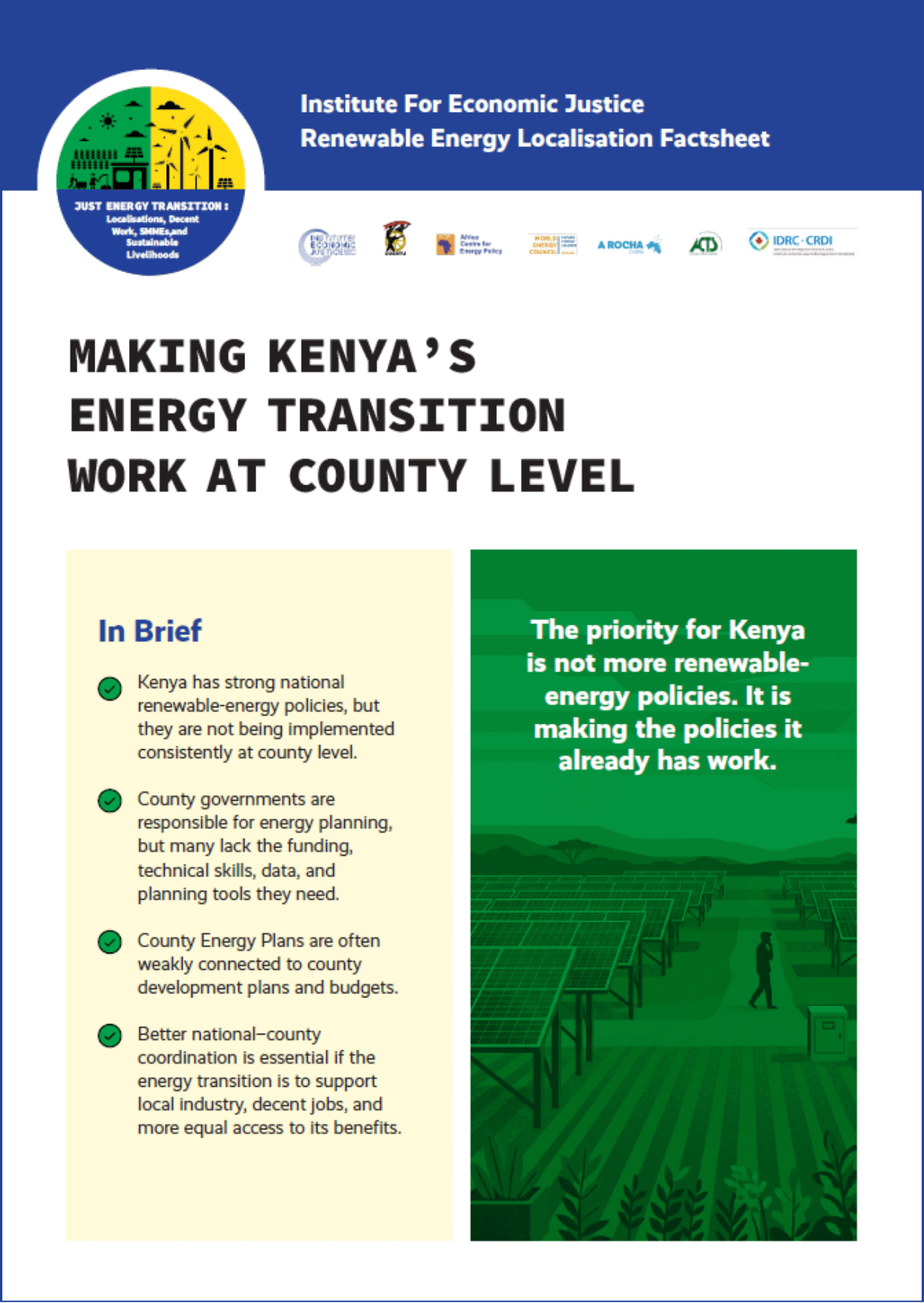
Kenya’s energy transition is supported by an extensive national policy framework, but implementation remains inconsistent at county level. County governments have significant energy-planning responsibilities, yet many lack the funding, technical expertise, data, and institutional systems needed to translate national ambitions into practical programmes.
Under the Energy Act of 2019, all 47 county governments must prepare County Energy Plans. These plans are intended to feed into the Integrated National Energy Plan, which brings together energy planning across the country.
The Integrated National Energy Plan Regulations 2025 and the Kenya National Energy Compact 2025–2030 have strengthened the framework. However, County Energy Plans remain weakly integrated into County Annual Development Plans, budgets, and implementation processes.
Responsibilities without sufficient support
Research covering all 47 counties found inconsistent coordination across the country. Many counties lack the data, modelling tools, technical staff, and institutional capacity required to plan and implement renewable energy projects.
The consequences include:
- County Energy Plans that are not connected to budgets or annual development plans;
- overlapping or unclear responsibilities between national and county institutions;
- substantial differences in counties’ technical and financial capabilities;
- weak monitoring of whether county plans are being implemented; and
- uncertainty for businesses about where investment and procurement opportunities will arise.
Energy reforms are also shaped by established political and institutional interests. Formal policy changes therefore do not necessarily transform implementation or the distribution of benefits.
Why coordination matters
A just energy transition should do more than increase access to renewable electricity. It should create decent employment, support Kenyan businesses and manufacturers, expand opportunities for women and young people, and deliver benefits to underserved communities.
Without stronger national-county coordination, counties with fewer resources and weaker institutions risk being left behind. Fragmented planning also makes it difficult to build domestic renewable energy industries and supply chains.
The factsheet notes that the Local Content Bill, 2025, would place enforcement with a national office without establishing a defined role for county governments. Without national-county cooperation, local-content rules may fail to create industrial and employment opportunities across the country.
A formal intergovernmental system
The factsheet recommends that the Ministry of Energy and Petroleum and the Council of Governors establish a binding intergovernmental coordination framework.
This framework should define responsibilities, reporting requirements, and accountability mechanisms. National implementation guidelines should require counties to integrate their energy plans into annual development plans and budgets.
Counties also need technical training, financial support, data, and digital planning tools. However, capacity-building alone will not resolve unclear responsibilities or weak accountability. It must be combined with a national system for monitoring implementation and publishing results.
Kenya has an opportunity to strengthen coordination while implementation of the National Energy Compact is still developing. The Local Content Bill also provides an opportunity to define a stronger county role in implementing and monitoring local-content requirements.
Effective coordination could create a more predictable investment environment, strengthen local manufacturing and supplier development, support decent work, and help communities across Kenya share in the benefits of the transition. Kenya’s challenge is not a lack of policy, but the failure to translate policy into coordinated planning, budgeting, implementation, and local economic development.
Explore how stronger national-county coordination can connect Kenya’s renewable energy plans to budgets, implementation, local manufacturing, decent work, and public accountability.
About the project
This publication is an output of Advancing a Just Energy Transition: Localisation, Decent Work, and Sustainable Livelihoods, a multi-country research project examining the energy sectors of Ghana, Kenya, and South Africa in the context of global decarbonisation. The project investigates how localisation, decent work, gender equity, SMME participation, and sustainable livelihoods can be embedded in renewable energy production networks to strengthen local manufacturing and avoid reproducing unequal global economic patterns.