
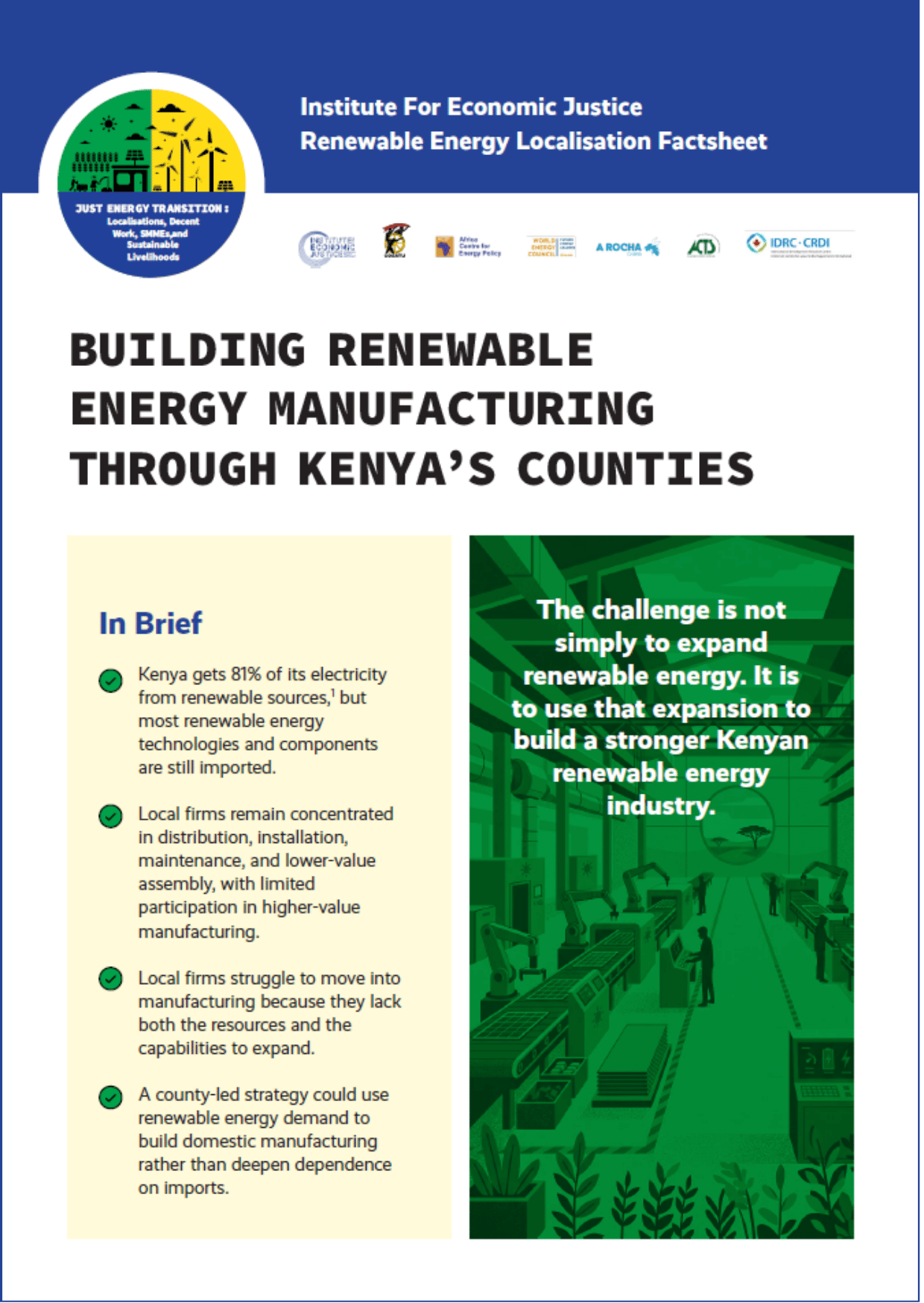
Renewable energy manufacturing through Kenya’s counties could help the country capture more of the industrial and employment benefits generated by its clean energy transition. Kenya obtains approximately 81% of its electricity from renewable sources, but most renewable energy technologies and components are imported.
Domestic firms remain concentrated in distribution, installation, maintenance, and basic assembly, with limited participation in higher-value manufacturing. As a result, much of the productive capacity, manufacturing value, and skilled employment associated with Kenya’s energy transition is created elsewhere.
Counties with significant renewable energy resources capture relatively little industrial value. Women and young people are also particularly likely to miss out on higher-value manufacturing opportunities.
What prevents localisation?
A 2026 survey by the African Centre for Technology Studies examined five solar, wind, and related firms. Three were concentrated in low-skill assembly or the supply of basic materials. Only one manufactured and assembled final products, while another participated in design, research, and development.
Four of the five firms considered existing policies largely ineffective in supporting their businesses. Two sourced less than a quarter of their key inputs locally.
Manufacturing SMMEs face three central barriers. First, they struggle to secure finance for expansion and often lack suitable industrial facilities. Second, firms lack specialised skills, technologies, and production knowledge. Third, Kenya does not have a dedicated and effectively enforced local-content instrument connecting renewable energy deployment to industrial development.
Local-content rules alone will not resolve these challenges. International experience shows that they must be supported by affordable finance, supplier development, technology transfer, skills development, capable institutions, and predictable demand.
A new opportunity for local content
When the factsheet was prepared, the Local Content Bill, 2025, was before Parliament’s Departmental Committee on Trade, Industry and Cooperatives. The Bill would require foreign-owned firms to source at least 60% of their goods and services from Kenyan companies and support local suppliers through technology transfer and capacity-building.
These measures could create opportunities in foundation construction, tower assembly, component fabrication, and other areas of renewable energy production. However, the Bill does not define a clear role for county governments.
A county-led localisation strategy
The factsheet recommends establishing county renewable energy manufacturing clusters where firms can share infrastructure, build supplier relationships, and develop production capabilities.
Localisation targets should be incorporated into County Integrated Development Plans, industrial strategies, and procurement frameworks. Local-content requirements for publicly funded projects should be phased in alongside financial and technical support for SMMEs.
Partnerships between training institutions, research bodies, government, and industry should develop the specialised skills firms need. A formal coordination mechanism should also connect county industrial plans with national renewable energy procurement, monitoring, and policy implementation.
Kenya can continue expanding renewable energy while importing most of the associated technologies. Alternatively, it can use renewable energy investment deliberately to build domestic manufacturing and spread industrial opportunities across its counties. The second path would support stronger local industries, skilled jobs, and greater economic benefits for communities.
Explore how county manufacturing clusters, stronger local-content measures, SMME support, skills development, and national–county coordination could build Kenya’s renewable energy manufacturing capacity.
About the project
This publication is an output of Advancing a Just Energy Transition: Localisation, Decent Work, and Sustainable Livelihoods, a multi-country research project examining the energy sectors of Ghana, Kenya, and South Africa in the context of global decarbonisation. The project investigates how localisation, decent work, gender equity, SMME participation, and sustainable livelihoods can be embedded in renewable energy production networks to strengthen local manufacturing and avoid reproducing unequal global economic patterns.