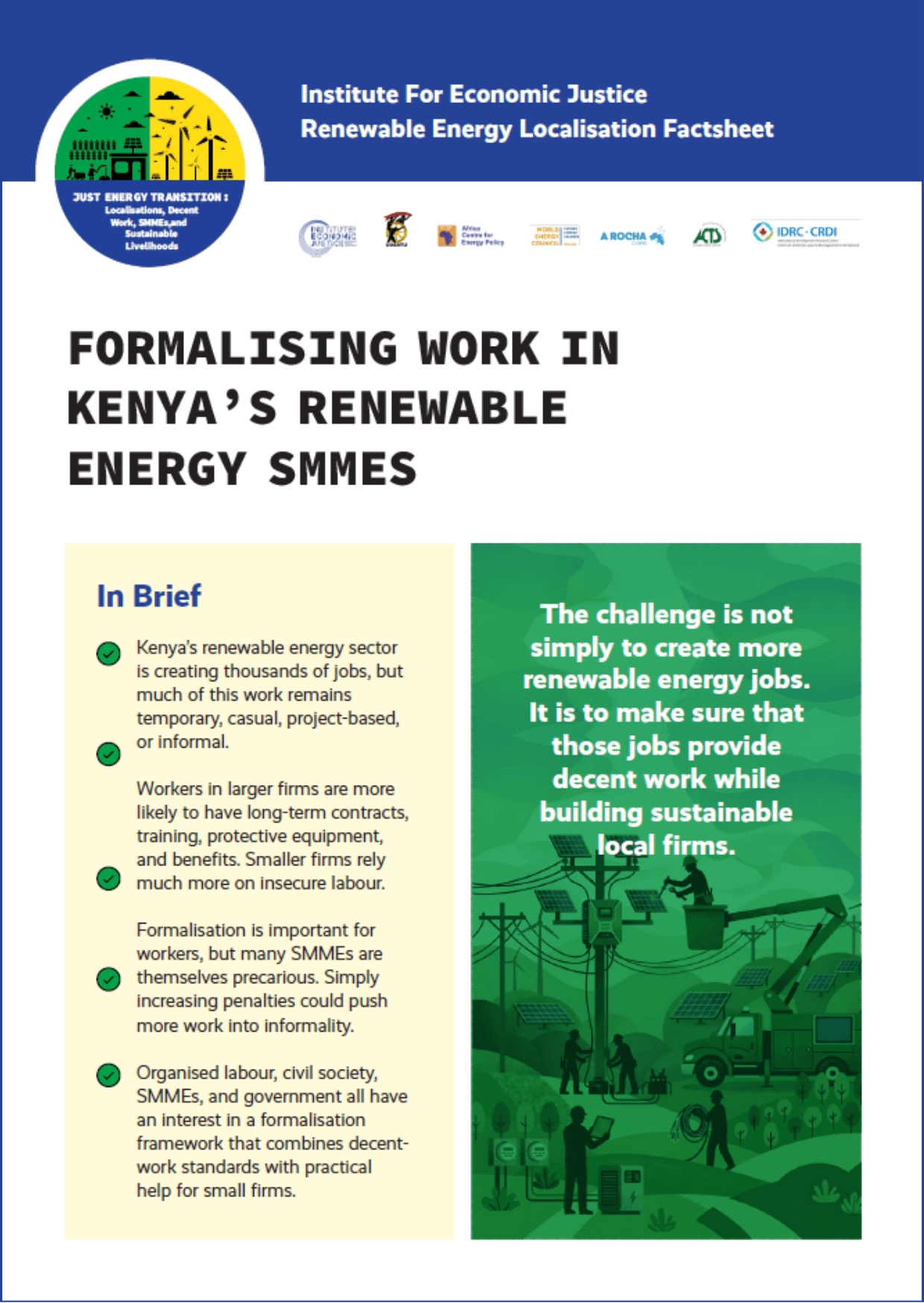
Formalising work in Kenya’s renewable energy SMMEs is essential if the country’s energy transition is to create decent jobs and sustainable local enterprises. Kenya’s renewable energy sector already supports thousands of workers, but much of this employment remains casual, temporary, project-based, or informal.
Decentralised renewable energy activities supported approximately 53,000 direct, indirect, and induced jobs by 2022. The 2022 Powering Jobs Census estimated that 30,523 of the sector’s 48,280 direct jobs in 2021 were informal. An International Labour Organization study of Kenya’s green mini-grid industry found that 97.5% of the direct jobs examined were temporary positions lasting approximately one month.
Renewable energy is creating employment in solar installation, distribution, sales, maintenance, customer service, civil works, and construction. However, many workers lack written contracts, predictable wages, social protection, protective equipment, career-development opportunities, and effective grievance procedures. Research across Central, Coastal, and Western Kenya also found union membership below 5%.
A two-tier labour market
A clear divide is emerging between workers employed by larger companies and those working for smaller firms or casual installation teams. Larger firms are more likely to provide formal contracts, structured training, protective equipment, statutory benefits, and predictable employment.
Smaller firms rely more heavily on short-term and project-based labour. Some workers in informal positions reported earning between KES 300 and KES 1,000 a day, often without predictable benefits or career progression.
Insecure work also affects businesses. SMMEs with irregular cash flow and thin profit margins struggle to retain skilled employees, improve service quality, and develop sustainable operations. A green job is therefore not automatically a decent job: job quality depends on wages, security, workplace safety, social protection, and workers’ ability to organise.
Supporting firms to formalise
Kenya has legislation protecting employment rights and workplace safety, but implementation remains weak. Smaller renewable energy firms also lack practical guidance and administrative capacity. Increasing inspections and penalties without providing support could push vulnerable enterprises and their workers further into informality.
The factsheet recommends a supported formalisation framework that combines minimum labour standards with practical assistance. Government should provide simple employment agreements, registration support, occupational-safety guidance, self-assessment tools, advisory inspections, and training on decent-work standards. Compliance should be phased, while enforcement should concentrate on serious or repeated violations.
Renewable energy tenders, grants, and SMME-support programmes should require participating firms to provide written employment agreements, social-protection registration, protective equipment, workplace-safety measures, and grievance procedures.
Trade unions, civil society organisations, and industry associations should help workers understand their rights, organise, and report abuses without fear of retaliation. Government and Parliament should also monitor contracts, safety, social-protection enrolment, and complaints. This information should be disaggregated by gender, age, disability, region, and employment type.
Kenya can expand renewable energy while allowing employment to remain temporary, informal, and poorly protected. Alternatively, government, organised labour, civil society, and SMMEs can build an industry in which growing employment is accompanied by stronger firms, safer workplaces, social protection, skills development, and greater worker influence.
Explore how a supported formalisation framework can improve contracts, workplace safety, social protection, job security, and the sustainability of Kenya’s renewable energy SMMEs.
About the project
This publication is an output of Advancing a Just Energy Transition: Localisation, Decent Work, and Sustainable Livelihoods, a multi-country research project examining the energy sectors of Ghana, Kenya, and South Africa in the context of global decarbonisation. The project investigates how localisation, decent work, gender equity, SMME participation, and sustainable livelihoods can be embedded in renewable energy production networks to strengthen local manufacturing and avoid reproducing unequal global economic patterns.