
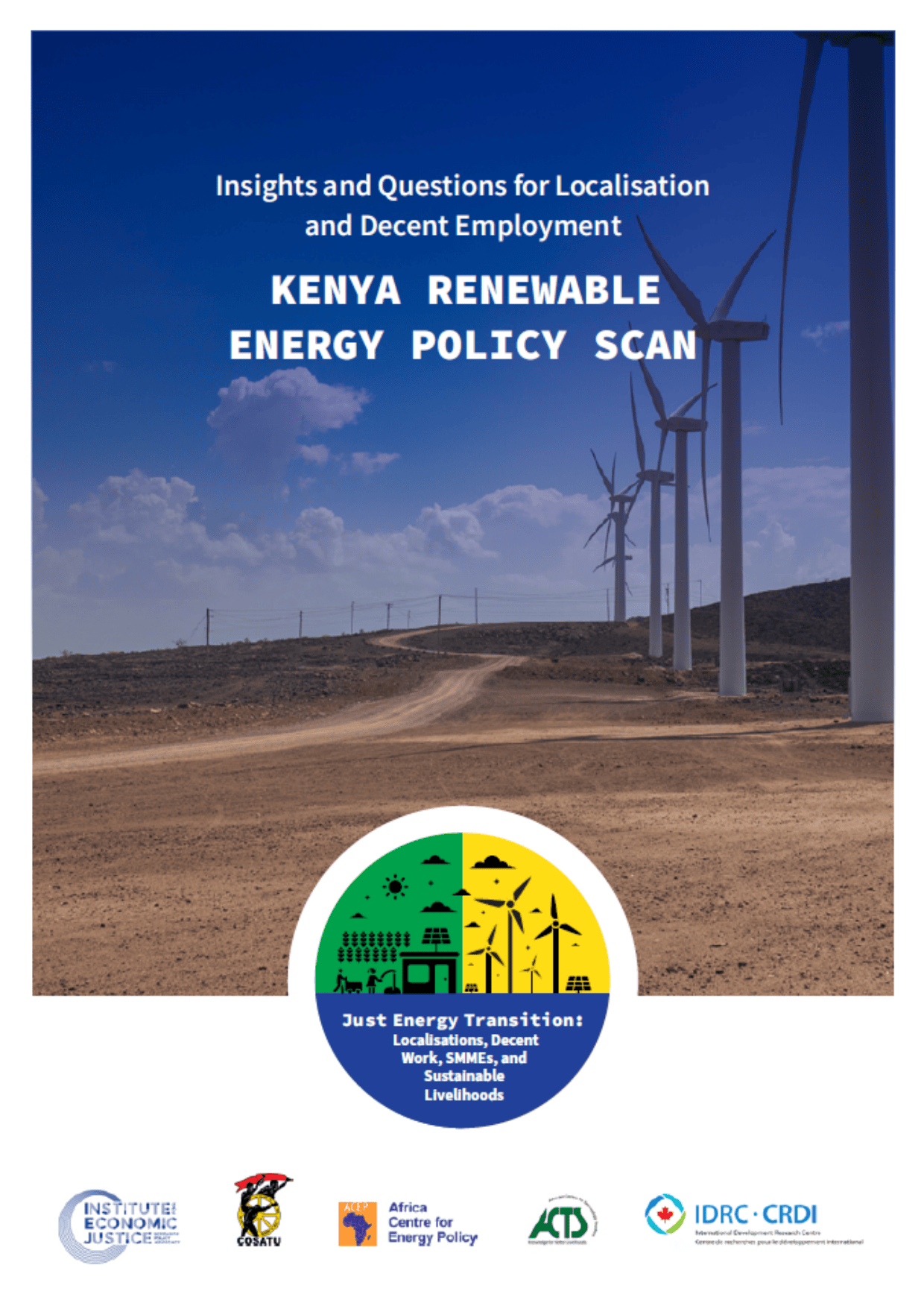
The Kenya Renewable Energy Policy Scan forms part of the broader Just Energy Transition research project. It provides a structured assessment of how Kenya’s policy and regulatory frameworks support, or constrain, an inclusive, employment-generating, and industrially transformative renewable energy (RE) transition.
Purpose of the framework
Kenya has committed to ambitious climate and energy targets, including reducing greenhouse gas emissions by 32% by 2030 and achieving 100% renewable electricity generation by 2030. While the country already sources more than 90% of its electricity from renewables, the central policy question is not only how fast the transition proceeds, but who benefits from it.
This policy scan is designed to evaluate whether existing policies meaningfully advance:
-
Localisation and structural transformation
-
Development of Medium Enterprises (MEs)
-
Decent work
-
Gender equity and social inclusion
-
Sustainable livelihoods
The framework recognises that without deliberate intervention, the energy transition risks reinforcing import dependency, informalisation, gender exclusion, and unequal value-chain participation.
Analytical pillars of the policy scan
1. Localisation and industrial capability
Kenya’s development strategies, including Vision 2030, the National Industrial Policy Framework, the Energy Act (2019), and Buy Kenya Build Kenya, articulate a strong rhetorical commitment to localisation.
However, the scan finds that:
-
Renewable energy components (solar PV, wind turbines, batteries) remain heavily import-dependent.
-
Local firms are largely confined to assembly and distribution.
-
Weak enforcement of local content provisions limits industrial upgrading.
-
R&D ecosystems, technology transfer mechanisms, and financing support remain underdeveloped.
The framework, therefore, assesses the gap between policy ambition and industrial capacity, focusing on whether Kenya is moving up the global production network ladder or remaining locked into low-value segments.
2. Medium Enterprise (ME) capability development
Policies such as the MSE Act (2022) and the National Industrial Policy Framework aim to build local firm competitiveness, technological upgrading, and regional market integration.
The scan evaluates:
-
Access to finance for MEs in high-tech renewable sectors
-
Tailored capacity-building versus generic training programmes
-
Effectiveness of special economic zones
-
Public procurement implementation
-
Technology transfer and supplier development
The core question is whether MEs are being structurally positioned to scale, innovate, and integrate into renewable energy value chains — or whether systemic barriers continue to exclude them.
3. Gender equity and social inclusion
Kenya’s Constitution (2010), Gender Policy in Energy (2019), and Vision 2030 establish a strong legal architecture for gender equality.
Yet the framework highlights persistent challenges:
-
Underrepresentation of women in technical and leadership roles in energy.
-
Continued reliance on biomass among low-income households.
-
Limited access to finance and training for women entrepreneurs.
-
Weak enforcement of gender quotas and monitoring systems.
The scan interrogates whether gender policy commitments are translating into material transformation within renewable energy value chains.
4. Decent work and labour standards
Kenya’s labour framework — including the Constitution (Article 41), Employment Act (2007), Labour Relations Act (2007), and Occupational Safety and Health Act (2007) — provides strong legal guarantees for fair labour practices.
However, the scan identifies:
-
Widespread casualisation and short-term contracting in energy projects
-
Weak labour inspection and enforcement capacity
-
Occupational safety concerns
-
Limited access to social protection for contract workers
The framework assesses whether renewable energy expansion is generating stable, protected, and fairly remunerated employment, or reproducing precarious labour conditions.
Methodological approach
The policy scan is based on a systematic literature review of:
-
Energy, climate, labour, gender, and industrial policies
-
Government strategies and development plans
-
Academic literature and international agency reports
It applies a set of defined parameters to evaluate policy coherence, implementation effectiveness, and alignment with just transition objectives. The guiding question is:
Do Kenya’s existing policy frameworks support localisation, decent work, gender equity, sustainable livelihoods, and ME capability development — and where are the gaps?
Why this matters
Kenya’s renewable energy transition presents a critical opportunity to:
-
Reduce poverty and inequality
-
Build domestic industrial capacity
-
Create quality employment
-
Advance gender justice
-
Strengthen economic sovereignty
The Kenya Renewable Energy Policy Scan provides a diagnostic tool for policymakers, researchers, labour movements, civil society, and industry stakeholders to assess whether the transition is structurally transformative, or merely green in energy mix but unchanged in political economy.
The framework ultimately calls for moving beyond policy declarations toward enforceable, well-resourced, and integrated industrial and labour strategies that embed justice at the centre of Kenya’s energy future.