
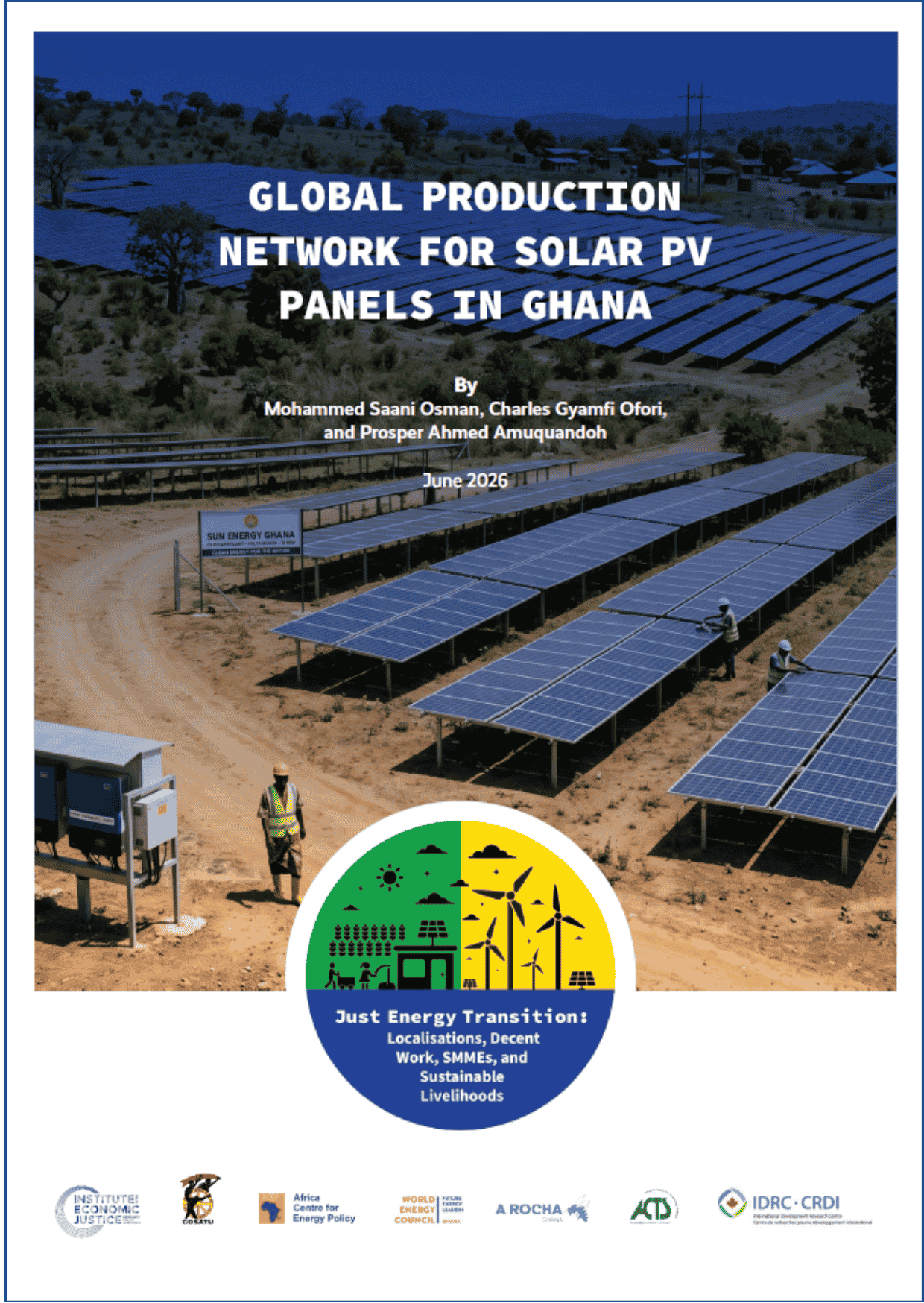
Solar PV panels in Ghana could play an important role in expanding access to clean energy while supporting industrial development, technological learning, and decent work. However, Ghana remains heavily dependent on imported solar technologies and components. Local firms participate primarily in downstream activities such as sales, distribution, installation, engineering, operations, and maintenance.
This report, Global Production Network for Solar PV Panels in Ghana, examines how Ghana participates in the international solar photovoltaic production network and identifies opportunities to deepen localisation. It considers how the country’s clean energy transition could create greater economic and social value rather than focusing only on the deployment of imported technologies.
Written by Mohammed Saani Osman, Charles Gyamfi Ofori, and Prosper Ahmed Amuquandoh, the report uses the Global Production Network framework to map the firms, workers, institutions, and relationships involved in the solar PV panel value chain. The framework enables the authors to examine where value is created, who captures that value, how power is distributed, and how local firms and workers are positioned within the production network.
Ghana’s position in the solar PV production network
The report finds that manufacturing, technological innovation, and intellectual property within the global solar PV industry are highly concentrated among lead firms based in China. These firms exercise considerable influence over international supply chains, technology development, and access to essential components.
Ghana, by contrast, does not yet have a developed solar PV manufacturing sector. Most of the technologies and components used in the country are imported. Ghanaian firms participate mainly in engineering, procurement and construction services, installation, sales, distribution, operations, maintenance, and other downstream activities.
Although these activities create employment and enable the deployment of renewable energy, they generally offer fewer opportunities for technological upgrading and domestic value capture than manufacturing, product development, and research. High capital requirements, expensive energy, limited access to long-term finance, skills shortages, and dependence on foreign technology make it difficult for Ghanaian firms to enter higher-value activities.
Employment, skills, and gender equality
The expansion of solar PV panels in Ghana could create new employment opportunities, but the report cautions that job creation alone does not guarantee decent work. Evidence from Ghana and comparable developing countries points to the prevalence of temporary, insecure, and project-based employment in parts of the renewable energy industry.
Workers may face limited opportunities for career progression, while women remain underrepresented in technical and managerial positions. This is despite women’s considerable participation in entrepreneurial and other economic activities.
A successful localisation strategy must therefore pay attention to the quality, security, and distribution of employment. The report highlights the need to expand vocational training, strengthen technical universities, and create clearer pathways for women and young people to enter technical, manufacturing, and managerial roles.
Policies for localisation and industrial development
Ghana has adopted policies and legislation intended to promote renewable energy development and local participation. These include the Renewable Energy Act, the Renewable Energy Master Plan, the National Energy Policy, and the National Energy Transition Framework.
However, the report finds that implementation challenges, fragmented policymaking, financing constraints, and weak institutional coordination have limited the effect of these interventions. International development finance has supported the construction and deployment of large solar projects, but financing arrangements have generally done less to promote domestic manufacturing, assembly, and technological development.
Deeper localisation will require coordinated industrial policies that bring together renewable energy deployment, manufacturing, SMME development, skills, research, public procurement, and gender equality. Affordable long-term finance and stronger relationships between local firms, public institutions, universities, and international technology leaders will also be essential.
Opportunities in assembly, recycling, and regional trade
The report identifies solar-module assembly as a potential entry point for Ghana. Assembly is relatively labour-intensive and could help develop technical skills, supplier relationships, and industrial capabilities. Ghana could also expand local production of basic components and build stronger installation, maintenance, certification, and testing services.
Recycling and material recovery represent another important opportunity. Millions of solar panels will reach the end of their operational lives over the coming decades. Ghana could position itself as a regional centre for recovering materials such as silver, copper, and aluminium. This could support a circular economy, strengthen raw-material security, and generate green jobs in related industries.
Regional integration could further strengthen the commercial case for localisation. The African Continental Free Trade Area could enable Ghanaian firms to supply larger regional markets and participate in production networks extending beyond the domestic economy.
Building an inclusive solar industry
The report concludes that Ghana’s transition to renewable energy should be treated as an opportunity for structural transformation. Increasing the use of solar PV panels in Ghana is important, but deployment targets alone will not determine who participates in or benefits from the transition.
A meaningful localisation strategy must address the distribution of power, technology, finance, skills, and economic value across the production network. It must also confront insecure employment, gender inequality, and the social and institutional barriers that restrict participation.
By coordinating industrial policy, skills development, affordable finance, public procurement, research, regional trade, and support for domestic firms, Ghana can use its expanding solar market to build local capabilities and create more widely shared economic benefits.