
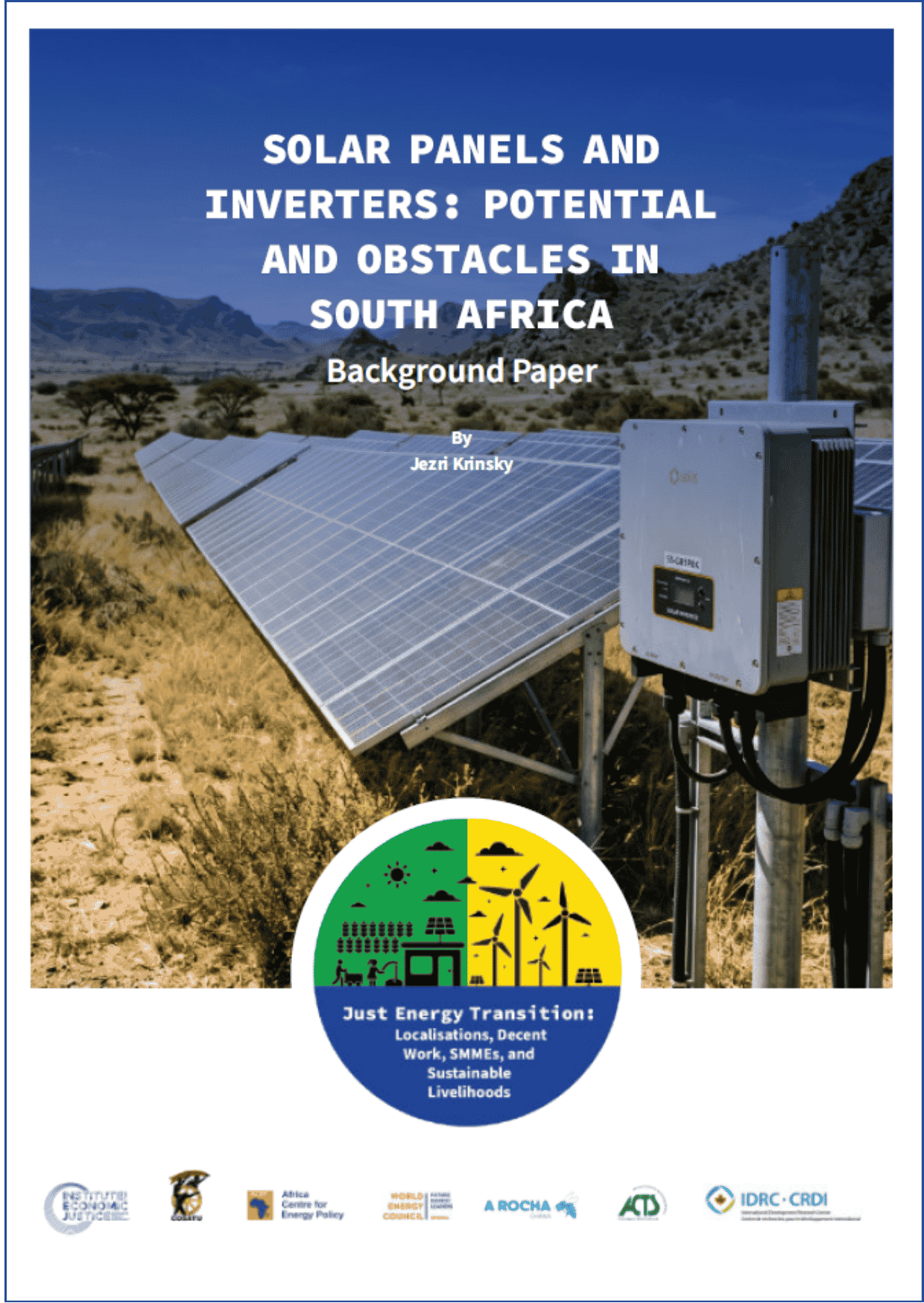
Solar panels and inverters in South Africa could support local manufacturing, industrial development, and the creation of decent work. However, South Africa currently imports most of these components, particularly from China, despite possessing existing manufacturing capacity, industrial infrastructure, technical skills, and access to growing regional markets.
This background paper by Jezri Krinsky develops a foundational analysis of South Africa’s solar-panel and inverter industries. It examines how these production networks are structured and identifies the opportunities and obstacles involved in expanding domestic manufacturing. It also considers how localisation could contribute to decent work, gender equity, the inclusion of small, medium, and micro enterprises (SMMEs), and a more just energy transition.
The paper uses the Global Production Network framework to examine how value is created, enhanced, and captured within the solar-panel and inverter industries. It also considers how corporate, institutional, and collective power shape these industries, and how production is embedded within South Africa’s economy, industrial regions, communities, and systems of social reproduction.
The analysis is based on desktop research, including trade data covering 2012 to 2023, academic and industry literature, government and development-agency reports, company information, and provisional maps of the firms and institutions involved in the two production networks.
Import dependence and local manufacturing capacity
The production networks for solar panels and inverters in South Africa share several important characteristics. Both are dominated by imported products, while domestic firms participate primarily in assembly, installation, maintenance, and other downstream activities.
However, South Africa already has some capacity to manufacture both products. The paper identifies ARTsolar and Seraphim as local solar-panel manufacturers. It identifies RWW Engineering, Microcare, ArioGenix, and MLT as firms involved in manufacturing inverters.
These firms generally use a combination of imported and locally sourced components. In solar-panel production, activities undertaken locally may include assembly, lamination, wiring, testing, and the sourcing of components such as frames and wiring. Local inverter manufacturers similarly combine imported components with domestic manufacturing and assembly.
South Africa also has several sources of demand that could support expanded production. These include utility-scale renewable energy projects developed through public-private partnerships, private utility-scale projects, embedded generation, smaller on-grid and off-grid systems, and markets for inverters outside the renewable energy sector.
Despite this demand, local manufacturers face intense competition from imported products. The liberalisation of South Africa’s energy sector has also weakened or removed some of the industrial policy instruments that could support domestic producers.
Who creates and captures value?
The paper finds that much of the manufacturing value associated with South Africa’s renewable energy expansion is captured outside the country. South Africa, like many countries in the Global South, exports critical raw materials while importing higher-value manufactured products.
Within public-private renewable energy projects, private developers, financiers, original equipment manufacturers, and other commercial actors may also capture substantial value through de-risking measures and long-term electricity-purchase agreements.
The distribution of value cannot be fully assessed without more detailed financial and employment information. The paper therefore identifies several areas requiring further research, including ownership and supplier relationships, technology sources, the distribution of profits and tax revenue, employment numbers, working conditions, and the social effects of production.
Industrial policy, local content, and power
The prospects for manufacturing solar panels and inverters in South Africa are shaped by wider political struggles over the country’s energy transition. These include disputes over the pace of the transition away from fossil fuels, the liberalisation of electricity generation, the role of the state, and whether renewable energy deployment should be connected to domestic industrialisation.
The paper identifies an important conflict between importers and local manufacturers. Importers benefit from access to cheaper international products, while domestic manufacturers require stable demand, supportive financing, industrial coordination, and effective local-content measures.
South Africa has industrial-policy institutions and instruments that could support localisation. The Renewable Energy Independent Power Producer Procurement Programme has included local-content requirements, while the Industrial Development Corporation has provided financing to local firms. However, these interventions remain fragmented and are not always effectively coordinated with energy, trade, labour, macroeconomic, and social policy.
Local-content requirements have also fluctuated between procurement rounds and may be weakened through poor monitoring or avoidance. The paper argues for more ambitious local-content requirements that expand progressively as domestic capacity develops.
Decent work, gender equity, and communities
Localisation should not be assessed only through investment, output, or the number of jobs created. The quality of employment and the distribution of social and environmental benefits are equally important.
Available evidence suggests that some higher-value parts of renewable energy production may provide relatively good employment. However, the sector also includes temporary and project-based work, limited union organisation, and uneven access to training and career progression. Women remain underrepresented in many technical and higher-paid positions.
The paper places these workplace issues within South Africa’s wider systems of social reproduction. Manufacturing workers may face long, expensive, and unsafe journeys from peripheral settlements. Their households also depend on unpaid care work, overstretched public services, and unequal patterns of labour divided along gender and generational lines.
Communities surrounding renewable energy projects do not necessarily capture significant value from them. Concerns include weak community participation, limited local employment, poor-quality jobs, insufficient skills development, and failures in community-development arrangements.
A successful localisation strategy must therefore combine domestic manufacturing with enforceable standards for decent work, training, gender equity, community participation, and environmental protection.
Building a renewable energy manufacturing base
South Africa has the industrial regions, ports, firms, workers, infrastructure, and regional markets needed to expand solar-panel and inverter manufacturing. The country could also develop manufacturing capacity for more of the inputs and subcomponents used in both products.
The rest of Africa already provides an important export market for South African solar products and inverters, particularly those used in smaller-scale systems. Growing renewable energy deployment across the continent could create further opportunities for South African manufacturers.
Realising this potential will require stable demand, appropriate finance, supplier development, and stronger links between manufacturers, universities, research institutions, workers, and the state. It will also require a national system of innovation capable of supporting technological learning and domestic product development.
The paper concludes that South Africa can connect the transition to renewable energy with a wider programme of just reindustrialisation. This would require more ambitious and progressively expanding local-content measures, stronger coordination between industrial and social policy, support for research and innovation, and organised action to ensure that workers and communities share in the benefits.
Expanding the manufacture of solar panels and inverters in South Africa is therefore not simply a question of replacing imports. It is an opportunity to build a more inclusive industrial base, create decent work, strengthen technological capabilities, and move towards a more just and ecologically sustainable economy.