
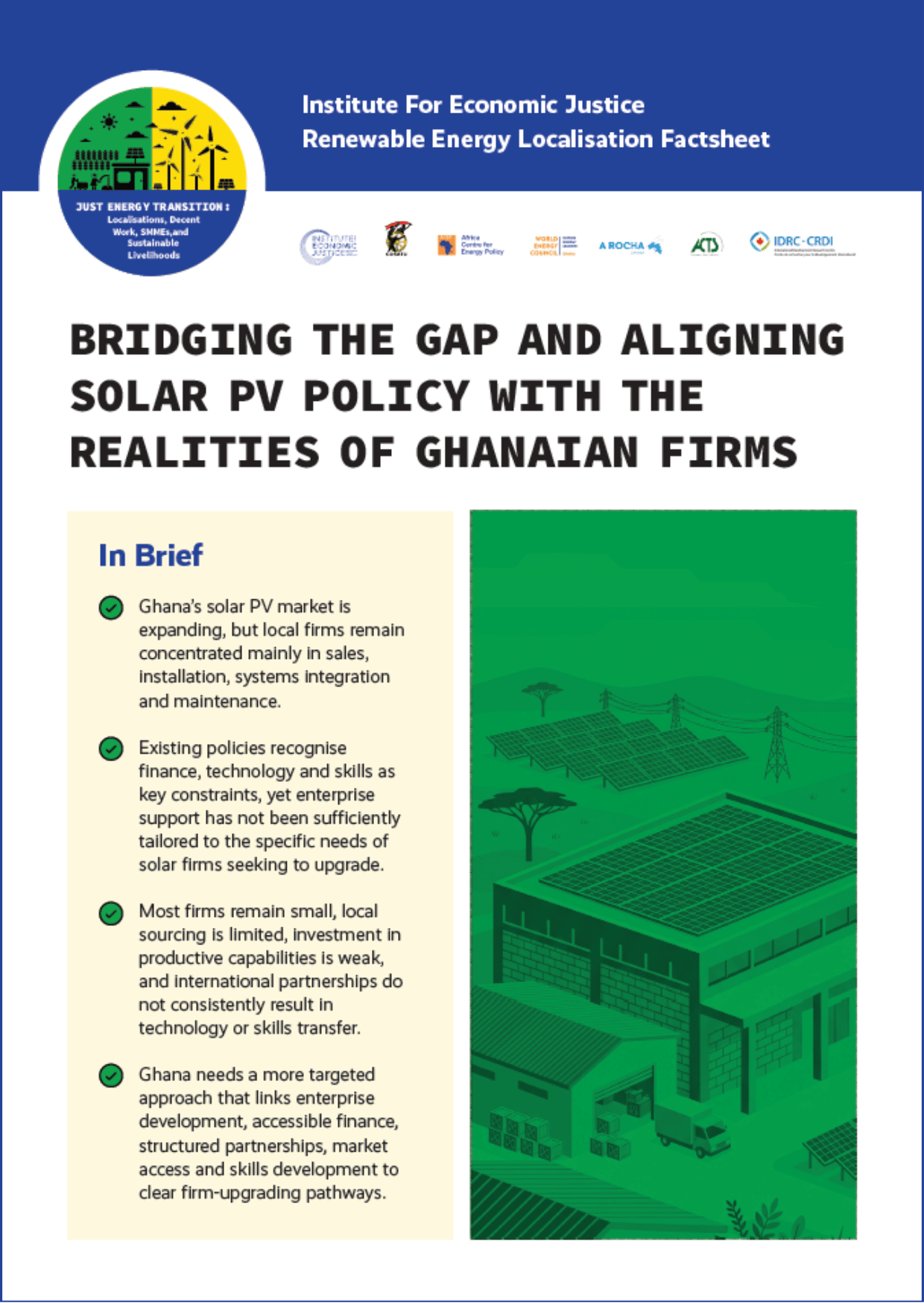
Aligning solar PV policy with the realities of Ghanaian firms requires targeted support that helps businesses invest, develop technical capabilities, and compete for larger contracts. Ghana’s expanding solar market creates opportunities for domestic enterprises, but existing support has not sufficiently addressed the specific barriers they face.
Based on research into Ghana’s solar photovoltaic sector and the accompanying policy brief, this factsheet explains why local participation has not yet translated into substantial industrial upgrading. It outlines practical measures to connect enterprise development, finance, partnerships, market access, and skills.
From market participation to productive capability
Ghanaian firms already contribute to system design, sales, installation, integration, and maintenance. However, a survey of 16 licensed solar PV firms shows that participation remains concentrated in these downstream activities.
Around 62.5% of surveyed firms operated mainly as solution providers or systems integrators, while only 12.5% undertook assembly or light manufacturing. Nearly half sourced less than 25% of their key inputs locally, and only 20% invested in production efficiency or quality systems.
These findings suggest that commercial capabilities are developing faster than productive and technological capabilities. More targeted assistance could help firms retain a greater share of the value generated by solar expansion.
Why existing support falls short
Solar firms need finance for equipment, certification, technology, quality systems, and working capital. High interest rates and demanding eligibility requirements can make suitable funding difficult to access.
General business-development programmes may also overlook specialised engineering, production, and investment-readiness needs. International partnerships are common, but do not consistently transfer technical or managerial capabilities.
Training follows a similar pattern. About 93% of surveyed firms provided training when required, while fewer than half operated formal programmes. Learning therefore often responds to immediate tasks rather than supporting sustained enterprise development.
Five priorities for stronger domestic firms
The factsheet recommends:
- Establish a Solar Enterprise Development Programme. Map licensed firms’ capabilities and provide tailored support for business management, engineering, certification, digital systems, technology acquisition, and production improvement.
- Make finance usable. Combine guarantees, concessional loans, equipment leasing, working-capital facilities, and results-based grants. Help firms strengthen financial records and funding proposals, with support tied to clear investment and capability milestones.
- Structure partnerships around learning. Match firms with credible technology providers and offer legal and commercial advice. Include measurable commitments covering technology transfer, skills, management systems, and supplier development.
- Connect capable firms to demand. Maintain a verified supplier directory, publish market opportunities, support tender readiness, and facilitate relationships with public and private buyers.
- Build skills with industry. Co-design modular training with firms, universities, and training institutions, covering installation, design, battery systems, quality assurance, maintenance, manufacturing fundamentals, and recycling.
Connecting these interventions can help Ghanaian enterprises move towards more predictable commercial relationships and sustained investment. Targeted enterprise upgrading would enable the growing solar market to support stronger domestic businesses, deeper technological capabilities, and greater local value creation.
About the project
This publication is an output of Advancing a Just Energy Transition: Localisation, Decent Work, and Sustainable Livelihoods, a multi-country research project examining the energy sectors of Ghana, Kenya, and South Africa in the context of global decarbonisation. The project investigates how localisation, decent work, gender equity, SMME participation, and sustainable livelihoods can be embedded in renewable energy production networks to strengthen local manufacturing and avoid reproducing unequal global economic patterns.