
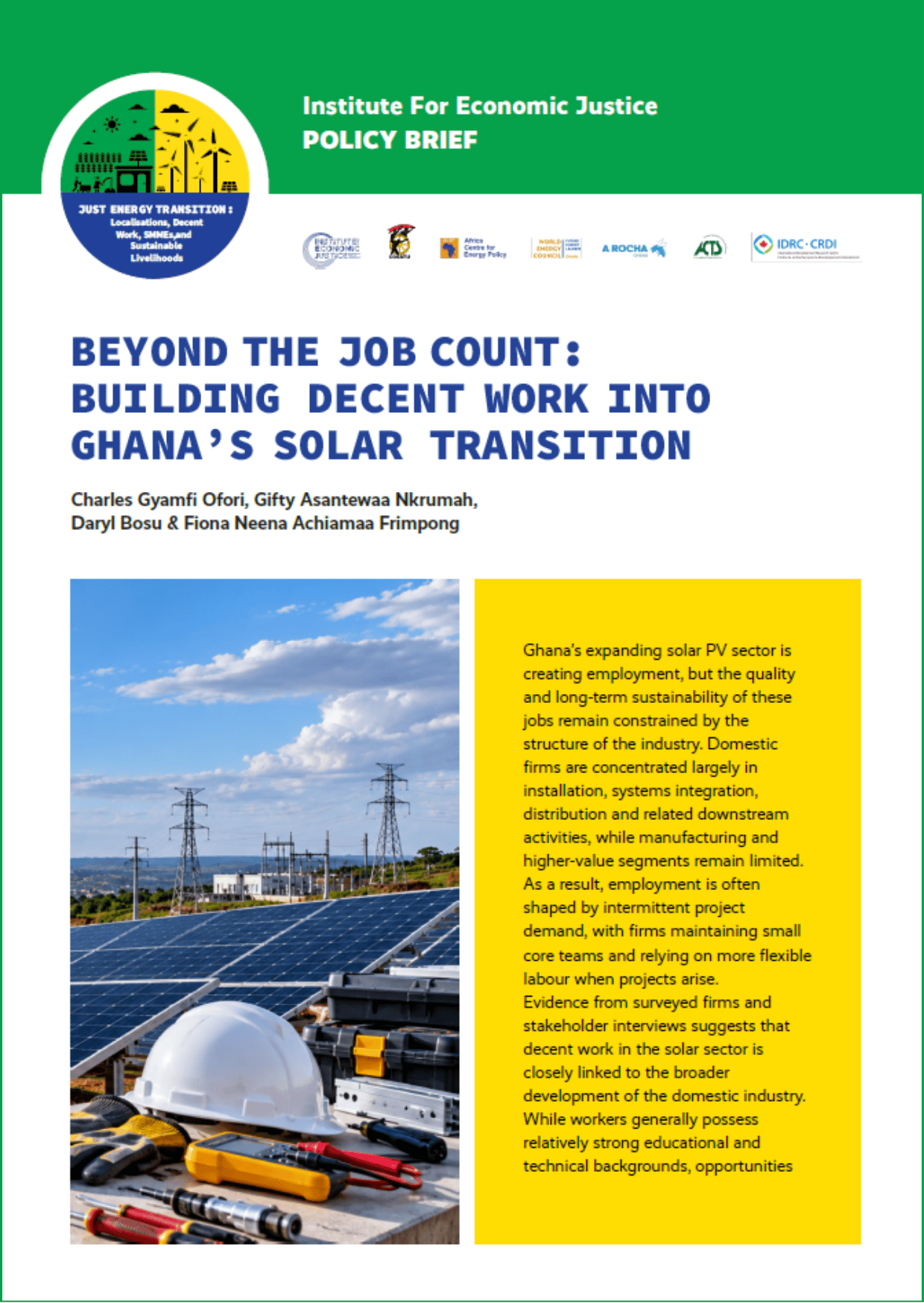
Building decent work into Ghana’s solar transition requires coordinated action on industrial development, employment conditions, skills, and inclusion. Solar expansion is creating jobs, but their developmental value depends on whether they provide security, protection, and opportunities for workers to build sustainable livelihoods.
This policy brief by Charles Gyamfi Ofori, Gifty Asantewaa Nkrumah, Daryl Bosu, and Fiona Neena Achiamaa Frimpong examines how industry structure shapes employment quality. Drawing on a survey of 16 licensed solar photovoltaic firms and stakeholder interviews, it argues that stronger domestic enterprises and effective labour governance must advance together.
How industry structure shapes employment
Ghanaian solar firms operate mainly in distribution, systems integration, installation, maintenance, and related services. Manufacturing and higher-value activities remain limited, while intermittent project demand influences how businesses organise their workforces.
The research identifies a two-tier employment structure. Firms commonly retain relatively stable teams for engineering, business development, and project management, while engaging additional installation and site-based workers as projects arise. This creates different levels of employment security within the same industry.
Workers generally have strong educational and technical backgrounds. However, training often responds to immediate project requirements, with limited formal provision or recognised pathways into more specialised roles. Firms’ concerns about losing trained employees can also discourage sustained investment in workforce development.
Labour protection and access to better jobs
Stakeholder interviews identified uneven safety practices, including instances of workers supplying their own protective equipment. These accounts indicate enforcement gaps in parts of the market. The brief also highlights weaknesses in professional certification, practical training, and worker representation.
Industrial constraints help explain these conditions, but workers still require safe workplaces, social protection, and effective channels for raising concerns.
Access to better employment is also unequal. About 88% of surveyed firms reported that women comprised less than half their workforce. Expanding women’s access to technical training, apprenticeships, engineering, supervision, and management is essential to improving both participation and career progression.
Four priorities for a coordinated response
The brief recommends:
- Create predictable solar demand. Coordinate and communicate deployment plans covering several years, helping firms retain workers, invest in training, and sustain technical teams between projects.
- Build competitive domestic suppliers. Identify products and services Ghanaian firms can realistically supply, including mounting structures, cables, packaging, and technical services. Combine finance, upgrading, testing, and certification with access to public and large-scale projects.
- Turn skills into recognised career pathways. Develop portable competencies across installation, maintenance, system design, storage, and related functions. Shared apprenticeships and industry training can spread costs and support progression across employers.
- Link public support to labour standards. Apply proportionate requirements covering safety, contracts, social protection, non-discrimination, and training, while helping smaller firms develop the capacity to comply.
Ghana already has policies addressing renewable energy, enterprise development, localisation, skills, and gender inclusion. The priority is to connect their implementation through a shared delivery agenda.
By linking deployment to domestic productive capabilities and worker protection, Ghana can create an industry capable of sustaining better employment and distributing the benefits of solar expansion more equitably.
About the project
This publication is an output of Advancing a Just Energy Transition: Localisation, Decent Work, and Sustainable Livelihoods, a multi-country research project examining the energy sectors of Ghana, Kenya, and South Africa in the context of global decarbonisation. The project investigates how localisation, decent work, gender equity, SMME participation, and sustainable livelihoods can be embedded in renewable energy production networks to strengthen local manufacturing and avoid reproducing unequal global economic patterns.