A defining moment for the right to social assistance
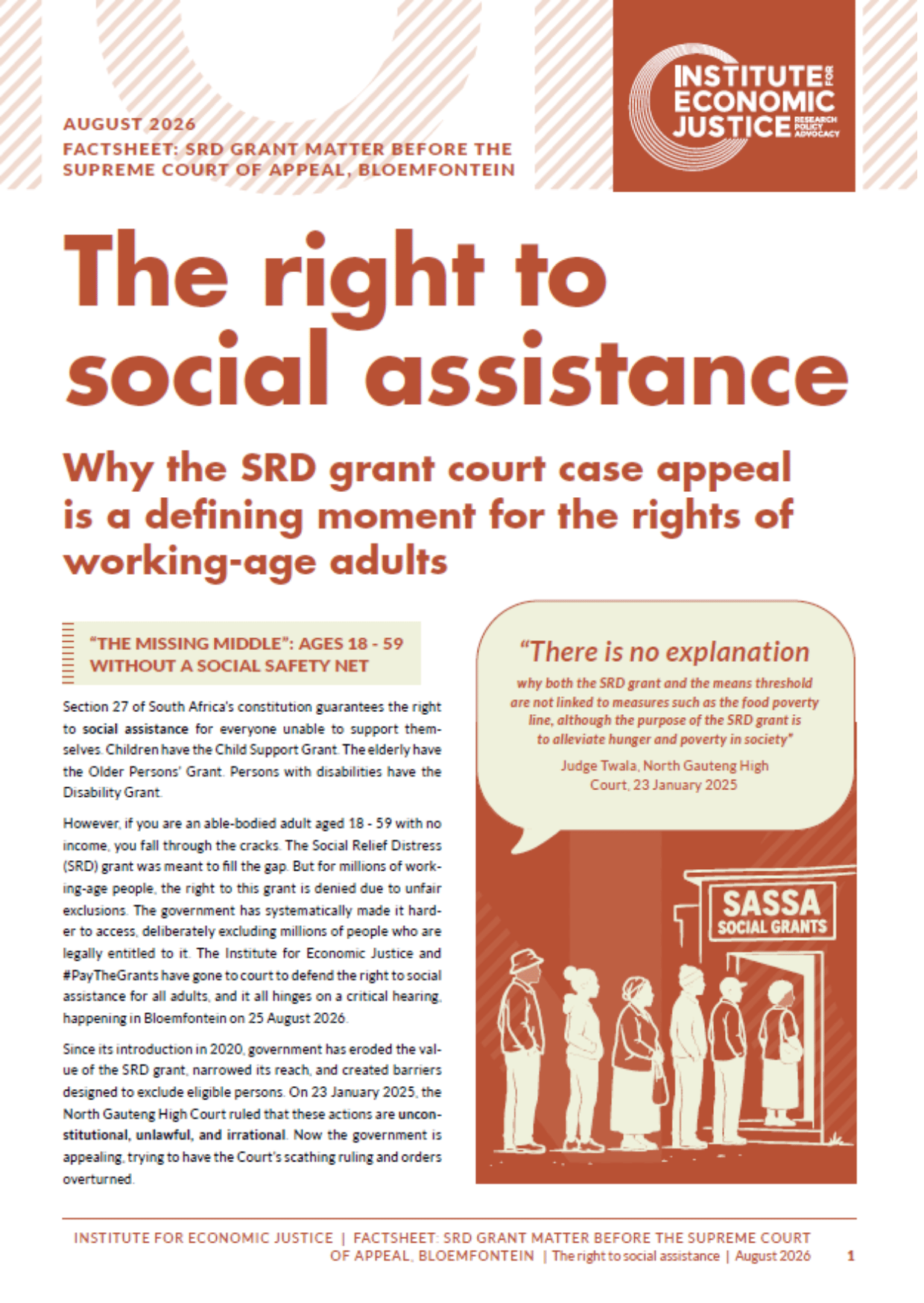
Section 27 of South Africa’s Constitution guarantees social assistance to everyone who is unable to support themselves. While children, older persons, and persons with disabilities can access permanent grants, working-age adults between 18 and 59 have historically been left without a social safety net.
The Social Relief of Distress (SRD) grant was introduced in 2020 to help address this gap. However, millions of eligible people have been excluded through restrictive regulations, administrative barriers, and an inadequate budget.
This factsheet explains why the government’s appeal against the January 2025 High Court judgment is a defining moment for the constitutional rights of working-age adults.
A system that excludes eligible people
The Institute for Economic Justice (IEJ) and #PayTheGrants challenged regulations that made the SRD grant unnecessarily difficult to access. These included online-only applications, flawed bank and database verification systems, a restrictive definition of income, and a narrow appeals process.
The applicants argued that the grant’s administration was shaped by an arbitrary budget cap, rather than the number of people who qualified for assistance.
On 23 January 2025, the North Gauteng High Court ruled that several aspects of the SRD grant’s administration were unconstitutional, unlawful, and irrational. The government subsequently appealed the judgment, with the matter before the Supreme Court of Appeal in Bloemfontein on 25 August 2026.
Why the appeal matters
The outcome could have far-reaching consequences for social protection in South Africa.
First, the case will help determine whether the constitutional right to social assistance has meaningful application to working-age adults. It challenges the idea that government can limit access to a constitutional right simply by imposing an insufficient budget.
Second, the judgment could support a rights-based transition from the temporary SRD grant to permanent Basic Income Support. This would require government to plan beyond annual extensions, progressively improve the grant, and ensure that everyone who qualifies can access it.
Finally, the case tests whether government’s administration of the grant is consistent with its public commitment to expand social protection.
The human cost of exclusion
Approximately 18.3 million working-age adults were living below the food poverty line in 2022, while only around seven million SRD grant payments are made each month.
The grant is currently R370 a month. Had its original value kept pace with inflation, it would be approximately R474. In real terms, its value has fallen to the equivalent of R273 in 2020 Rands. This is far below the food poverty line of R855 a month.
These figures have direct consequences for people’s ability to eat. Ninety-three per cent of recipients spend their grant on food.
What the High Court ordered
The Court ordered government to:
- Allow in-person applications at SASSA offices;
- Reform the definition of income;
- End unconstitutional bank verification and faulty database checks;
- Remove the arbitrary budget cap;
- Develop a plan to progressively increase the grant;
- Raise the means-test threshold and link it to inflation; and
- Investigate payment delays affecting approximately 1.2 million beneficiaries.
The outcome of the appeal will help determine whether these protections are upheld and whether South Africa moves closer to social assistance that is accessible, adequate, and grounded in constitutional rights.