
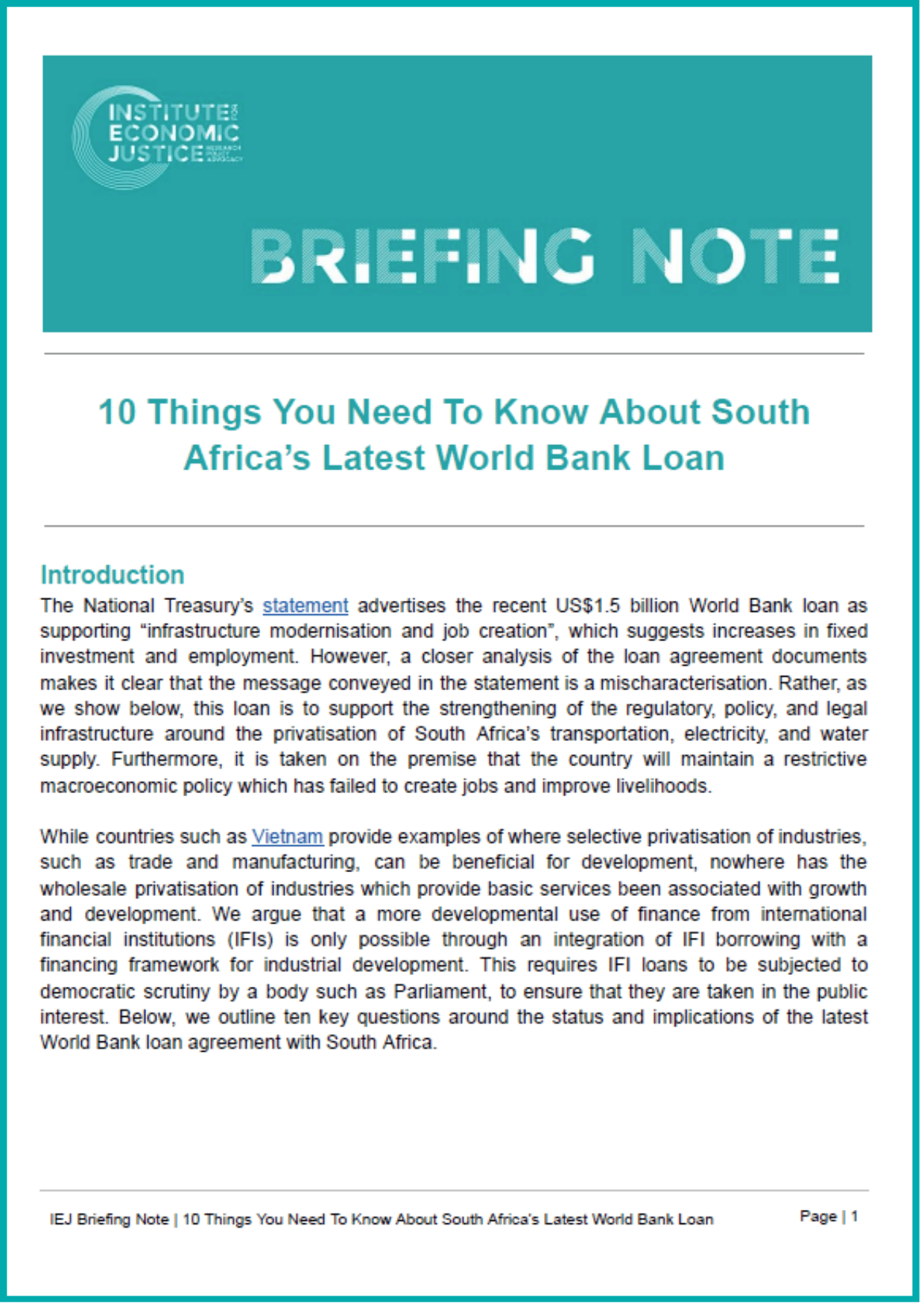
What lies behind South Africa’s latest World Bank loan?
In July 2026, the National Treasury announced that South Africa had secured a US$1.5 billion World Bank loan to support infrastructure modernisation and job creation. However, the loan documents reveal that the agreement is primarily intended to support regulatory, policy, and legislative reforms in electricity, transport, and water.
This briefing note examines ten important questions about the loan, including its financial terms, policy conditions, risks, and implications for South Africa’s development.
Ten things to know about the loan
- The national government is responsible for the loan. The National Treasury negotiated the agreement, will manage the funds, and will be responsible for distributing them to the relevant departments.
- The loan is worth approximately R24.7 billion. It has a 15-year term, a front-end fee of 0.25%, and a recurring commitment fee on any funds that remain unwithdrawn.
- The interest rate is variable. It is linked to the six-month Secured Overnight Financing Rate in the United States, plus 1.35%. South Africa’s repayment costs could therefore increase if United States interest rates rise.
- The loan creates currency risk. Because it is denominated in US dollars, its cost in rand will depend on movements in the exchange rate over the loan’s lifetime.
- The agreement is tied to policy reforms. These include increased private-sector participation in electricity generation and transmission, freight rail, and port management, as well as regulatory changes in the water sector.
- The loan reinforces restrictive macroeconomic policies. Access to the funding depends on the World Bank being satisfied with South Africa’s macroeconomic framework, which is underpinned by fiscal consolidation and a lower inflation target.
- Repayment will come mainly from tax revenue. The loan is not attached to a specific revenue-generating project. Repayments are expected to begin in September 2029 and continue until 2041.
- Previous World Bank lending has produced mixed results. A 2024 loan successfully mobilised private capital for renewable energy, but several objectives relating to poor households, women-led households and businesses, and carbon-tax collection were not achieved.
- Alternative sources of finance were available. These include adjusting the primary surplus, raising additional progressive revenue, reducing inefficient tax breaks, and making developmental use of available public savings.
- Parliament has limited oversight. Under the Public Finance Management Act, the Minister of Finance can negotiate and approve international financial institution loans without parliamentary approval.
A developmental approach to international finance
The IEJ argues that borrowing from international financial institutions should form part of a broader financing framework for reindustrialisation. Relatively affordable finance could support state-led infrastructure, productive investment, job creation, and the expansion of South Africa’s industrial capacity.
Achieving this requires greater transparency, democratic scrutiny, and parliamentary oversight. International borrowing should expand South Africa’s developmental options, rather than restrict the policy choices available to current and future governments.
Read the full briefing note to explore the terms, risks, alternatives, and policy implications of South Africa’s latest World Bank loan.