The SRD grant court case
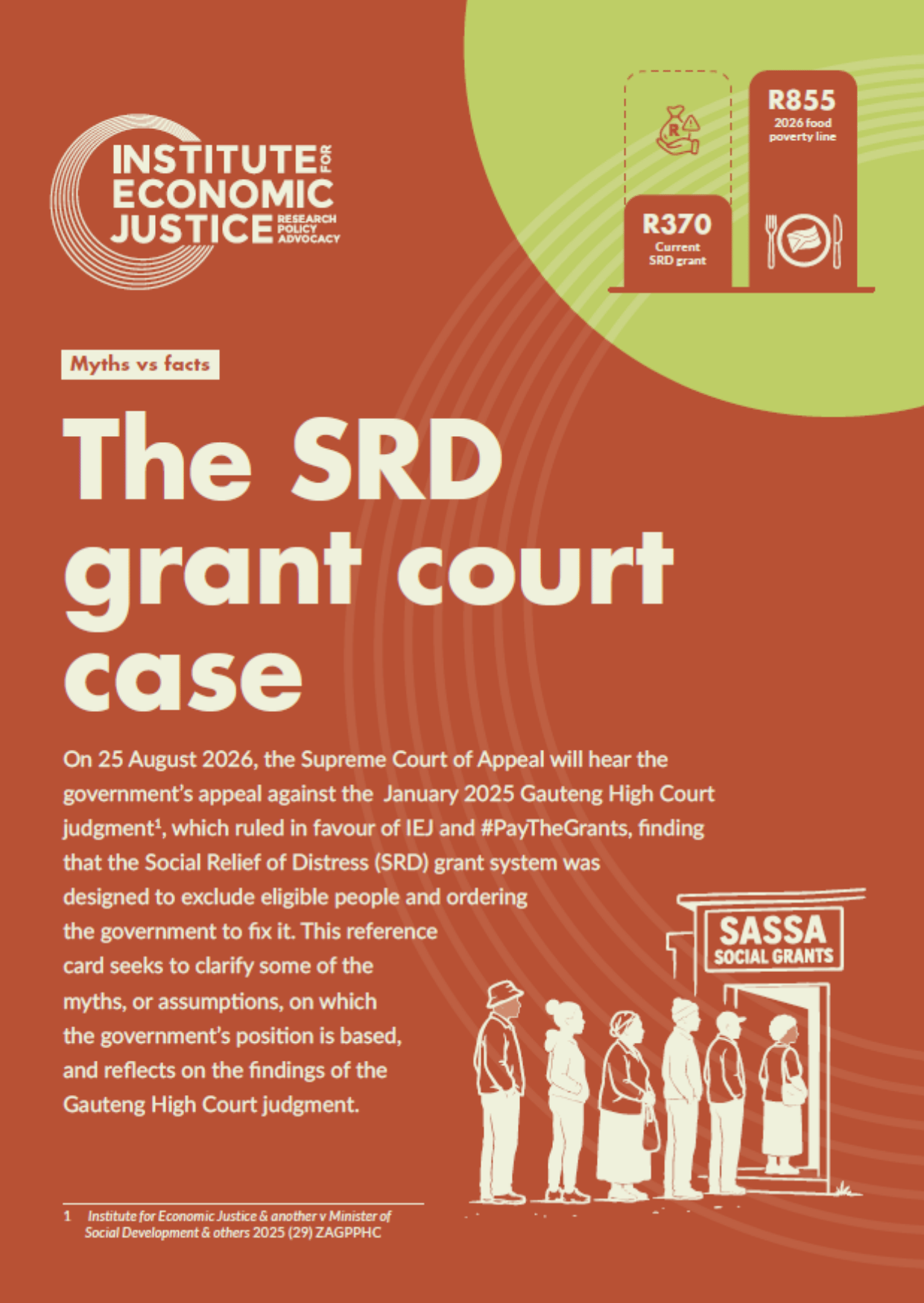
On 25 August 2026, the Supreme Court of Appeal heard the government’s appeal against the January 2025 Gauteng High Court judgment in favour of the Institute for Economic Justice (IEJ) and #PayTheGrants.
The High Court found that the Social Relief of Distress (SRD) grant system was designed and administered in ways that unlawfully excluded eligible people. It ordered the government to address several barriers preventing people from accessing the grant.
Produced ahead of the appeal hearing, this infographic examines ten assumptions underpinning the government’s approach to the SRD grant and contrasts them with the evidence and the High Court’s findings.
An exclusionary application and verification system
The infographic explains why an online-only application system cannot meet the needs of everyone who is entitled to social assistance. Although online applications may be convenient for some people, they exclude those without reliable internet access, smartphones, data, or adequate digital literacy.
It also examines the government’s reliance on databases belonging to institutions such as the South African Revenue Service, the Unemployment Insurance Fund, the National Student Financial Aid Scheme, and the Department of Home Affairs. These databases may contain outdated or inaccurate information that does not reflect an applicant’s present circumstances.
Bank verification creates another significant barrier. The system may classify all money entering a bank account as income, regardless of whether it is a loan, child maintenance, once-off assistance, or money held on behalf of somebody else.
A budget designed to exclude
The amount budgeted for the SRD grant does not cover all eligible people. The High Court found that restrictions were introduced to keep spending within a predetermined budget ceiling, rather than determining the budget according to the number of people who qualify.
The eligibility threshold has also remained frozen at R624, the 2021 food poverty line. As the cost of living has increased, this threshold has excluded people who remain unable to afford enough food.
An inadequate grant affected by payment failures
The infographic challenges the assumption that the SRD grant is sufficient to meet people’s basic needs. Its value remains far below the food poverty line and has not kept pace with rising living costs.
Even people approved for the grant do not necessarily receive it. Between 10% and 15% of approved beneficiaries reportedly experience non-payment each month. The High Court declared these delays unlawful and ordered SASSA to investigate and address the problem.
Defending the right to social assistance
The poverty and hunger that prompted the introduction of the SRD grant have not disappeared. Government has repeatedly committed to transforming the grant into a system of basic income support.
Rather than treating social assistance as an expense to be minimised, it should be understood as a constitutional right and an investment that supports household consumption, economic activity, and government revenue.