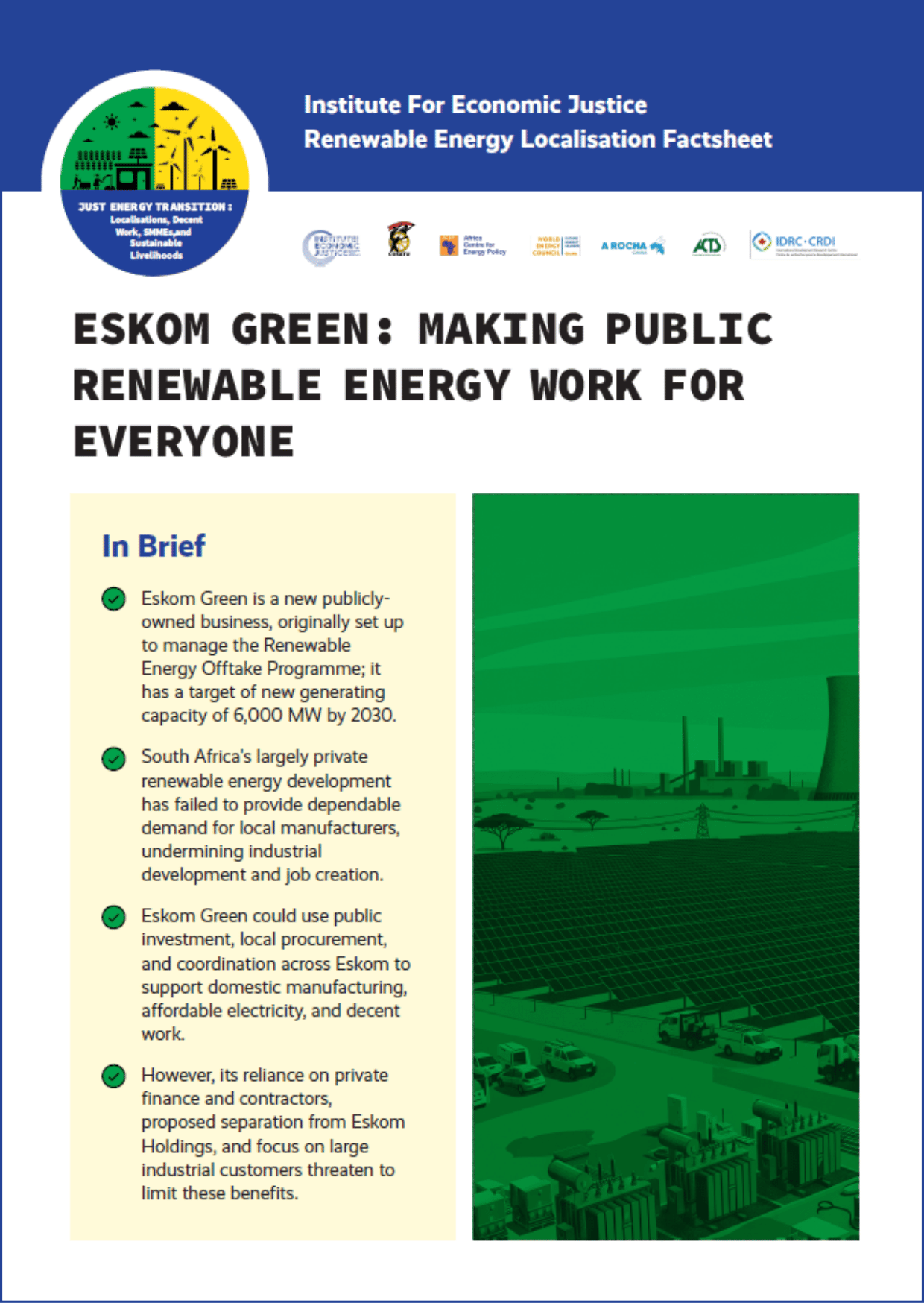
Eskom Green could use public renewable energy investment to strengthen domestic manufacturing, provide affordable electricity, and create decent jobs. Realising this potential requires a clear developmental mandate, adequate public finance, and procurement that delivers sustained orders for South African manufacturers.
This factsheet examines how Eskom’s renewable energy subsidiary could advance a just energy transition. It considers the opportunities offered by public ownership, alongside concerns about reliance on private finance and contractors, proposed institutional separation, and a focus on large industrial customers.
Connecting public generation to industrial development
Eskom Green has a target of 6,000 MW of new renewable energy generating capacity by 2030. Its role includes managing the Renewable Energy Offtake Programme for large customers, with its first project under construction being a 75 MW solar plant at Lethabo Power Station.
The factsheet argues that public generation can serve wider social and industrial objectives. However, these objectives need to be explicitly built into Eskom Green’s mandate, including affordable household electricity, domestic manufacturing, and decent employment.
South Africa already has firms capable of producing renewable energy equipment. Yet private development has not provided dependable demand for these manufacturers. Procurement delays, late orders, demanding specifications, and financing requirements make it difficult for local suppliers to sustain production and retain workers.
Local procurement figures also require scrutiny: spending classified as local does not necessarily show how much equipment was manufactured domestically or whether producers receive consistent orders.
Public finance and long-term public capacity
The factsheet raises concerns about financing through special purpose vehicles backed by long-term electricity purchase agreements. Such arrangements can leave the state or electricity buyers carrying substantial risks, while private lenders may favour established international suppliers.
It argues that direct public finance can offer lower costs, greater transparency, and more freedom to pursue industrial and social goals.
Coordination across Eskom is equally important. The proposed separation of Eskom Green from Eskom Holdings could weaken planning across generation, transmission, storage, maintenance, and the declining coal fleet.
Eskom Rotek provides an existing base of technical expertise. Bringing maintenance work into Rotek and developing its renewable energy capabilities could preserve skills, support stable employment, and reduce dependence on successive short-term contracts.
Six priorities for a developmental approach
The factsheet recommends:
- Prioritise public finance. Reduce dependence on private financing arrangements and special purpose vehicles.
- Expand the public mandate. Plan subsidised renewable electricity for energy-poor households and smaller, labour-intensive industries.
- Enforce meaningful localisation. Require locally manufactured components, publish procurement information, verify contractor compliance, and provide adequate lead times and predictable orders.
- Build public-sector skills and jobs. Insource maintenance to Eskom Rotek and strengthen long-term technical capacity and employment conditions.
- Protect coordination and delivery. Maintain planning across Eskom entities and closely monitor progress against generation targets.
- Address municipal financing. Explore alternatives to current municipal debt arrangements without transferring costs to poor communities.
These measures would position Eskom Green to connect renewable energy expansion with public benefit. Its contribution to a just transition will depend on how ownership, finance, procurement, and employment decisions translate into affordable electricity, stronger domestic industry, and decent work.
About the project
This publication is an output of Advancing a Just Energy Transition: Localisation, Decent Work, and Sustainable Livelihoods, a multi-country research project examining the energy sectors of Ghana, Kenya, and South Africa in the context of global decarbonisation. The project investigates how localisation, decent work, gender equity, SMME participation, and sustainable livelihoods can be embedded in renewable energy production networks to strengthen local manufacturing and avoid reproducing unequal global economic patterns.