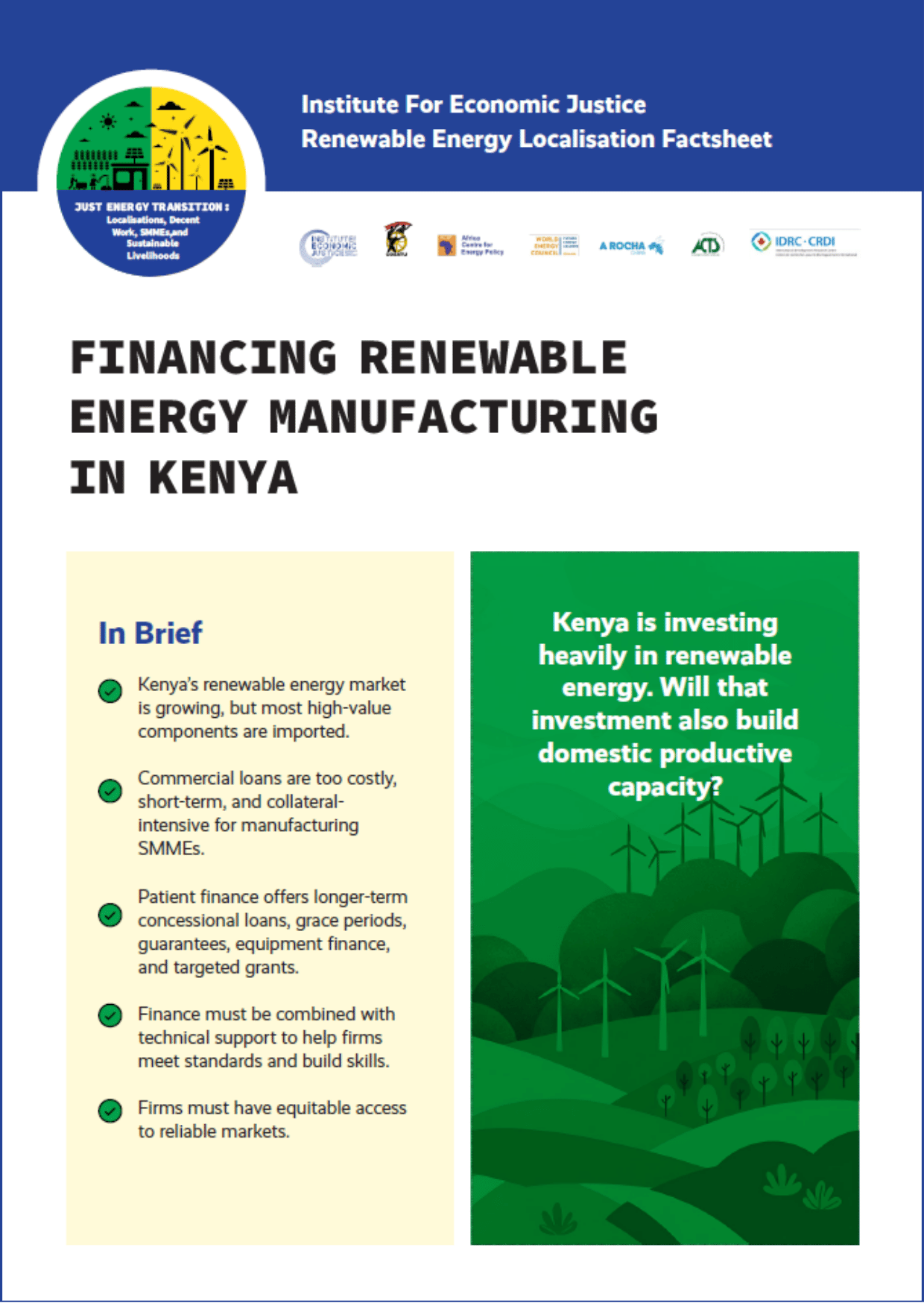
Renewable energy manufacturing in Kenya could enable the country to capture more of the industrial value generated by its growing clean energy market. Renewable sources supplied approximately 81% of Kenya’s grid electricity in 2025, while decentralised renewable energy supported 48,280 direct jobs in 2021.
However, most advanced renewable energy components are manufactured outside Kenya. Domestic firms remain concentrated in lower-value activities such as sales, installation, repair, maintenance, and basic assembly. As a result, growing renewable energy demand has not yet produced a strong local manufacturing base.
Conventional finance does not fit manufacturing
Kenyan manufacturers rely heavily on their own resources and commercial-bank debt. Manufacturing, however, requires substantial upfront investment in machinery, testing, certification, technology, and skills. It also involves long working-capital cycles before firms begin earning returns.
Commercial finance typically offers high interest rates, short repayment periods, demanding collateral requirements, and limited tolerance for risk. These conditions prevent capable SMMEs from investing and upgrading. Larger and foreign-owned firms are generally better positioned to secure both finance and major contracts.
Kenya has introduced measures intended to support localisation, but it does not yet have a coordinated pathway combining affordable long-term capital, equipment finance, working-capital facilities, guarantees, certification assistance, and reliable markets.
Patient finance can create an upgrading pathway
Patient finance provides longer repayment periods, grace periods, lower interest rates, guarantees, equipment finance, and targeted grants. This can give firms the time and resources needed to purchase machinery, develop products, meet technical standards, and strengthen their employees’ skills.
Initial support should prioritise components that Kenya can feasibly manufacture, including mounting structures, frames, enclosures, cables, and batteries. Public resources can reduce risks through credit guarantees, first-loss arrangements, diversification, and technical assistance.
Possible sources of patient capital include pension funds, development finance institutions, climate funds, banks, and other institutional investors.
Finance alone will not be sufficient. It must be combined with support for production, research, testing, certification, skills, procurement, and access to dependable markets. Firms outside Nairobi, particularly those in coastal areas, also need deliberate outreach because they reported greater exclusion from financial assistance.
A dedicated patient-finance facility
The factsheet recommends establishing a patient-finance and enterprise-upgrading facility for renewable energy SMMEs. The facility should combine concessional loans, guarantees, equipment finance, working-capital support, and targeted grants with certification, training, procurement, and technical assistance.
The National Treasury and relevant ministries should design the facility within 12 months and pilot it within 18 months. Financing should offer lower rates, longer repayment and grace periods, lighter collateral requirements, and simplified applications.
Industrial institutions should coordinate their support: the Kenya Industrial Research and Development Institute could assist production, the Kenya Bureau of Standards could support certification, and training institutions could develop relevant technical skills.
The facility should conduct regional outreach, help firms prepare proposals, and report on beneficiaries by business size, ownership, gender, and location.
Kenya can continue importing most renewable energy equipment and leave domestic firms in low-margin activities. Alternatively, patient finance and public procurement can help build local manufacturing, supply chains, skilled employment, and productive capabilities.
Explore how patient finance, enterprise support, technical assistance, and public procurement could help Kenya’s renewable energy SMMEs invest, upgrade, and enter manufacturing.
About the project
This publication is an output of Advancing a Just Energy Transition: Localisation, Decent Work, and Sustainable Livelihoods, a multi-country research project examining the energy sectors of Ghana, Kenya, and South Africa in the context of global decarbonisation. The project investigates how localisation, decent work, gender equity, SMME participation, and sustainable livelihoods can be embedded in renewable energy production networks to strengthen local manufacturing and avoid reproducing unequal global economic patterns.