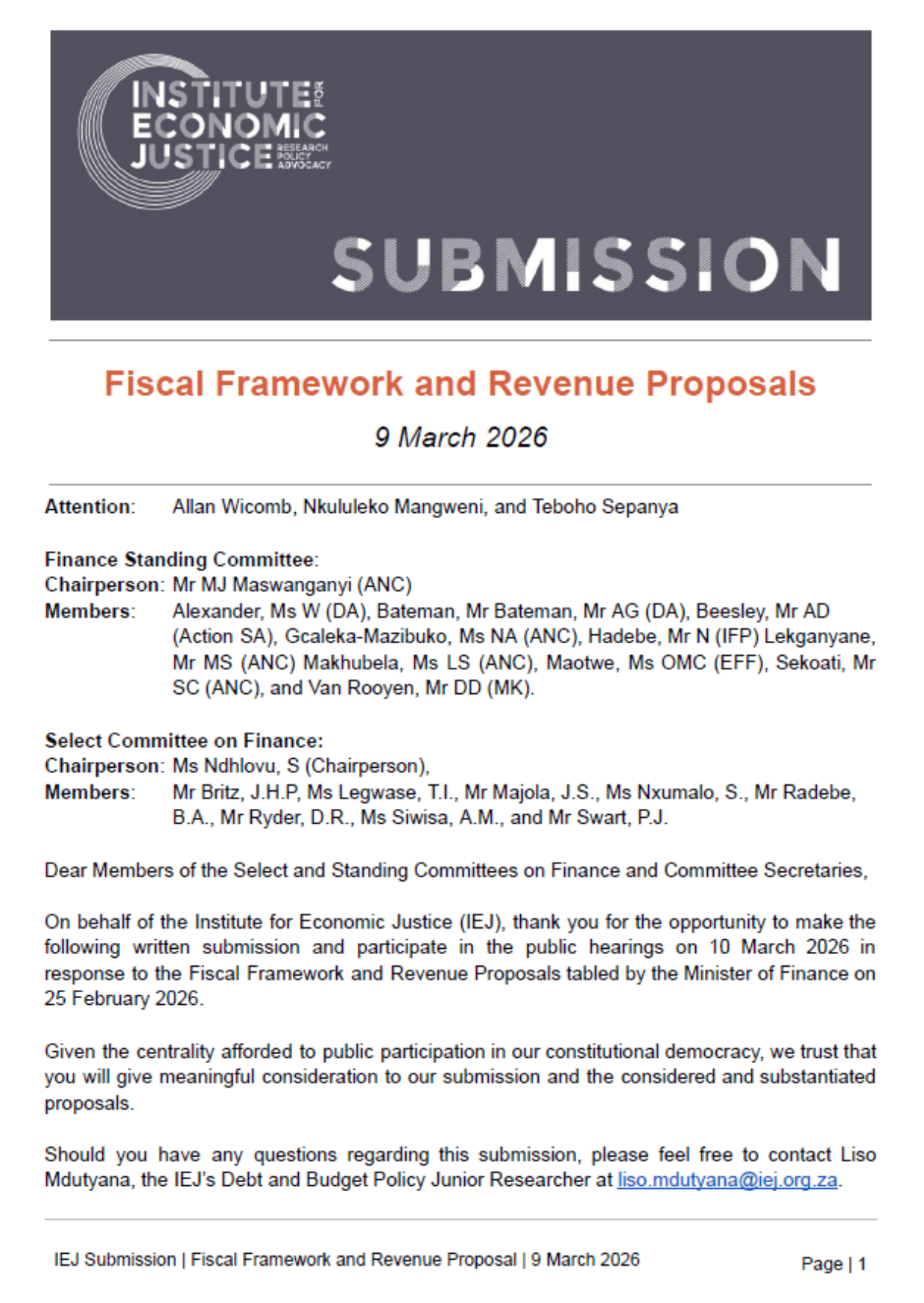
On 9 March 2026, the Institute for Economic Justice (IEJ) made a written submission to Parliament on the 2026 Fiscal Framework and Revenue Proposals, ahead of public hearings before the Standing and Select Committees on Finance held on 10 March 2026.
The submission argues that the 2026 Budget entrenches the status quo instead of breaking with a decade of austerity and using public finance as a lever for transformative growth, redistribution, and stronger public services.
IEJ’s Assessment of the 2026 Budget
The IEJ argues that the 2026 Budget fails to reverse previous expenditure cuts and continues a fiscal approach that underinvests in both infrastructure and essential social services. While the Minister of Finance highlights improvements in debt metrics and fiscal balances, the Budget does little to respond to the urgent realities of high unemployment, deep inequality, and widespread food insecurity.
Instead of using available fiscal space to expand public investment and social protection, the Budget maintains low growth assumptions, restrains spending, and directs tax relief towards higher-income earners.
Key Issues Raised in the Submission
The IEJ submission identifies several structural concerns in the fiscal framework:
-
Low investment levels, which remain far below the targets required to support sustained economic growth and industrial development.
-
Declining real public spending, which undermines education, healthcare, and social protection.
-
Inadequate revenue mobilisation, despite the availability of measures such as wealth taxation and better use of public financial assets.
-
A misdirected debt strategy, where spending cuts are prioritised over policies that would accelerate economic growth.
-
Weak implementation of gender-responsive budgeting, which fails to address the structural drivers of women’s economic marginalisation.
IEJ Policy Proposals
The submission outlines a set of policy proposals aimed at shifting South Africa’s fiscal framework toward a developmental macroeconomic approach. These include:
-
Increasing public investment to support growth, infrastructure development, and industrialisation.
-
Benchmarking social spending against inflation and population growth to protect essential services.
-
Strengthening revenue mobilisation, including the introduction of a net wealth tax and better deployment of public financial assets.
-
Improving coordination between fiscal and monetary policy to lower borrowing costs and expand productive investment.
-
Reforming the budget process, including reviewing fiscal anchors and strengthening Parliament’s oversight of spending decisions.
Parliamentary Hearing: 10 March 2026
In addition to submitting written comments, the IEJ presented its analysis during the public hearings on the Fiscal Framework and Revenue Proposals before the Standing and Select Committees on Finance.
The oral submission was delivered by Liso Mdutyana, IEJ Debt and Budget Policy Junior Researcher, who presented the organisation’s analysis and recommendations directly to Members of Parliament.
Access the IEJ Submission Materials
Written Submission
Read the IEJ’s full written submission to Parliament on the Fiscal Framework and Revenue Proposals.
Oral Presentation (10 March 2026)
Watch Liso Mdutyana present the IEJ’s analysis and recommendations to the Standing and Select Committees on Finance.