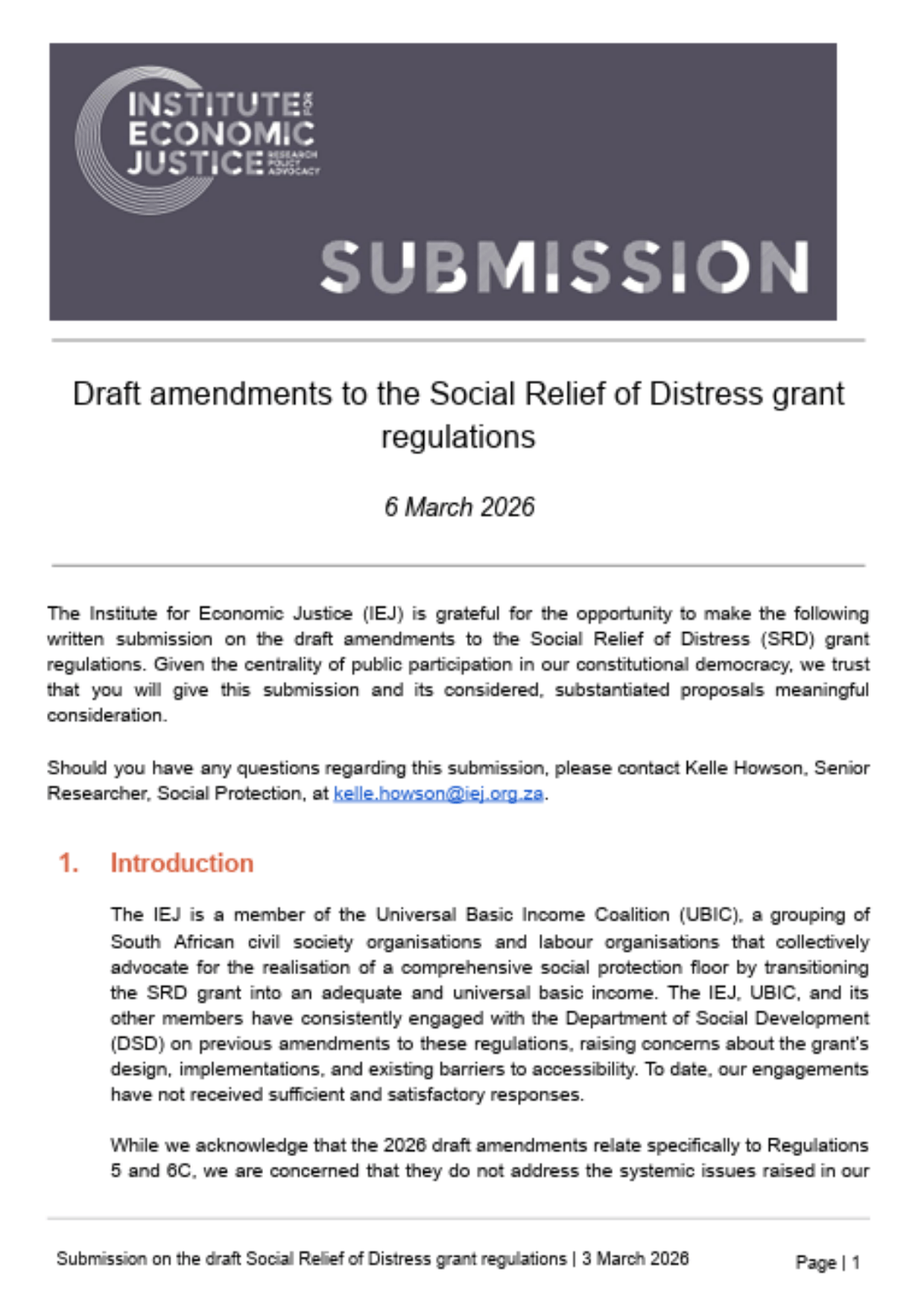
The Institute for Economic Justice (IEJ) has made a written submission to the Department of Social Development (DSD) on the draft amendments to the Social Relief of Distress (SRD) grant regulations.
In this submission, the IEJ sets out concerns and recommendations on the scope, design, and implementation of the proposed amendments, with a focus on addressing longstanding systemic exclusions, improving accessibility, and ensuring that the grant fulfils its constitutional purpose of providing adequate social assistance to those in need.
About the submission
The IEJ welcomes the opportunity to comment on the draft amendments to the SRD grant regulations. However, as the submission argues, the proposed changes are limited in scope and fail to address the systemic issues that have been consistently raised in previous engagements.
The submission emphasises that the SRD grant, in its current form, continues to exclude millions of eligible beneficiaries due to design and implementation flaws. These include restrictive application processes, inadequate grant value, and exclusionary eligibility criteria. As such, the amendments risk perpetuating rather than resolving existing challenges.
What the IEJ recommends
Addressing systemic exclusions
The IEJ argues that the amendments must go beyond narrow regulatory changes to address the structural barriers embedded in the SRD system. These include the reliance on online-only applications, limited language accessibility, and restrictive verification processes that exclude individuals without access to digital tools or stable connectivity.
Adequacy of the grant
The submission highlights that the current grant value remains far below the food poverty line, undermining its effectiveness in providing meaningful relief. It calls for an increase in the grant value and an adjustment of the means-test threshold to better reflect the realities of poverty in South Africa.
Fair and accessible eligibility processes
The IEJ raises concerns about the continued reliance on bank verification and outdated government databases, which are often inaccurate and exclusionary. It recommends a shift toward self-declaration mechanisms, supported by appropriate safeguards such as random audits, to improve access while maintaining accountability.
Certainty and continuity of support
While the IEJ welcomes the extension of the SRD grant to March 2027, the submission notes that short-term extensions create uncertainty for beneficiaries. It calls for a longer-term approach that aligns with the introduction of Basic Income Support (BIS), including a clear and binding implementation timeline to ensure continuity of income support.
Strengthening administrative systems
The submission emphasises the need for improvements to the appeals process, including allowing applicants to submit additional evidence. It also raises concerns about provisions that allow for the suspension or cancellation of grants based on flawed or incomplete information.
Sustainable and inclusive reform
The IEJ calls on government to work with National Treasury to secure sustainable financing for an expanded and more adequate grant. This includes ensuring that reforms support a transition toward a comprehensive social protection system, rather than maintaining a limited and exclusionary safety net.
Why this matters
The SRD grant plays a critical role in supporting millions of people facing economic hardship. However, its current design limits its ability to meet this objective. The IEJ’s submission argues that without meaningful reform, the grant will continue to fall short of its constitutional mandate.
A strengthened and more inclusive SRD system is essential not only for immediate relief, but also as a foundation for a more comprehensive and permanent social protection framework, including Basic Income Support.