
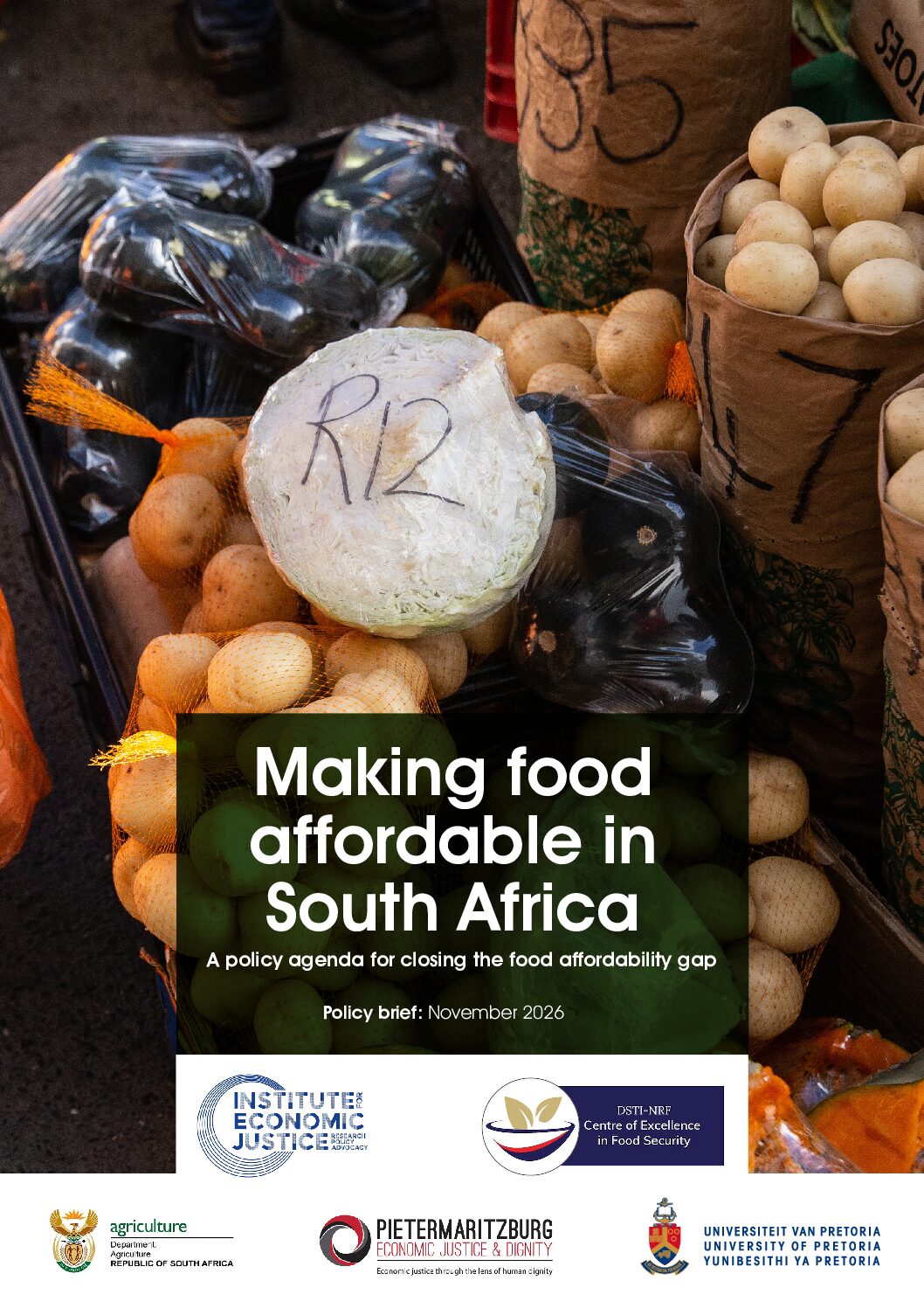
Food affordability in South Africa requires more than addressing rising food prices. Millions of households struggle to access nutritious food because of low incomes, concentrated food markets, rising essential service costs and weaknesses in the country’s food distribution systems. Addressing the crisis requires coordinated action to reduce food costs, strengthen local food economies and increase the income available to households to meet their basic needs.
This policy brief, Making food affordable in South Africa: A policy agenda for closing the food affordability gap, examines the structural factors driving food unaffordability and sets out a policy agenda to address them. Written by Marc Wegerif, Mervyn Abrahams, Andrew Bennie, Stephen Devereux, Yondela Mahlathi, Lebone Seleho, Oscar Sithole and Roger Tuckeldoe, the brief argues that food affordability must become a central priority across economic, social and food policy.
Drawing on evidence about food prices, market structures, household incomes and social protection, it proposes a coordinated approach that addresses both the supply and demand sides of the food system.
Understanding the food affordability gap
South Africa produces enough food, yet millions of people cannot afford a sufficient, nutritious and healthy diet. Almost two-thirds (64%) of households experience some form of food insecurity, while 29% of children under five experience stunted growth.
The brief argues that this crisis cannot be understood through food price inflation alone. Food affordability depends on the relationship between household incomes, food prices and the cost of other essential expenses, including electricity, transport, housing and healthcare.
Between 2020 and 2026, the cost of 44 basic food items increased by 45%. Although the National Minimum Wage increased by 45.6% over the same period, electricity and transport costs for an average household rose by 66.9%. These increases have eroded household purchasing power and widened the food affordability gap.
Closing this gap requires action on both sides: increasing household incomes and reducing food prices and the costs of essential services.
Lowering food costs and strengthening local food economies
The brief identifies several structural weaknesses that contribute to high food prices and limit access to affordable food. These include concentrated food markets, limited transparency in price formation, inadequate public market infrastructure and regulatory barriers facing informal food traders.
It argues for a more competitive and transparent food system, with stronger oversight of pricing and profit margins across food value chains. Supporting local and public markets, protecting informal traders and investing in infrastructure for production, processing, storage and distribution are also essential.
The proposed interventions include:
-
Strengthening competition and price transparency across food value chains, including regular monitoring of market margins.
-
Protecting and enabling informal food economies through accessible licensing, secure trading spaces and improved public infrastructure.
-
Investing in municipal and local food markets, particularly in underserved communities, while supporting local producers and small businesses.
-
Using price caps and margin regulation to protect consumers from excessive food prices, particularly during periods of crisis.
-
Establishing publicly managed buffer stocks for key food commodities, such as white maize and wheat, to reduce price volatility.
-
Making food affordability a central consideration in tariff and trade decisions, including the potential use of export tariffs on key food products.
Closing the affordability gap through income support
Reducing food prices alone will not resolve food insecurity if households lack sufficient income to purchase nutritious food. The brief therefore emphasises the importance of strengthening social assistance, improving wages and reducing the costs of essential services.
It highlights that social grants have lost purchasing power relative to the cost of food. In August 2026, the Child Support Grant stood at R580, compared with an estimated R962 needed to provide a child with nutritious food.
The brief recommends raising low-value social grants, including the Child Support Grant and Social Relief of Distress Grant, to at least the Food Poverty Line, with progressive increases towards the cost of a nutritionally adequate and healthy diet. It also calls for a Nutrition Poverty Line that better reflects the cost of a healthy diet.
Other priorities include aligning the National Minimum Wage with the cost of basic household needs, strengthening enforcement of wage protections, expanding affordable public transport and improving access to affordable electricity and other essential energy services.
Ten policy priorities for action
The brief sets out ten interconnected policy priorities to address food unaffordability:
-
Make food markets more competitive and transparent.
-
Protect and enable informal food economies.
-
Invest in and plan for more public and local markets.
-
Introduce price caps and margin regulation to protect food affordability.
-
Establish buffer stocks to smooth food price volatility.
-
Prioritise food affordability in tariff and trade decisions.
-
Strengthen social assistance and grants.
-
Align minimum wages with the cost of basic needs.
-
Make essential services, including electricity, energy and transport, affordable.
-
Implement immediate measures to address the food affordability crisis.
The tenth priority calls for an operational and inclusive National Food and Nutrition Security Council, a national Food Affordability Index, a review of food tariffs and trade measures, investment in local food infrastructure and a coordinated food crisis response protocol.
A coordinated response to food insecurity
The brief argues that these interventions must be implemented as a coordinated policy agenda rather than as isolated measures. This requires stronger collaboration across government departments, municipalities, regulatory institutions and civil society.
Improving food affordability is central to addressing South Africa’s food insecurity and malnutrition crisis. A sustainable response must tackle the structural drivers of high food prices while strengthening household purchasing power and protecting access to nutritious food.
Ultimately, closing the food affordability gap requires action on both sides of the equation: higher incomes and lower food prices.