
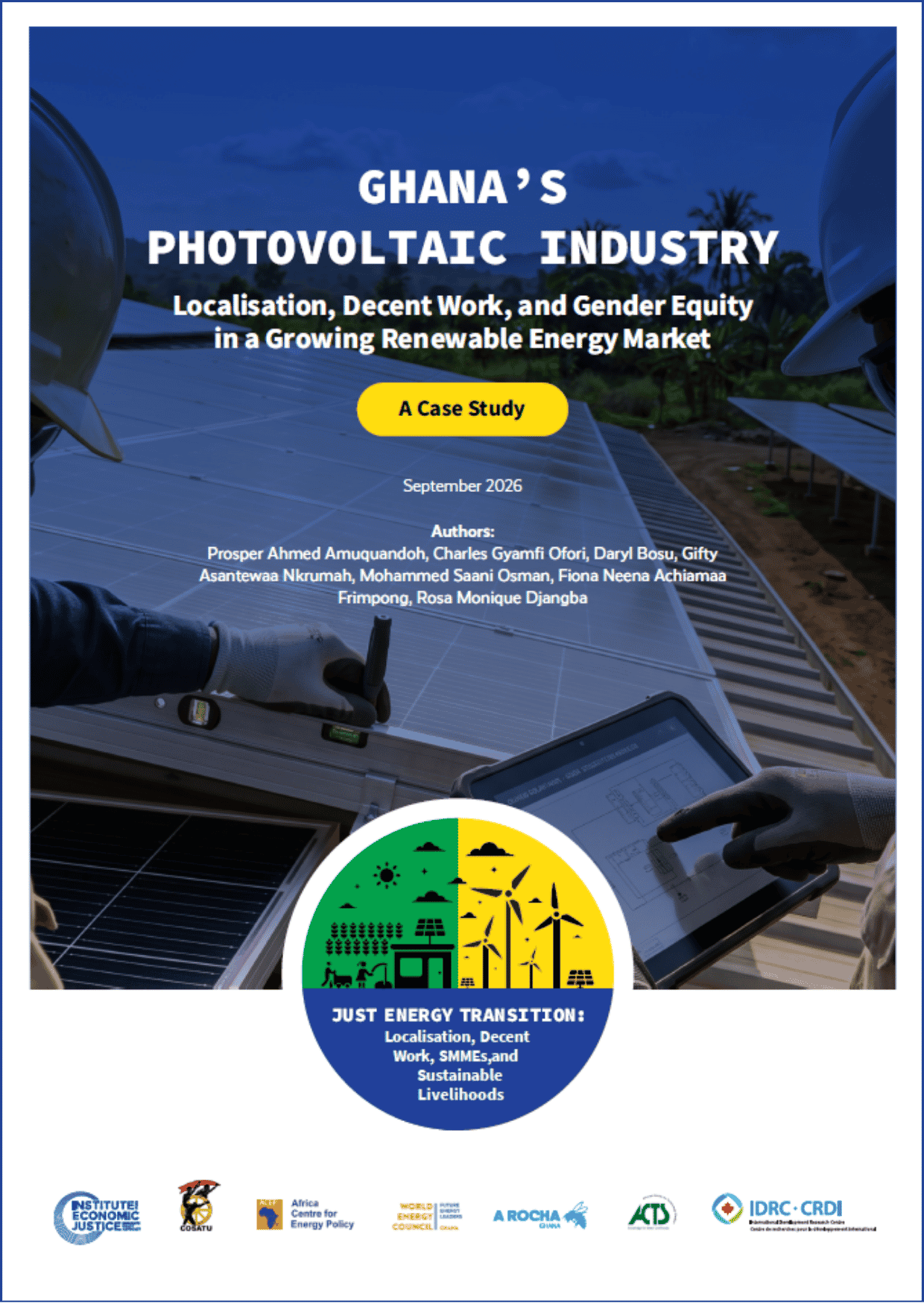
Ghana’s photovoltaic industry offers an opportunity to connect renewable energy expansion with domestic manufacturing, decent employment, and gender equity. However, growing solar deployment has largely reinforced Ghana’s position as an importer, installer, and consumer of technologies produced elsewhere. Turning this growth into inclusive industrial development requires deliberate, coordinated policy choices.
This detailed case study examines who creates, captures, and benefits from value across Ghana’s solar photovoltaic production network. It draws on a survey of 16 licensed solar companies, 19 stakeholder interviews, and analysis of policy documents and published research.
The authors are Prosper Ahmed Amuquandoh, Charles Gyamfi Ofori, Daryl Bosu, Gifty Asantewaa Nkrumah, Mohammed Saani Osman, Fiona Neena Achiamaa Frimpong, and Rosa Monique Djangba.
Building domestic productive capabilities
Ghanaian firms participate mainly in distribution, installation, systems integration, and maintenance. Manufacturing remains limited, while imported components and technology account for much of the value associated with solar expansion.
The study identifies costly, short-term finance, inconsistent policy implementation, skills gaps, and limited technology transfer as barriers to industrial upgrading. It also identifies practical opportunities in module assembly, mounting structures, cables, packaging, long-term maintenance, and solar equipment recycling.
Realising these opportunities requires support matched to firms’ capabilities, investment needs, and prospects for competing in domestic and regional markets.
Connecting localisation to decent work
Employment patterns reflect the sector’s project-based structure. Firms commonly retain small permanent teams while engaging installation workers as contracts arise. Workers face intermittent income, uneven safety practices, limited social protection, and weak representation.
The study emphasises that manufacturing and long-term service activities can create conditions for more continuous employment. Achieving decent work also requires effective labour protection, recognised skills pathways, and worker participation.
Addressing structural barriers to gender equity
Women remain underrepresented in technical, managerial, and field-based roles. Fourteen of the 16 surveyed firms reported that women comprised less than half their workforce, and only two had formal gender policies.
Barriers extend beyond recruitment and training. Male-dominated professional networks, occupational stereotypes, and women’s disproportionate unpaid care responsibilities constrain access to employment and advancement. Gender equity therefore needs to be embedded in industrial policy, procurement, financing, and workplace practices.
Priorities for an inclusive solar industry
The case study recommends coordinated action across five areas:
- Shape demand. Use government procurement to create predictable markets for domestic suppliers, linking eligibility to local sourcing, labour standards, and gender equity.
- Strengthen trade and technology partnerships. Develop regional export opportunities and negotiate measurable technology-transfer commitments in major solar contracts.
- Support enterprise upgrading. Provide manufacturing finance, credit guarantees, and working capital, alongside training in production management, quality assurance, and recycling.
- Advance decent work and inclusion. Strengthen worker protection and introduce measurable gender targets, supported by systematic collection of gender-disaggregated data.
- Improve implementation and accountability. Coordinate localisation, enterprise development, and gender inclusion across government, with time-bound targets and publicly tracked progress.
Together, these measures can help Ghana retain more value from solar expansion while building domestic capabilities, improving employment conditions, and widening access to the benefits of its energy transition.
About the project
This publication is an output of Advancing a Just Energy Transition: Localisation, Decent Work, and Sustainable Livelihoods, a multi-country research project examining the energy sectors of Ghana, Kenya, and South Africa in the context of global decarbonisation. The project investigates how localisation, decent work, gender equity, SMME participation, and sustainable livelihoods can be embedded in renewable energy production networks to strengthen local manufacturing and avoid reproducing unequal global economic patterns.