
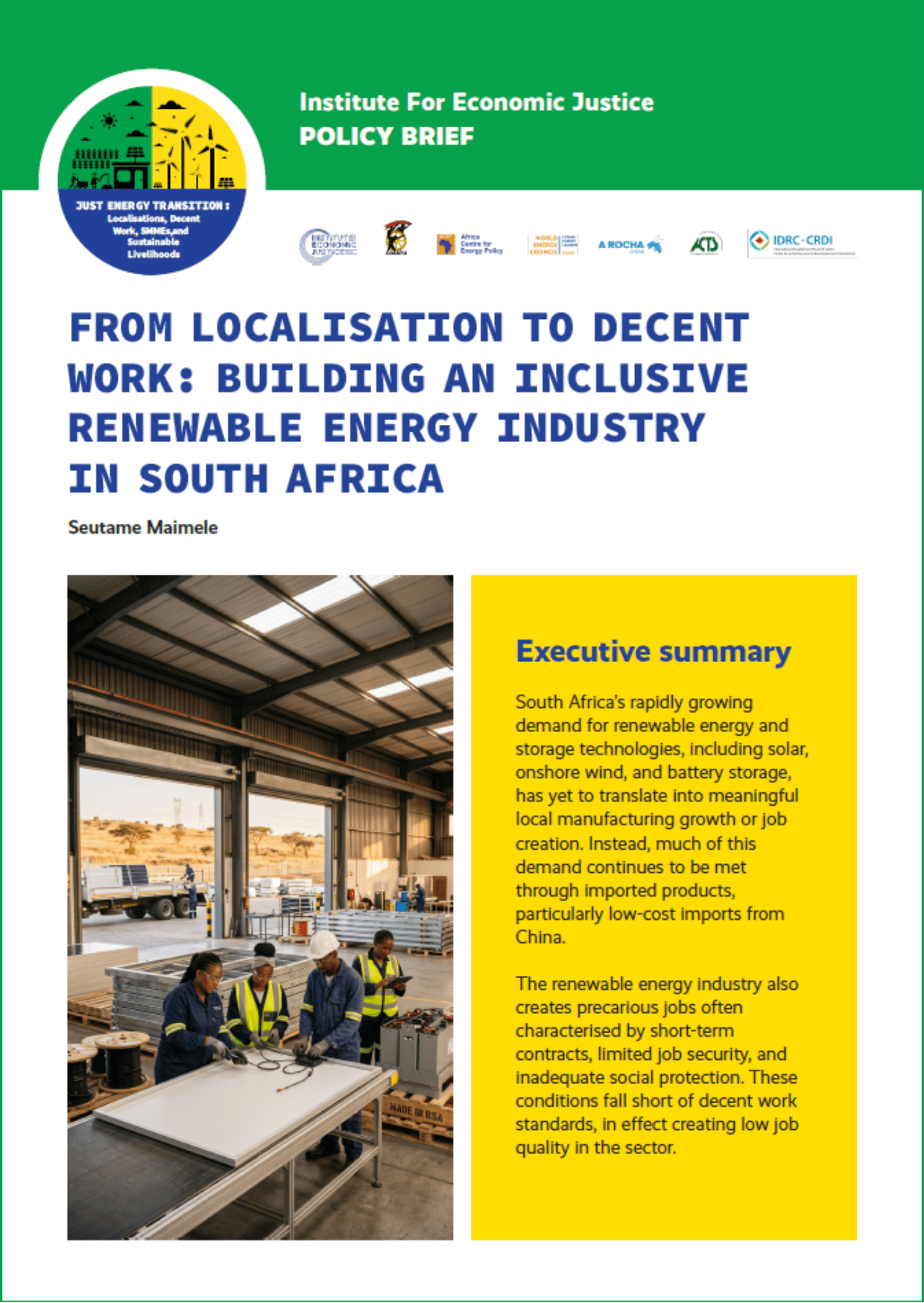
Building an inclusive renewable energy industry in South Africa requires sustained demand for locally manufactured products, stronger industrial capabilities, and deliberate action to improve employment conditions and gender equity. Growing investment in solar, wind, and battery storage presents an opportunity to address unemployment, poverty, and inequality through the energy transition.
This policy brief by Seutame Maimele examines how localisation can support decent work across renewable energy production networks. Drawing on four years of research by the Institute for Economic Justice and partners, including a survey of nine manufacturers and interviews with 60 workers, it connects industrial development with employment quality and inclusion.
Turning renewable energy demand into local production
South Africa’s demand for renewable energy and storage technologies has largely been met through imported products. Imports reached R70 billion in 2023, while domestic manufacturers continued to rely heavily on internationally sourced components.
The brief identifies several barriers to local manufacturing: unpredictable public procurement, production costs, established relationships between global developers and overseas suppliers, skills gaps, and weak policy coordination. These constraints make it difficult for local firms to plan, invest, and sustain employment.
A more predictable pipeline of demand, supported by coordinated industrial policy, could help domestic producers build capacity and supply both South African and regional markets.
Making job quality and inclusion central
The research documents precarious employment in parts of the sector, including contracts lasting three months or less, limited social protection, safety risks, and weak worker representation. Some workers reported missing employment records and benefits, alongside demanding working conditions.
The brief argues that decent work must encompass adequate wages, social protection, workers’ rights, and social dialogue.
Women also face barriers to technical employment, leadership, and career progression. Gender stereotypes influence how work is allocated, restricting access to higher-skilled and better-paid roles. Inclusion must therefore be embedded in industrial development, procurement, and training from the outset.
Six priorities for an inclusive industry
The brief recommends:
- Coordinate government policy. Use the South African Renewable Energy Masterplan (SAREM) to align energy and industrial policy, improve implementation, and provide greater certainty for investors.
- Build sustained demand and support localisation. Combine reliable procurement with manufacturing incentives, targeted trade measures, and stronger verification of local-content requirements.
- Make industrial support conditional on decent work. Link incentives and localisation measures to meaningful commitments to create and sustain quality employment.
- Implement a gender action plan. Set measurable targets for women’s employment and leadership, incorporate gender targets into public and private procurement, and challenge workplace stereotypes.
- Expand inclusive technical training. Direct funding towards local technical and vocational programmes aligned with industry demand, with ring-fenced gender quotas and training in regions receiving renewable energy investment.
- Develop a sector-wide decent work charter. Bring government, organised labour, and industry together to establish common employment standards, worker protections, social dialogue, and transparent reporting.
Together, these measures would connect renewable energy expansion to lasting productive capabilities, stronger local firms, and more secure and equitable employment. The brief positions inclusive localisation and sustained demand as mutually reinforcing foundations for South Africa’s just energy transition.
About the project
This publication is an output of Advancing a Just Energy Transition: Localisation, Decent Work, and Sustainable Livelihoods, a multi-country research project examining the energy sectors of Ghana, Kenya, and South Africa in the context of global decarbonisation. The project investigates how localisation, decent work, gender equity, SMME participation, and sustainable livelihoods can be embedded in renewable energy production networks to strengthen local manufacturing and avoid reproducing unequal global economic patterns.