
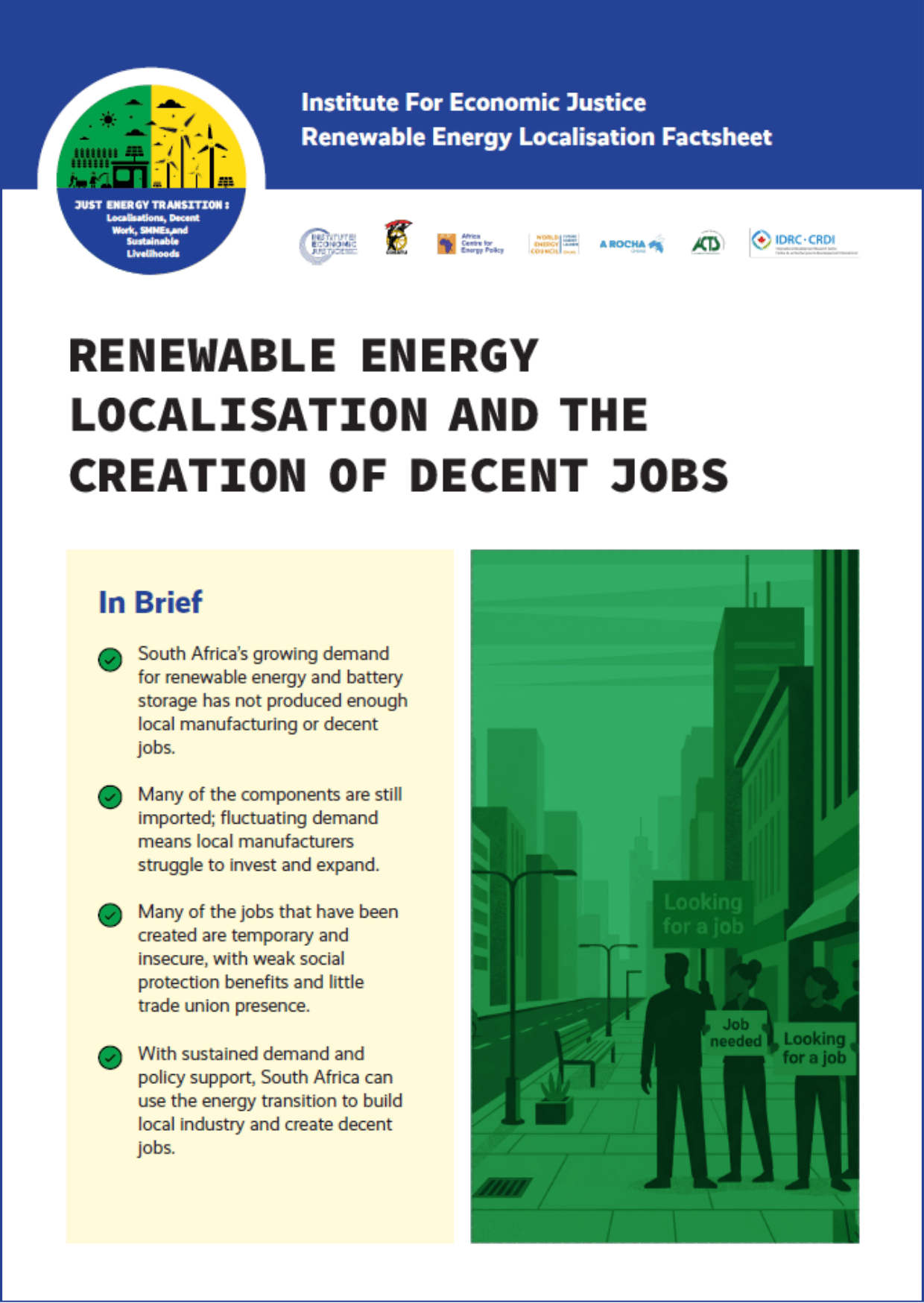
Renewable energy localisation could enable South Africa’s transition to cleaner energy to support domestic manufacturing, industrial development, and decent employment. However, growing demand for renewable energy and battery storage has not yet translated into sufficient local production or secure jobs.
South Africa imported approximately R70 billion in renewable energy and storage products in 2023. Although demand slowed during 2024 and 2025, it is expected to remain substantial. In the Western Cape alone, demand for solar, wind, and battery-storage products could reach R37.4 billion by 2030.
This demand has not produced equivalent growth in domestic manufacturing. Research by the Institute for Economic Justice, including a survey of nine manufacturers and interviews with industry experts and 60 workers, found that some firms sourced less than a quarter of their inputs locally, while others depended mainly on large or foreign suppliers.
Why is local manufacturing struggling?
Public procurement has been inconsistent, making it difficult for manufacturers to plan, invest, expand production, and retain workers. Locally manufactured products also face strong competition from cheaper imports, particularly from China.
The apparent price advantage of imported products can be reinforced by tariff misclassification and the manipulation of price, delivery-time, and technical requirements to justify exemptions from local-content rules. Project developers may also prefer established international suppliers and supply chains.
Weak coordination between energy, industrial, trade, and procurement policy further constrains domestic firms. Although the South African Renewable Energy Masterplan provides an important framework for green industrialisation, delays have slowed its implementation.
These conditions create an anti-localisation cycle: uncertain demand discourages investment, weak investment limits domestic production, limited production increases reliance on imports, and greater reliance on imports results in fewer local jobs.
Many renewable energy jobs are not decent jobs
Workers interviewed by the IEJ reported short-term contracts, long working hours, inadequate employment benefits, and workplace safety risks. Some did not receive contracts or payslips, while trade union presence was extremely limited.
A decent job should provide sufficient wages, social protection, reasonable working hours, a safe workplace, and the right to organise and bargain collectively. Many jobs in construction and installation do not yet meet these standards because they are temporary, insecure, and linked to individual projects.
Women also remain underrepresented. Women made up only around 10% of downstream renewable energy employment in 2021. Across the wind and solar industries, women constitute approximately 33% of workers but only 19% of corporate directors. Women are often concentrated in lower-paid assembly work and excluded from technical, engineering, and leadership positions.
Building a local industry that creates decent work
Government must create sustained demand, coordinate policy implementation, and move the Renewable Energy Masterplan from commitment to implementation. Firms receiving public support should be required to create and maintain decent jobs, while exemptions from local-content requirements should be transparent and properly verified.
Government, organised labour, and business should negotiate a renewable energy Decent Work Charter through NEDLAC. A Gender Action Plan should establish measurable employment and leadership targets, while skills programmes should be linked to actual employment opportunities and include ring-fenced opportunities for women.
South Africa can continue meeting demand mainly through imports, leaving much of the manufacturing value and employment abroad. Alternatively, it can use sustained demand, active industrial policy, and effective localisation to build domestic productive capacity and create secure jobs with decent pay, social protection, safe working conditions, and strong labour rights.
Explore how South Africa can use renewable energy localisation, sustained demand, industrial policy, and enforceable labour standards to build domestic manufacturing and create decent jobs.
About the project
This publication is an output of Advancing a Just Energy Transition: Localisation, Decent Work, and Sustainable Livelihoods, a multi-country research project examining the energy sectors of Ghana, Kenya, and South Africa in the context of global decarbonisation. The project investigates how localisation, decent work, gender equity, SMME participation, and sustainable livelihoods can be embedded in renewable energy production networks to strengthen local manufacturing and avoid reproducing unequal global economic patterns.