Why IFI conditionalities and human rights matter
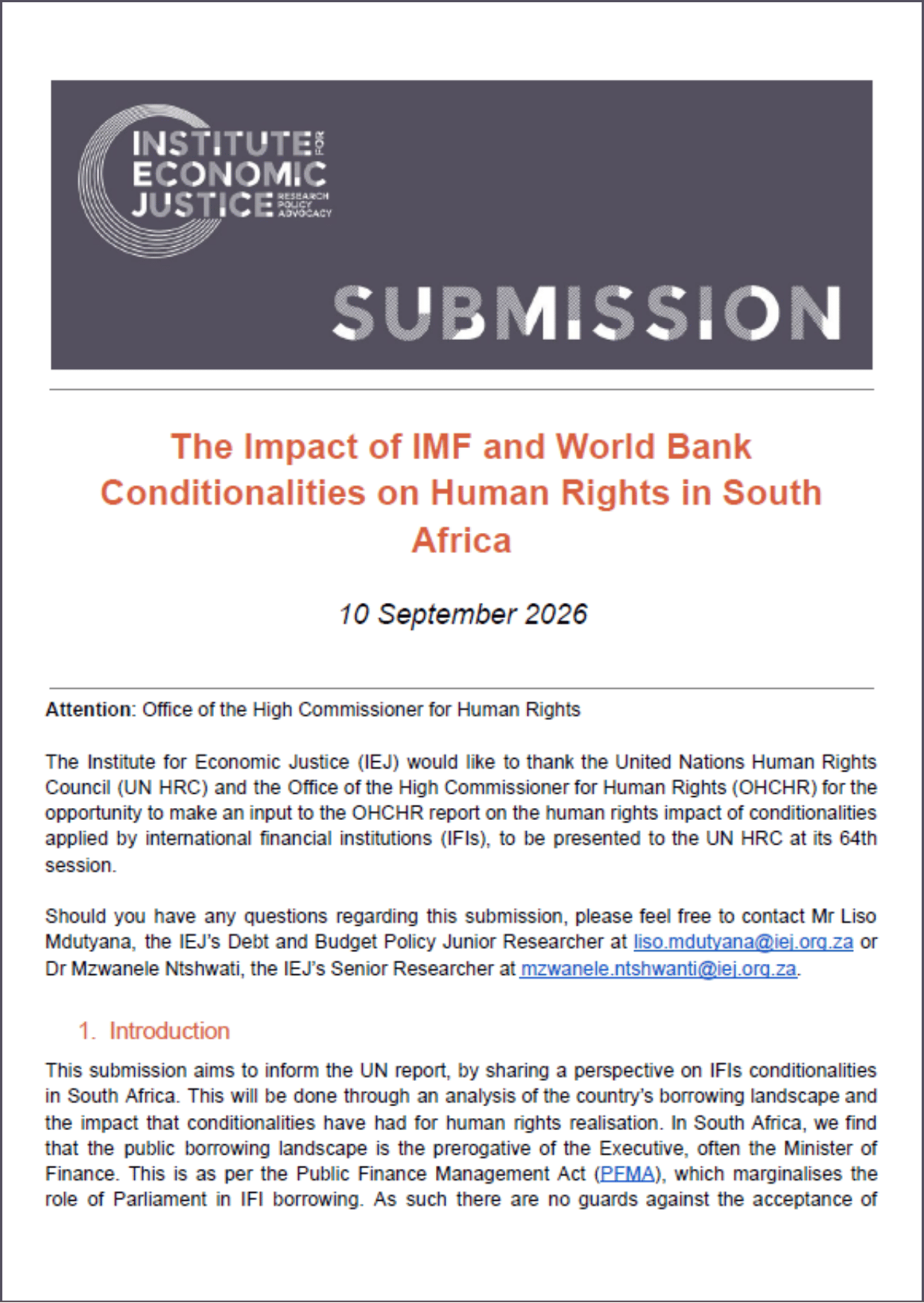
The Institute for Economic Justice (IEJ) made this submission to the Office of the United Nations High Commissioner for Human Rights to inform its report on the human rights impact of conditionalities applied by international financial institutions (IFIs). The report will be presented to the United Nations Human Rights Council at its 64th session.
The submission examines South Africa’s public borrowing framework and the consequences of loan conditions imposed or supported by institutions such as the International Monetary Fund (IMF) and the World Bank. It argues that the current framework grants extensive discretion to the Executive, particularly the Minister of Finance, while providing insufficient opportunities for parliamentary oversight, public scrutiny, or meaningful participation by social partners.
How loan conditions affect socioeconomic rights
Drawing on South Africa’s 2020 IMF loan and 2022 World Bank loan, the submission considers how both formal conditions and policy recommendations have shaped fiscal and social policy. It highlights the effects of fiscal austerity, restrictions on public spending, and the digitalisation of social protection on the rights to social assistance, education, healthcare, water, and other essential public services.
The submission also challenges the presentation of certain loan conditions as neutral “prior actions”. These requirements can entrench contested policies, restrict the choices available to future governments, and limit Parliament’s ability to adopt legislation and budgets that advance socioeconomic rights. The lack of transparency surrounding loan negotiations makes it especially difficult for Parliament and the public to assess these implications before agreements are concluded.
Strengthening oversight of IFI borrowing
The IEJ calls for a new public borrowing framework grounded in transparency, participation, accountability, and respect for human rights. This should include a requirement for Parliament to scrutinise and ratify proposed IFI loans, the public disclosure of loan terms and conditions, and an assessment of their compatibility with South Africa’s Constitution and international human rights obligations.
Greater democratic oversight would help ensure that decisions taken in the name of public borrowing do not undermine the rights of the people who ultimately bear their consequences. Addressing the relationship between IFI conditionalities and human rights is essential to ensuring that international finance is secured on fair terms and advances, rather than obstructs, the progressive realisation of human rights.