
Starved for care: Why we need a UBI to support the nation’s caregivers
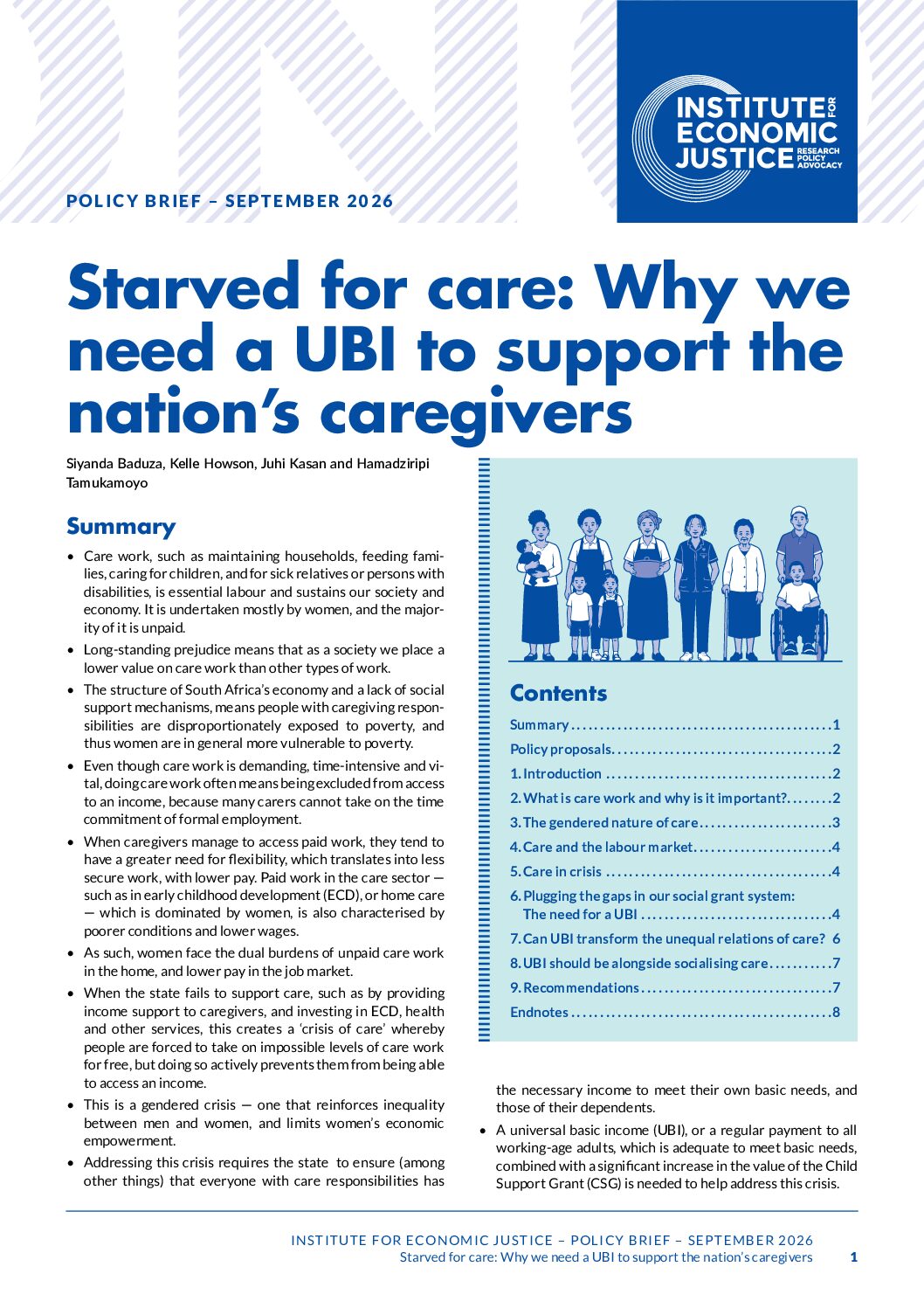
Care work is essential labour that sustains our families, communities, society and economy. It includes raising children, feeding families, cleaning households, caring for older people and supporting people who are sick or have disabilities.
Yet much of this work is unpaid, undervalued and overwhelmingly performed by women. The time required for caregiving can make it difficult to access paid employment, while those who do enter the labour market often face more precarious work, lower pay and less security.
This creates a crisis of care: people are expected to provide vital care for free, while the lack of income and public support leaves caregivers themselves vulnerable to poverty and insecurity.
This policy brief examines the structural causes of this crisis and argues that South Africa needs a universal basic income (UBI) alongside stronger public investment in care.
Care is work
Care work takes many forms. It includes household maintenance, preparing food, childcare, caring for sick and elderly people, transporting household members and providing support within communities.
Although this labour is essential to sustaining the economy, much of it takes place in the home and remains invisible and unpaid. Officially, full-time unpaid caregivers are classified as not economically active, despite the essential contribution their work makes to households and the wider economy.
The devaluation of care has material consequences. Caregivers often lack independent income, social protection and economic security, leaving them vulnerable to poverty and dependence.
A deeply gendered burden
Care work is profoundly gendered. Women make up 88% of full-time unpaid caregivers in South Africa and spend substantially more time than men on household maintenance and caring for other people. Women also experience significantly less leisure time as a result of these unequal responsibilities.
The burden does not end at the household level. Paid care work, including domestic work, nursing, social work and early childhood development, is also disproportionately performed by women and is frequently characterised by lower wages and poorer working conditions.
Women therefore face a double burden: unpaid care in the home and unequal conditions in the labour market.
Care and the labour market
The labour market is often poorly designed around the realities of caregiving. Care responsibilities can make rigid full-time employment difficult to access, contributing to what is described as a ‘care penalty’.
Women are consequently more likely to work in lower-paying, less secure and informal jobs. The brief notes that for every rand earned by men from work, women earn only 76 cents. Women also experience higher unemployment and poverty rates.
The result is a cycle in which the people doing essential care work have the least economic security with which to sustain themselves and those who depend on them.
A crisis of care
When public services and social protection fail to adequately support care, households become the shock absorbers. Responsibilities that could otherwise be supported through public healthcare, childcare, elder care and other services are transferred to families, disproportionately increasing the burden on women.
This crisis has severe consequences for caregivers and those they care for. In food-insecure households, for example, women may reduce their own food consumption so that others can eat. The capacity for care cannot be stretched indefinitely without placing caregivers’ own wellbeing and survival at risk.
Why a universal basic income?
South Africa’s existing social protection system leaves significant gaps for working-age caregivers. The brief argues that caregivers need access to an income that enables them to meet their own basic needs and those of their dependents.
A universal basic income would provide regular income to all working-age adults, rather than making access conditional on employment or caregiving status. This is important because a caregiver-specific grant could unintentionally reinforce gendered expectations by tying women’s access to income to their role as caregivers.
The brief therefore proposes an unconditional UBI for adults aged 18 to 59, set at a dignifying level that can meet basic needs, alongside a significant increase in the Child Support Grant.
Income alone is not enough
A UBI should not replace investment in public services. The brief argues that a gender-just basic income must form part of a broader social protection floor.
This means increasing investment in publicly provided care and basic services, including healthcare, maternity support, early childhood development, water, sanitation, waste services and care for older people. Labour-market policies should also better accommodate caregiving responsibilities.
Publicly funded care services can shift some of the responsibility for essential care away from individual households and towards society as a whole.
Building a caring economy
A UBI can help transform the unequal relations of care by giving caregivers access to their own income and reducing their dependence on other household members. It can also help recognise care as socially and economically valuable work.
But a UBI is only one part of the solution. Building a caring economy requires income security alongside strong public services that recognise care as a collective responsibility.
The brief calls for:
- an unconditional UBI for all adults aged 18 to 59 living in South Africa;
- a basic income set at a dignifying level based on objective measures of need;
- a Child Support Grant that maintains parity with the UBI and is sufficient to meet basic needs; and
- increased investment in publicly funded care services, including healthcare, maternity support, ECD, community services and care for older people.
Recognising the value of care
Care is not a private responsibility that can be taken for granted. It is essential social and economic labour that makes all other work possible.
Supporting caregivers through income security and public services is therefore not simply a social welfare intervention. It is an investment in a more equal economy and a society in which everyone has the resources and support they need to live with dignity.