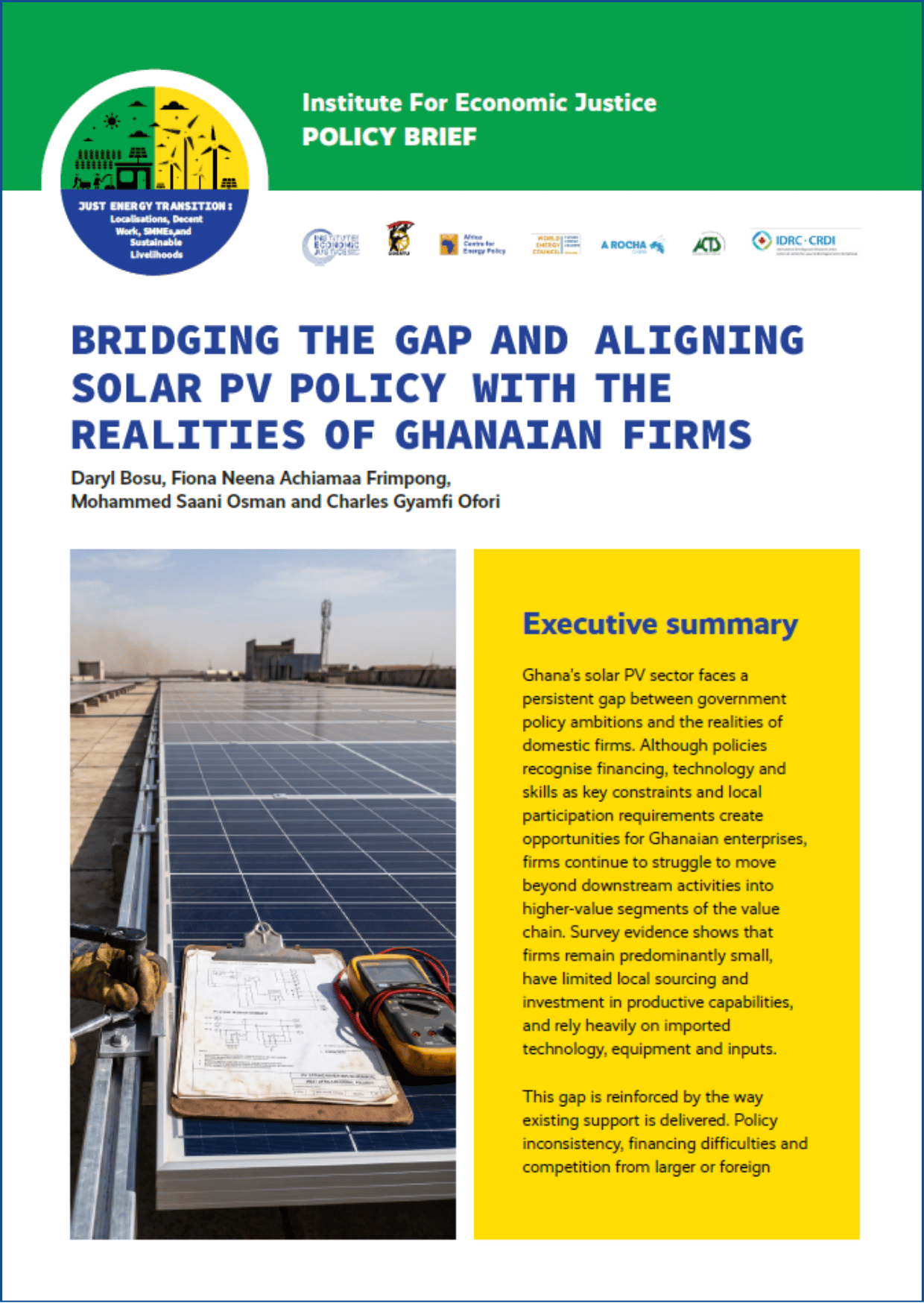
Ghana solar PV firms face a persistent gap between government ambitions for renewable energy localisation and the realities of building domestic productive capabilities. Although Ghana’s policies recognise finance, technology, and skills as major constraints, local firms continue to struggle to move beyond downstream activities into higher-value segments of the solar photovoltaic value chain.
This policy brief examines the experiences of Ghanaian solar enterprises and identifies the support required to help them invest, upgrade, and capture more value from the country’s growing renewable energy market. It argues that local participation requirements must be accompanied by accessible finance, structured technology and skills transfer, targeted enterprise development, and stronger coordination between institutions.
The gap between policy and firms’ experiences
Solar PV adoption in Ghana increased more than fivefold between 2000 and 2021. Ghanaian firms already create value through sales, system design, installation, maintenance, and other customer services. However, most remain unable to invest in panel assembly, manufacturing, advanced engineering, and other higher-value activities.
Many firms cannot access the finance needed to purchase equipment, develop new technologies, improve production processes, or meet certification requirements. Smaller businesses may be unable to absorb the costs of certification needed to compete for formal contracts.
International partnerships provide access to products and markets, but they do not consistently transfer technological, engineering, production, and management capabilities to Ghanaian firms. Without deliberate mechanisms for knowledge and technology transfer, domestic companies may remain distributors of technologies developed and manufactured elsewhere.
The policy brief draws on a survey sent to Ghana’s 54 registered renewable energy companies, which received 16 responses. Although this is a relatively small sample, its findings provide a clear picture of the challenges confronting domestic solar enterprises.
A sector dominated by small firms
Half of the surveyed firms employed between one and ten workers, while a further 43.8% employed between 11 and 49 people. This indicates that the domestic industry is overwhelmingly composed of small enterprises.
These firms also reported irregular revenue because of their dependence on unpredictable project calls. Inconsistent demand makes it difficult to maintain stable operations, retain skilled employees, and invest in equipment, technology, and productive capacity.
Approximately 62.5% of surveyed businesses operated as solution providers or systems integrators. Only 12.5% had moved into assembly or light manufacturing. Nearly half sourced less than 25% of their key inputs locally.
This means that Ghana solar PV firms increasingly manage customer relationships and deliver solar systems, but much of the supply chain—and the economic value associated with it—remains outside Ghana.
Commercial investment rather than productive upgrading
The firms’ investment patterns reinforce their downstream position. More than half invested in activities such as design, marketing, logistics, and research. Only 20% invested in production efficiency or quality systems.
Commercial capabilities are important, but they do not necessarily enable firms to move into manufacturing or other higher-value activities. Industrial upgrading also requires investment in equipment, testing, quality assurance, engineering, certification, production systems, and workforce development.
Four in five surveyed firms had some form of international partnership. These ranged from informal supply relationships to formal partnerships and joint ventures. However, many of these relationships focused on obtaining products rather than transferring technology and building lasting domestic capabilities.
The policy brief calls for structured partnerships with measurable technology, skills, and supplier-development commitments. Smaller firms also require legal and commercial support to negotiate equitable agreements with larger international partners.
Training remains reactive
Although 93% of respondents provided training when required, fewer than half operated formal training programmes. Training was generally reactive and focused on immediate tasks rather than building specialised capabilities that could be retained across the firm and the wider industry.
This restricts the development of expertise in areas such as system design, project management, quality assurance, battery systems, manufacturing, operations and maintenance, and recycling.
The brief recommends partnerships between firms, technical and vocational education and training institutions, and universities. These institutions should jointly design modular training programmes that respond directly to the sector’s changing technological and production requirements.
Finance remains difficult to access
Policy inconsistency was identified as a challenge by 87.5% of surveyed firms, while 81% identified competition from larger or foreign companies. Three-quarters reported financing difficulties.
Ghana already has institutions intended to support enterprise development. The Ghana Enterprises Agency provides training, business development, and support to micro, small, and medium enterprises. However, its programmes tend to be broad and short-term rather than designed around the technological and financial needs of solar businesses.
Development Bank Ghana has the potential to provide the longer-term finance needed for equipment, technology, and productive investment. However, many firms continue to face high interest rates, stringent eligibility requirements, and difficulties preparing bankable proposals.
Providing wholesale concessional finance to participating financial institutions will not be sufficient if solar businesses cannot produce the records, environmental and social commitments, or investment proposals needed to qualify.
Finance must therefore be combined with technical assistance, business-development support, and engagement between financial institutions and solar enterprises.
Targeted support for Ghana solar PV firms
The policy brief proposes establishing a dedicated Solar Enterprise Development Programme. The programme should map firms, assess their capabilities, and provide support based on their different needs and potential upgrading pathways.
Selection criteria, available investment amounts, and performance milestones should be published. This would make the programme transparent and help ensure that firms can qualify based on credible upgrading plans rather than political connections.
The programme could provide tailored business, engineering, diagnostic, and digital support. Eligibility should depend on firms completing baseline assessments and presenting realistic plans for investing in productive capabilities.
Making finance usable
The brief recommends combining credit guarantees, concessional loans, equipment leasing, working-capital facilities, and results-based grants. These instruments could complement Development Bank Ghana’s existing role and reduce the financing barriers facing smaller solar enterprises.
Firms should also receive assistance to prepare bankable proposals and meet funding requirements. Financial support could be released in instalments linked to quality, investment, and reporting milestones. This would strengthen accountability and reduce the risk of firms receiving green finance without developing meaningful productive capabilities.
Creating structured learning partnerships
Ghanaian businesses should be matched with credible technology providers through a facilitated process. Partnerships should include explicit commitments to engineering, production, management, and technological learning.
Joint ventures and supplier-development agreements should contain measurable milestones through which government and participating firms can track whether technology and skills are being transferred effectively.
Providing smaller domestic firms with legal and commercial advice would help them negotiate these agreements from a more informed position.
Connecting capable firms to demand
The brief recommends creating a verified supplier directory and publishing opportunities in the solar market. Firms that have completed certification should receive tender-readiness support, while supplier-development and buyer-matching initiatives should connect domestic businesses with public and private buyers.
This would provide a more mainstream and transparent route through which qualified Ghana solar PV firms could access contracts and compete for opportunities arising from the country’s expanding solar market.
Local participation requirements can create demand for domestic firms, but they must be supported by policies that enable businesses to meet technical standards, invest in productive capabilities, and compete successfully.
From policy ambition to implementation
Ghana already possesses many of the institutions and policy instruments needed to support a stronger domestic solar industry. The central problem is that these measures are fragmented, broad, or inaccessible to the firms expected to benefit from them.
Closing the gap will require coordinated implementation linking enterprise development, development finance, local-content requirements, skills development, technology transfer, certification, and access to markets.
By aligning these instruments with the realities facing domestic businesses, Ghana can use its growing solar market not only to increase renewable energy deployment, but also to strengthen local enterprises and retain more economic and technological value within the country.
About the project
This publication is an output of Advancing a Just Energy Transition: Localisation, Decent Work, and Sustainable Livelihoods, a multi-country research project examining the energy sectors of Ghana, Kenya, and South Africa in the context of global decarbonisation. The project investigates how localisation, decent work, gender equity, SMME participation, and sustainable livelihoods can be embedded in renewable energy production networks to strengthen local manufacturing and avoid reproducing unequal global economic patterns.