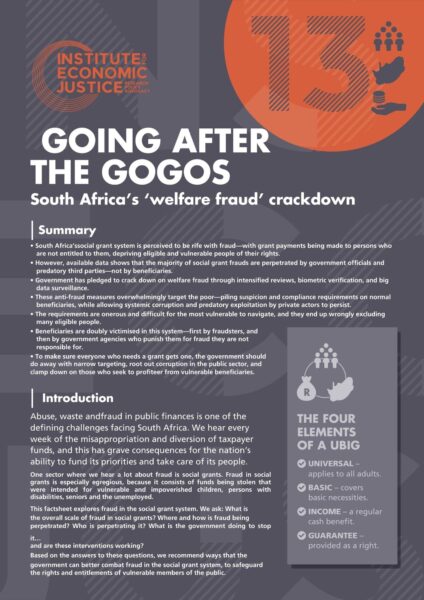
Public concern about fraud in South Africa’s social grant system has grown sharply in recent years. In response, the government has introduced stricter surveillance, biometric checks and large-scale verification processes aimed at rooting out fraud. However, these measures often misidentify wrongdoing and place the burden of policing on elderly, disabled and low-income beneficiaries. This factsheet, published by the IEJ, examines where fraud actually occurs and how current anti-fraud efforts are harming the very people social protection is meant to support.
What is driving the fraud crackdown?
Government has framed inclusion errors, meaning people receiving grants they should not qualify for, as a major driver of wastage. To address this, SASSA and the Department of Social Development have expanded automated checks using credit bureaus, bank data and biometric systems, alongside in-person reviews. While the intention is to protect public funds, these tools are often unreliable and frequently flag legitimate beneficiaries incorrectly, resulting in grant suspensions, long queues and widespread confusion.
Where fraud actually occurs
IEJ’s analysis shows that fraud in the social grant system is real but not in the way it is commonly portrayed. Key sources of fraud include:
- Fraud by government officials and contractors, including ghost beneficiaries and duplicate payments.
- Private third parties making unauthorised deductions or selling predatory financial products.
- Identity theft and database breaches that compromise beneficiary accounts.
- A minority of individuals receive grants they do not qualify for. The evidence indicates that officials and private actors account for a significant share of fraud cases, yet current enforcement efforts focus overwhelmingly on beneficiaries.
The harm of the current anti-fraud measures
Research shows that the new anti-fraud systems have produced widespread wrongful suspensions and exclusions. Key issues include:
- Faulty automated checks that misinterpret once-off transfers, family support or stokvel savings as income.
- Biometric failures that disproportionately affect elderly and disabled people.
- In-person reviews that require long travel, unsafe queues and unclear guidance on why grants were suspended.
- Documentation and digital barriers that exclude individuals without Smart IDs or reliable internet access. These measures undermine income security and deepen hardship for millions who rely on social assistance.
Who is most affected?
Those most harmed by the fraud crackdown are:
- Elderly beneficiaries, especially women.
- People with disabilities.
- Rural residents with limited access to SASSA offices or digital systems.
- Individuals without Smart IDs or formal bank accounts.
- Low-income households are vulnerable to predatory lending and unauthorised deductions. Rather than targeting organised fraud networks, the system disproportionately punishes vulnerable claimants.
A call for a rights-based approach
The IEJ recommends redirecting anti-fraud efforts to focus on systemic corruption while protecting beneficiaries from wrongful exclusion. Key recommendations include:
- Prioritising investigations into officials and third parties involved in large-scale fraud.
- Introducing transparent appeals processes and human oversight of automated flags.
- Reducing the burden of in-person verification for elderly and disabled beneficiaries.
- Offering non-digital alternatives and minimising documentation requirements that undermine access to income support.
- Strengthening the case for a universal basic income grant that reduces exclusion errors altogether.
Other factsheets in the series include:
- Why does South Africa need a Universal Basic Income Guarantee?
- No one left behind: Why universal basic income makes more sense than targeted grants
- Jobs versus Grants: Are employment and basic income a policy trade-off?
- How a UBIG can support healthier kids, happier adults, and lifelong learning
- How a UBIG can advance gender justice and social cohesion
- Not just a handout: How a UBIG gives people the power to prosper
- But how will we pay for it?? Financing a UBIG
- Modelling fiscal pathways to a basic income
- Work-seeking Conditionality is Just Bad Policy: Why a basic income should have no strings attached
- A True Safety Net: How a UBIG Can Support a Just Energy Transition
- Priority number one: How a UBIG can help defeat hunger
- The pitfalls of poverty targeting: The drivers and impacts of widespread exclusion from the SRD grant