
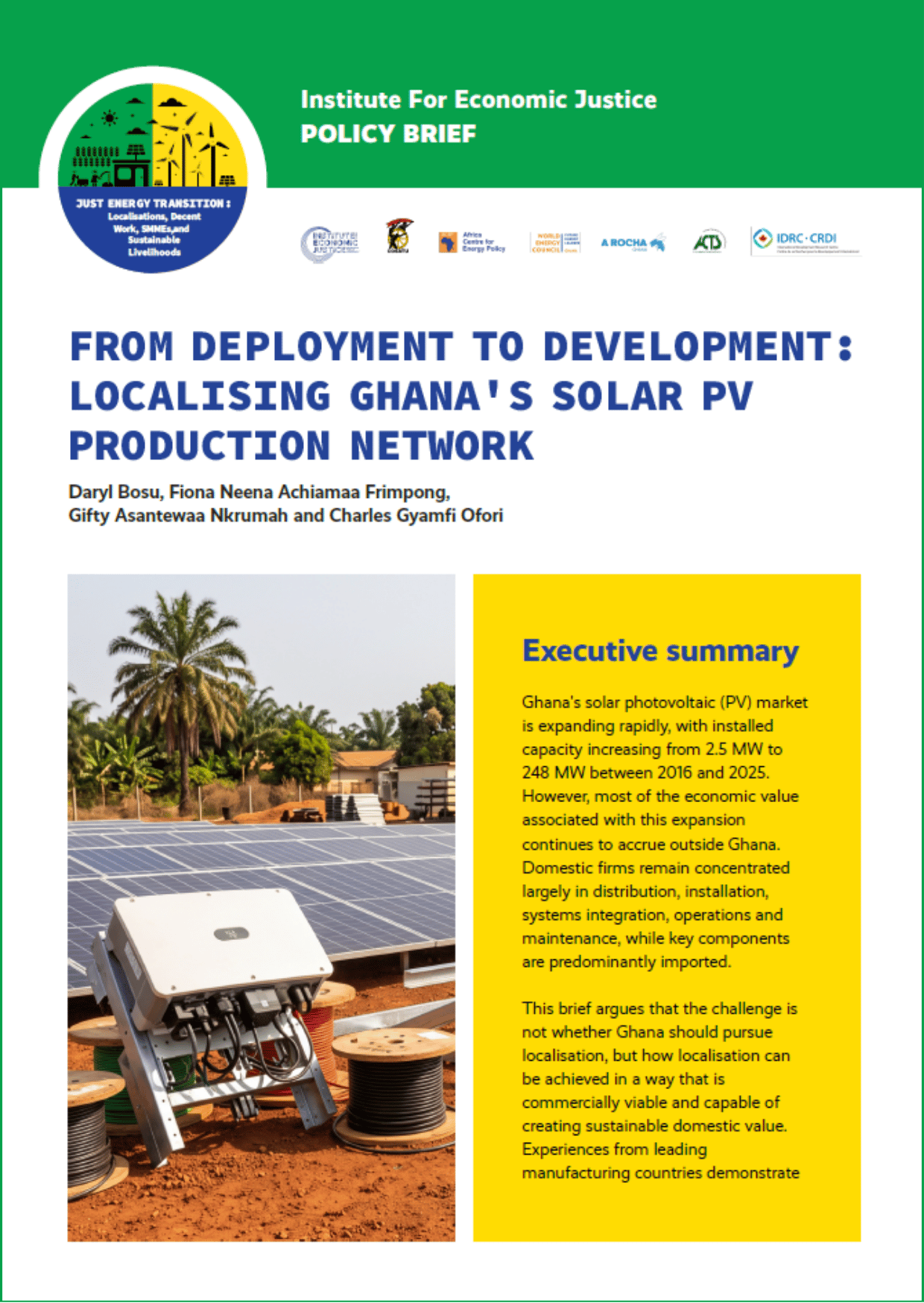
Localising Ghana’s solar PV production network offers an opportunity to turn growing solar deployment into domestic industrial development, stronger firms, and sustainable livelihoods. Installed solar capacity increased from 2.5 MW in 2016 to 248 MW by the end of 2025, but much of the economic value associated with this expansion continues to accrue outside Ghana.
This policy brief by Daryl Bosu, Fiona Neena Achiamaa Frimpong, Gifty Asantewaa Nkrumah, and Charles Gyamfi Ofori examines how Ghana can progressively expand its participation in solar production. It proposes a phased localisation strategy grounded in commercial viability, existing capabilities, and opportunities for technological learning.
Building capabilities and retaining domestic value
Ghanaian firms are concentrated in distribution, systems integration, installation, operations, and maintenance. Most solar modules, inverters, batteries, and other major components are imported, while domestic module assembly remains limited.
Moving into manufacturing requires sufficient demand, competitive production costs, appropriate technology, and access to long-term finance. Established global producers benefit from capabilities and supplier networks developed over many years. Ghana’s localisation strategy must therefore identify activities where domestic firms can realistically compete and develop more sophisticated capabilities over time.
Success should be measured through domestic production, technological learning, employment, and the value retained within Ghana’s economy.
Practical opportunities across the solar lifecycle
Immediate opportunities include strengthening system design, engineering, energy audits, installation, maintenance, and performance monitoring. These activities can help firms accumulate expertise and build relationships that support further upgrading.
Solar projects also create demand for goods and services supplied by existing Ghanaian industries. Metal fabrication, construction, electrical works, logistics, warehousing, and packaging can connect domestic businesses to the wider solar economy. Selected module assembly, component production, and battery integration may become viable as demand and capabilities develop.
The brief also identifies emerging opportunities in refurbishment, panel and battery recycling, material recovery, and specialised waste management. Partnerships with manufacturers, technology providers, universities, and research institutions can support learning throughout this process.
Six priorities for progressive localisation
The brief recommends:
- Establish a phased localisation framework. Select priority activities according to market potential, domestic capabilities, competitiveness, technology requirements, and opportunities for upgrading.
- Provide targeted industrial finance. Develop equipment finance, guarantees, blended finance, and patient capital suited to commercially viable production and technology investment.
- Use procurement and partnerships to build capabilities. Incorporate technology transfer, joint production, local engineering, supplier development, and research collaboration into public projects and investment agreements.
- Strengthen testing and certification. Invest in quality infrastructure that enables domestic firms to meet recognised technical and safety standards.
- Plan for regional markets. Integrate opportunities under the Economic Community of West African States and African Continental Free Trade Area into localisation strategies from the outset.
- Coordinate implementation and track results. Monitor domestic value added, technology transfer, firm upgrading, exports, and participation in higher-value activities.
A phased approach can connect Ghana’s expanding solar market to lasting productive capabilities. By aligning finance, technology, skills, supplier relationships, and market development, localisation can help domestic firms retain more value and deepen their participation in the regional and global solar economy.
About the project
This publication is an output of Advancing a Just Energy Transition: Localisation, Decent Work, and Sustainable Livelihoods, a multi-country research project examining the energy sectors of Ghana, Kenya, and South Africa in the context of global decarbonisation. The project investigates how localisation, decent work, gender equity, SMME participation, and sustainable livelihoods can be embedded in renewable energy production networks to strengthen local manufacturing and avoid reproducing unequal global economic patterns.