
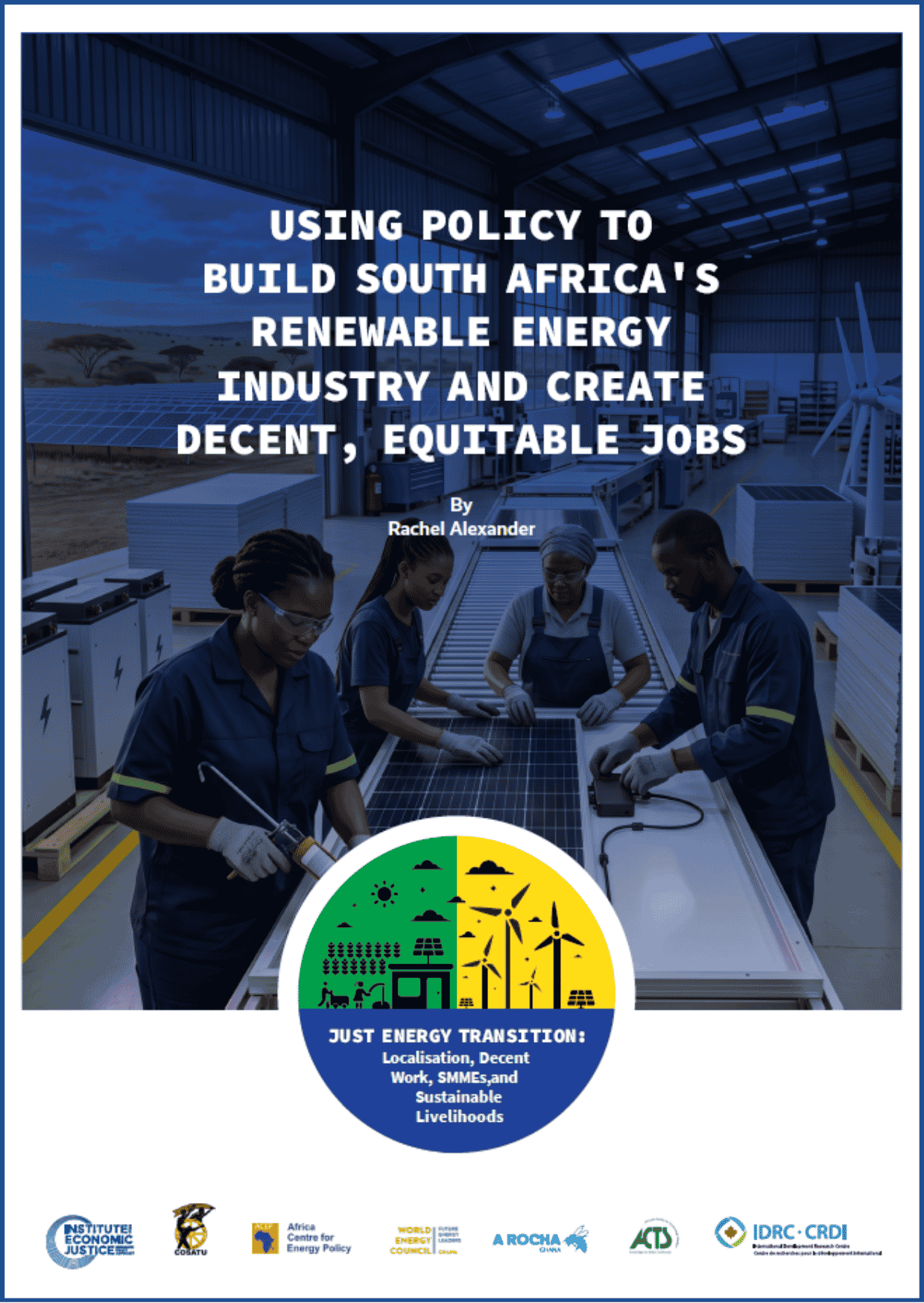
South Africa’s renewable energy industry presents an opportunity to build domestic manufacturing, create decent jobs, and advance gender equity. However, expanding renewable energy generation does not automatically deliver these benefits. Deliberate, coordinated public policy is needed to ensure that the energy transition strengthens local productive capabilities and improves the lives of workers and communities.
This detailed case study by Rachel Alexander examines how policy can support localisation across solar, wind, and battery energy storage production networks. It considers where economic value is created, who captures it, the quality of employment being generated, and the barriers preventing more equitable participation.
Drawing on sector research, 59 interviews, a survey of nine manufacturers, community observations, and stakeholder validation workshops, the report connects firms’ experiences with the wider policies, institutions, and power relations shaping the industry.
Building domestic capabilities and retaining value
South Africa already participates in renewable energy manufacturing, assembly, installation, operations, and maintenance. Yet much of the technology and many critical components are imported, while domestic producers face intense international competition, inconsistent demand, infrastructure constraints, and gaps in skills and technological capabilities.
Irregular public procurement undermines manufacturers’ ability to plan production, retain workers, and invest in upgrading. Established international supplier relationships can also limit opportunities for domestic firms, particularly smaller enterprises. Meanwhile, weaknesses in policy coordination and the enforcement of local-content requirements reduce the developmental impact of existing interventions.
The report identifies opportunities to expand domestic production through predictable public demand, technology transfer, regional markets, and stronger links between manufacturers, research institutions, and training providers. It also highlights potential in component production, services, recycling, and the recovery of materials from renewable energy equipment.
Making decent work and gender equity central
Increasing local production alone does not guarantee secure employment or a fair distribution of benefits. The research identifies precarious contracts, weak worker representation, and unequal access to opportunities as persistent concerns.
Women face additional barriers arising from occupational segregation, gender stereotypes, and unequal responsibility for unpaid care work. Addressing these barriers requires targeted training, pathways into technical occupations, and measures that support equitable participation throughout the industry.
The report also explores how worker and community ownership can broaden the benefits of renewable energy development, supported by meaningful participation and effective safeguards.
A coordinated policy agenda
The case study proposes action across five connected areas:
- Shape demand: establish predictable public procurement, expand Eskom Green’s role, and strengthen local-content requirements.
- Support trade and regional development: refine tariffs, improve customs enforcement, encourage technology transfer, and develop regional manufacturing markets.
- Strengthen manufacturers: reduce operating constraints, support technological upgrading, and expand shared testing facilities and industry networks.
- Advance decent work and inclusion: link industrial support to labour standards, strengthen skills development, and address gender inequalities.
- Improve implementation: coordinate government interventions and ensure that smaller firms’ experiences inform policy decisions.
Together, these measures offer a pathway towards an energy transition that builds lasting domestic capabilities, supports sustainable livelihoods, and distributes economic opportunities more equitably.
Download the full case study to explore the findings and policy recommendations for building local manufacturing, decent work, and gender equity.
About the project
This publication forms part of the IEJ’s Localising the Energy Transition project, which examines how renewable energy development in Ghana, Kenya, and South Africa can strengthen local manufacturing, decent work, gender equity, and sustainable livelihoods. Focusing on solar, wind, and battery storage production networks, the project develops evidence to inform policies that deepen domestic capabilities and broaden participation in the energy transition.
Learn more about the Localising the Energy Transition project.