
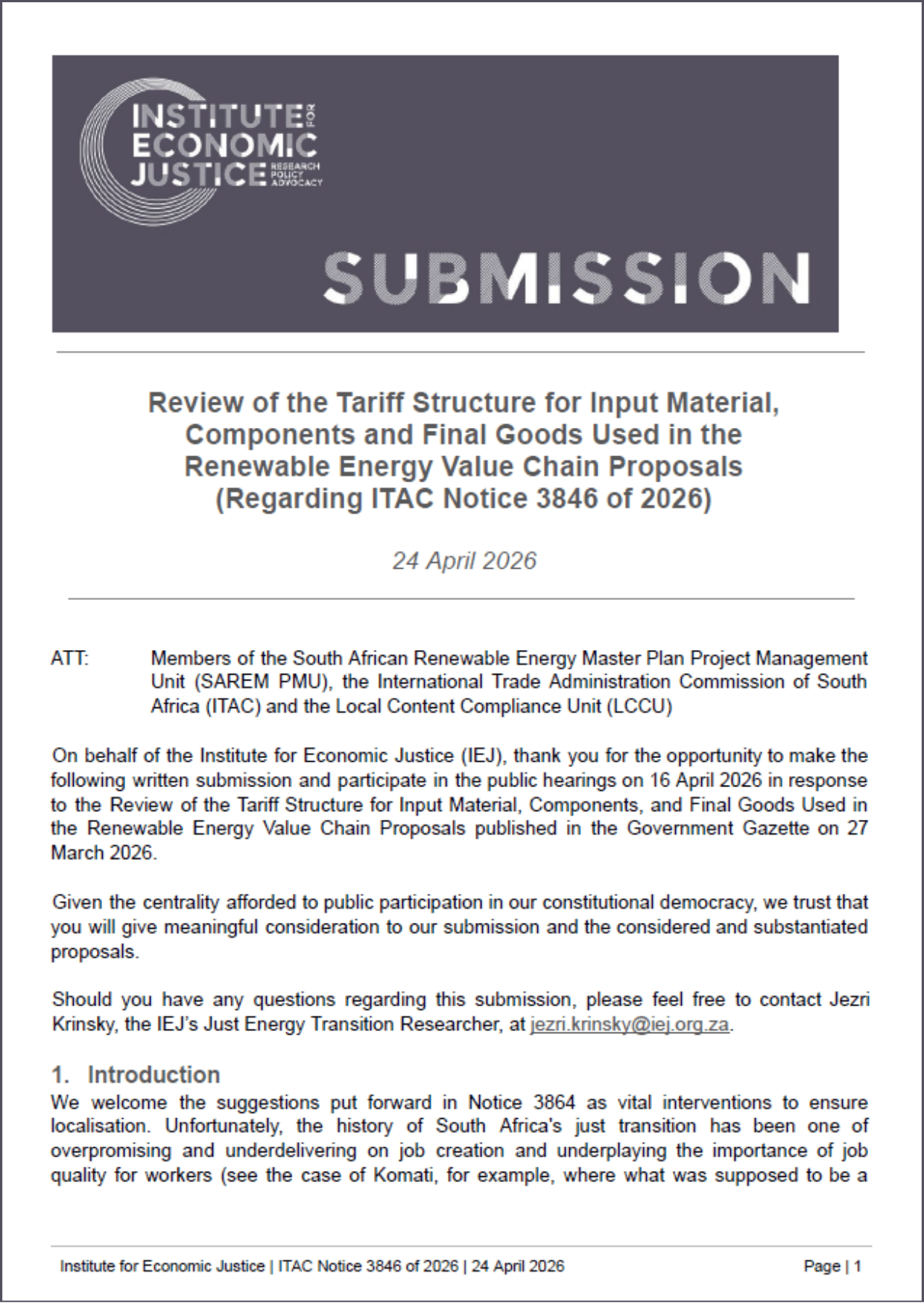
Renewable energy tariffs can help strengthen South Africa’s manufacturing capacity, but they must be supported by policies that deliver stable employment, decent work, and gender equity. In this submission, the Institute for Economic Justice (IEJ) sets out recommendations for linking tariff protection to a just energy transition that benefits workers, local producers, and communities.
Dated 24 April 2026, the submission responds to proposals to review the tariff structure for input materials, components, and final goods used in the renewable energy value chain. It is addressed to the South African Renewable Energy Master Plan Project Management Unit (SAREM PMU), the International Trade Administration Commission of South Africa (ITAC), and the Local Content Compliance Unit (LCCU), following public hearings held on 16 April 2026.
Connecting renewable energy tariffs to decent work
The submission welcomes measures to strengthen localisation, while arguing that industrial support must translate into tangible benefits for workers. South Africa’s renewable energy sector has often generated short-term construction and installation jobs, with fewer opportunities for permanent employment. Local manufacturing has also faced unstable demand, procurement delays, and weak enforcement of local content requirements.
The IEJ recommends linking the continuation of tariff protection beyond an initial period to realistic standards for job creation, employment quality, and gender equity. These commitments should include fair wages, permanent contracts, formal apprenticeships, and greater participation by women and young people. The submission also proposes a decent work charter negotiated through the National Economic Development and Labour Council (NEDLAC), alongside more transparent employment reporting and coordinated skills development.
Gender equity requires deliberate action. The submission highlights barriers to women’s participation, including unequal access to science and technical education, discriminatory assumptions about suitable work, and disproportionate responsibility for unpaid care work.
Strengthening local content enforcement
Tariff measures need to work alongside clear and enforceable local content requirements. The IEJ calls for stronger monitoring, evaluation, and auditing to ensure that renewable energy projects honour their procurement commitments. Greater transparency about where materials and components are sourced would help identify non-compliance and improve accountability.
The submission also recommends that the Department of Trade, Industry and Competition (the dtic) publish guidance and convene a workshop to clarify the legal framework for localisation. Clearer guidance would help stakeholders understand the powers available to mandate and enforce local content requirements, and address uncertainty that can undermine industrial policy.
Giving local manufacturers a fair opportunity
Local producers face obstacles beyond competition from imported products. Late orders and payment arrangements that require manufacturers to cover production costs upfront can make it difficult to secure contracts, plan production, and retain workers.
The IEJ recommends regulations requiring orders to be placed with sufficient lead times and ensuring that manufacturers receive a significant proportion of payment before production begins. These measures would help local firms manage cash flow and meet project deadlines. They would also reduce the risk that avoidable procurement pressures are used to justify sourcing products from elsewhere.
Protecting battery production without raising input costs
The submission identifies a concern about proposed tariffs on lithium-ion batteries. A tariff applied to a broad category covering both imported cells and fully assembled batteries could raise costs for South African battery manufacturers that depend on imported cells.
The IEJ therefore recommends separating the tariff codes for complete batteries and lithium-ion cells, so that duties on finished batteries do not increase the cost of essential inputs. It also calls for battery management units to remain duty-free. Support for future local cell manufacturing should focus on building production capacity before imposing tariffs on those inputs.
Building an energy transition that delivers for workers
The submission argues that renewable energy tariffs should form part of a coordinated industrial strategy, supported by reliable procurement, effective enforcement, skills development, and commitments to decent work. Together, these measures can strengthen local production and help ensure that the expansion of renewable energy creates lasting social and economic benefits.