Women’s Day this year marks 70 years since the 1956 Women’s March on Parliament. This year’s commemoration was held under the theme, “Empowered Women, Empower the Nation”. The theme is timely and offers an important opportunity to reflect on what it means to empower women.
It is important to acknowledge the considerable progress made by women, government, activists, and civil society in advancing women’s economic, social, and political empowerment. Women now make up approximately 44.6% of the National Assembly, up from just 2.7% before 1994. In education, girls accounted for approximately 56% of matric candidates, while women’s enrolment in higher education increased from around 564,800 in 2014 to 671,988 in 2023. In STEM, women now account for roughly 44% of graduates and nearly half of STEM bachelor’s degrees, while women make up 52% of university academic staff. These are significant gains.
Yet they also raise a more difficult question: what do these indicators tell us about the actual conditions of women’s lives? Educational attainment, increased political representation, and gains in social status have not translated into equal gains for all women and girls. For example, despite substantial advances in education, women’s employment outcomes continue to lag substantially behind those of men. In the most recent Quarterly Labour Force Survey (QLFS), the female unemployment rate stood at 37%, approximately seven percentage points higher than men. Education, while an important dimension of empowerment, is not closing the gaps in employment or economic equality.
A report released by Statistics South Africa in early August, as part of its Gender Series, titled Gender Disparities in Care Work in South Africa, 2015–2026, provides an important lens, and a number of rich and rigorous insights, to understand these persistent inequalities. It notes that in 2025, approximately 43% of households were headed by women, with the largest shares observed in rural KwaZulu-Natal and the Eastern Cape, and that 46% of children live with their mothers only. These households often span multiple generations, creating a melting pot of complex, intersecting, and often conflicting care needs.
These household formations, the responsibility for care and access to basic necessities are central to understanding the limits of ‘conventional measures’ of women’s empowerment. Women remain central providers of care, not only through the physical labour of childminding, cleaning, and attending to sick or elderly household members, but also through the financial responsibility of meeting the costs of care. The gender imbalance in the distribution of this unpaid care is profound. According to the 2010 Time Use Survey, among households with children, approximately 65% of women participated in direct daily care, compared with only 15% of men. This is not simply a matter of individual choice. It reflects persistent social norms that continue to naturalise women’s position as caregivers, alongside the historical and structural conditions that have shaped South African households, particularly through the migrant labour system during apartheid that divided and fragmented families.
Women’s disproportionate load of unpaid caregiving has real consequences. According to Stats SA (2026), for every one man who cites being a homemaker as a reason for being outside the labour force, approximately eight women are in the same position. The unequal distribution and intensity of unpaid care constrains women’s ability not only to enter the labour market but also to remain in paid employment. It also contributes to time poverty, limits opportunities for leisure and rest, and can undermine the quality of care available to both caregivers and care recipients.
The report also reveals that the proportion of households relying primarily on social grants increased from 21.1% in 2015 to 23.4% in 2025, with female-headed households consistently more dependent on grants and remittances than male-headed households. The Child Support Grant (CSG), primarily received by women, alongside the Older Persons Grant (OPG) and Social Relief of Distress (SRD) grant, constitute an important part of the social infrastructure through which households manage care and economic insecurity. The report’s findings should, in this sense, strengthen the case for social protection as a component of women’s empowerment: income security is not ancillary to empowerment, but a material condition for exercising agency and meeting basic needs.
Yet there is a striking disjuncture between what the evidence tells us about women’s and households’ circumstances and the fiscal choices made in response. This year, the OPG and CSG received increases of R80 and R20 respectively, bringing the grants to R3,080 and R580. While these increases are in line with headline inflation, they are insufficient to reverse the loss of purchasing power resulting from years of below-inflation increases, particularly for the CSG. Nor do they account for the fact that food-price inflation has consistently exceeded headline inflation. This is particularly consequential given the role of social grants in meeting household food needs. In late August, Statistics South Africa reported that the food poverty line had increased to R868 per person per month. The CSG remains approximately 32% below this threshold and around 40% below the average cost of securing a basic nutritious diet for a child, estimated at R962.
This brings into sharper focus what it means to ‘empower’ women and, by extension, to empower a nation. The realities of systemic poverty, hunger and persistent financial insecurity complicate any conception of empowerment centred primarily on whether women have acquired educational qualifications, entered particular occupations or achieved formal representation. These measures capture important dimensions of progress, but they do not capture women’s substantive capabilities, in other words, their ability not only to achieve these gains but to convert them into income, autonomy, security, rest and wellbeing. A degree may open a door, but it does not guarantee that a woman has the time, childcare, transport, income or social support necessary to walk through it and remain there. She may enter the labour market but experience severe time poverty because the unpaid work of maintaining her household remains unchanged.
A more substantive approach of empowerment attends to capabilities: the real opportunities people have to achieve the lives they value. This includes the capability to access a basic nutritious diet, secure adequate housing and public services, access childcare and healthcare, care for oneself, participate in paid and unpaid social life, and have sufficient time for rest and leisure. These are not secondary outcomes of empowerment. They are among its material foundations.
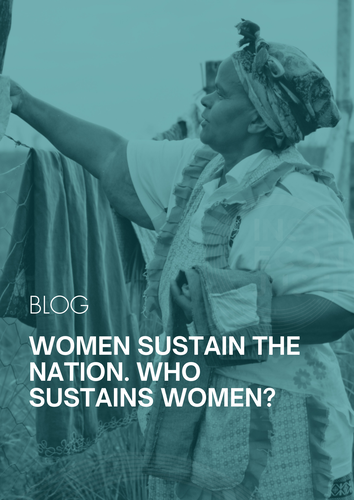
On reflection during Women’s Month, one can think of a deep irony: women who are not empowered, or remain economically and socially disempowered, continue to empower and sustain the nation through their unpaid and underpaid care work. This work is perpetual and depends, to a large extent, on women’s resilience, grit, and determination to keep households and communities going through difficult and, at times, unsafe conditions. This is particularly significant given women’s disproportionate exposure to poverty, unemployment, and economic insecurity. Women are therefore often expected to sustain families and communities precisely within conditions that constrain their own economic security and well-being.
It is from this vantage point that the empowerment of women must begin with recognising that women are already doing the work of sustaining entire households, communities, and economies. It must then ask what this responsibility means for women’s own rights and wellbeing, and the conditions under which this work is done. Taken together, these questions tell us much more about women’s lives: the time they have for themselves, their exposure to poverty and economic insecurity, their access to education and employment, their ability to participate in public and economic life, and their right to rest and live safely and with dignity. They also require us to consider the quality and sustainability of care itself when so much of it is carried by women, often without adequate income, support, and recognition.
This requires redistributing the responsibility for sustaining society, not only between women and men, but between families, communities, the market, and the state. A genuine commitment to women’s empowerment must therefore be reflected in free, accessible, and high-quality care, alongside adequate social protection, safe water, healthcare, childcare, maternity benefits, and other public services. These are measures that can meaningfully support women’s participation in the economy, create the conditions in which women can exercise their rights and live with dignity, and ensure that the responsibility for sustaining society is not continually transferred onto women’s unpaid and underpaid labour.