Update: The section of our statement analysing National Treasury’s Gender Budget Statement has been revised, as of 17:50 on Thursday, 26 February 2026, to reflect additional detail and clarification.
Introduction
Although the 2026 Budget was an opportunity for the Minister of Finance to reverse a decade of ill-informed austerity and to steer the country towards transformative growth, Minister Gondongwana has opted to maintain the status quo. The 2026 Budget fails to reverse the expenditure cuts proposed in the 2025 Medium Term Budget Policy Statement (MTBPS) and enacted over the past decade. In fact, the tabled National Budget makes additional budget cuts, on top of the tens of billions that have been removed in previous years. Despite the improved economic environment, the Minister of Finance reduces non-interest spending by R5.2 billion in 2026/27 and by R14.2 billion in 2027/28, compared to the 2025 National Budget. The National Treasury is once again starving the country of the resources needed to advance development and ensure quality public service delivery.
The Minister’s premature celebration of a declining debt level and boosting primary budget surpluses exposes the fact that the government is not attuned to the appalling realities of many South Africans. The Minister missed an opportunity to adopt a national emergency response to chronic food insecurity, high inequality, and astronomical levels of joblessness. Instead, the increased fiscal space, contrary to the promises of the National Treasury’s Director-General, has been used for tax relief skewed towards the relatively well-off and to reduce further borrowing.
In developmental terms, the National Budget is an utter failure, projecting that “growth is expected to average 1.8 per cent, reaching 2 per cent by 2028”. That rate of growth is nowhere near the level required to keep pace with the average yearly growth of the labour force (at 2% between 2015 and 2025) and population growth, and to give the fiscus the resources necessary to invest in infrastructure and to eradicate poverty. National Treasury’s acknowledgement that the current approach to managing the economy is only able to produce 2% growth reinforces the arguments the IEJ made in our pre-budget Briefing Note, that status quo policies are keeping the country trapped in a sub-3% growth trajectory.
Spending
The government has once again failed to match the challenges the country faces with a requisite investment by the fiscus in essential economic and social priorities. Public spending, excluding debt repayment and taking into account the effect of inflation, will decline by 2% in 2026/27, and by an average of 1.7% over the next three years. The government will spend, in real terms, R706 less per person in 2026/27 compared to 2024/25. Total government spending amounts to 33.9% of the country’s income, compared to an average of 42.6% of GDP in OECD countries (in 2023). It is unconscionable that South Africa spends less to uplift people from poverty than rich countries spend to maintain the livelihood of their largely well-off citizens.
As we argued in our Briefing Note, the quality of public services is important for the reproduction of the workforce, economic growth, and fulfilling constitutional rights. The public sector wage bill will grow in line with inflation over the next three years. While this may allow for some wage adjustment for incumbent public servants, it is still too little to fill the thousands of public sector vacancies.
Spending on public services continues to decline, after years of cutbacks. Inflation-adjusted spending on education per learner declines by an average of 0.33% over the medium term. The basic education allocation is insufficient to address deficiencies in school libraries, poor early-childhood development infrastructure, high learner-to-teacher ratios, and the general dilapidated state of public school infrastructure. In healthcare, real spending (in constant 2018/19 rands) is R4,028 per public service user in 2026/27, which is down from R4,108 per public service user in 2019/20.
Social protection spending, when adjusted for inflation, contracts at 0.33% over the next three years, largely due to the fact that the Covid-19 SRD grant is not increased, and not funded in the outer years. In addition, while the Older Person’s Grant (OPG) and Child Support Grant (CSG) have received small increases of R80 and R20 respectively, in line with headline inflation, this is insufficient to rectify the loss in purchasing power which has resulted from years of below inflation increases – particularly for the CSG – and does not account for the fact that food price inflation is consistently higher than headline inflation. The largest share of social grant spending is on food.
The Minister of Finance lauded SASSA’s new biometric and verification capabilities and the “savings” they are projected to achieve – a total of R3 billion over the next two years. This directly translates to cancelling and rejecting applications for about 0.5 million grants. Although the government describes this as a “fraud crackdown”, there is very little evidence to suggest that the majority of these rejected grant payments are fraudulent, and the methods SASSA is using to uncover so-called fraud are known to be deeply flawed and inaccurate. At a time when food insecurity and poverty levels outstrip social grant receipt, this amounts to a significant retrogression in constitutional rights. To achieve National Treasury’s projected savings, SASSA will need to quadruple its current rate of cancellations and rejections over the next year.
It is also extremely disturbing that despite the government repeatedly hailing the value of public employment, and the Presidential Employment Service (PES) in particular, the budget continues to reduce the allocation to this important programme. We have seen this allocation slashed by two-thirds in real terms, from R12.6 billion in 2021 to only R4.2 billion in the main budget this year. Supplementing this amount with an off-budget allocation of R4 billion via the Unemployment Insurance Fund (UIF) reserve is highly problematic, as it suggests that the fiscus is not prepared to accept responsibility for this critical function.
Although this Budget is supposed to give effect to the prioritisation of capital investment, such investment has been overstated by the Minister and remains completely inadequate. Over the last 10 years, the state has systematically underinvested in areas such as water, rail, and electricity, resulting in the multiple crises we see today. The R1.07 trillion allocation in infrastructure over the medium term – and the fact that medium-term payments for capital assets grow by 9.7%, compared with growth of 4.4% for employee compensation – will not sufficiently reverse this. The projected investment expenditure in the Budget is well below the levels needed to realise NDP targets. Worryingly, it appears that the National Treasury expects the private sector to make up this investment shortfall through intensifying public-private partnerships, which will most likely commodify essential public goods and worsen access to infrastructure and services for the public. National Treasury and Development Bank of South Africa (DBSA) establishing the Infrastructure Finance and Implementation Support Agency might be positive, but this should not continue to adopt an approach that is centred on ‘derisking’ private finance.
Pitting current spending on health, education, and welfare against infrastructure spending is also counterproductive and dangerous. The economy is an ecosystem, where spending on one programme is connected to the impact of other programmes. For example, building more clinics (infrastructure) will not do much to improve health outcomes if patients have to wait hours in line to get assistance from overworked nurses and doctors due to staff shortages.
This is the context under which we must closely scrutinise the National Treasury’s ‘Targeted and Responsible Savings’ (TARS) programme and a proposed new, probably much stricter, ‘fiscal anchor’. Members of Parliament should view the proposed new fiscal anchor with extreme caution. As our previous research shows, if the new fiscal anchor does not take account of the need for political contestation over spending priorities and is not entrenched in the need for greater economic development, then it will lead to the kinds of blanket cuts to public spending that have suppressed economic growth.
Revenue
Revenue mobilisation continues to be held back by the country’s flawed growth model. According to our government, the solution to depressed business investment is three-pronged. First, engage in the global race-to-the-bottom by slashing taxes on corporate profits. In South Africa, this has manifested in the corporate income tax rate falling from 48% in 1993 to 27% since 2023. However, as shown in Figure 1, private investment (the red line) does not respond strongly or immediately to changes to the corporate income tax rate (blue bars). If anything, we see the opposite trend. Second, protect private profits through low dividend taxes (at 20%). The effects of this on real variables such as private fixed investment are disputed, with the only guarantee being higher after-tax returns for the wealthy who dominate ownership of financial assets. Third, facilitate the costless movement of finance between countries. More than anything, this encourages short-term flows of money, often unrelated to the economic fundamentals of the country, that contribute both to making the rand volatile and to suppressing the levels of productive investment.
Figure 1: Corporate income tax rate versus private investment
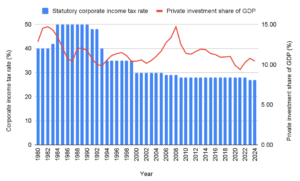
Source: SARB online statistical query & SARB tax chronology (1979 – 2025) publication
South Africa’s growth model resides in a fictional world where allowing corporations and rich people to have an increasingly larger share of the value created by all of society will somehow propel them to invest more in the real economy, despite extensive research which shows that their propensity to invest or consume is low. Indeed, research shows that nowhere in the world has this version of ‘trickle-down economics’ created conditions for sustained economic growth. Meanwhile, the channels that offer better prospects for (re)igniting private investment, such as massively increasing public investment, high domestic consumer demand, an appropriately skilled workforce, and reliable and cheap infrastructure, are either ignored or underfunded.
Instead of taking advantage of the improved economic environment to bolster revenue mobilisation and channeling it to pro-poor spending, the Minister of Finance opted to grant relief to higher-income earners and businesses. The concessions to SMMEs will only have the desired impact if poor communities have the spending power to buy their goods. The 2026 Budget tax proposals raise no additional revenue over the medium-term, and revenue projections are lower in real terms than those contained in the 2025 MTBPS. The R20 billion tax increase committed to in the 2025 National Budget is withdrawn, and personal income tax brackets and medical tax credits are fully adjusted for inflation, sacrificing revenue that could have been directed elsewhere.
A pro-poor approach to public spending would prioritise the earmarking of medical aid tax credits for the expansion of the public healthcare system through, for instance, hiring more nurses and doctors, building more clinics, and ensuring that medicines are available. Thus, the government foregoes revenue (last estimated at R37 billion in 2023/24) to subsidise middle and upper-class households.
The focus on increasing savings, including by increasing the allowance for tax-deductible retirement savings from higher-income earners by a large amount, is also based on the fallacious assumption that what constrains South Africa’s growth is low savings, rather than a lack of investment. Essentially, the National Budget prioritises putting money back in the pockets of the top earning 30% in the country (fueling fragile consumption-driven growth) and increasing the savings of the wealthy (fuelling inequality), while starving the fiscus of the funds needed to drive public investment.
Debt and deficits
The failure to raise economic growth to adequate levels continues to frustrate National Treasury’s efforts to contain the debt-to-GDP ratio. Consequently, once again, the public is forced to bear the brunt of the consolidation. Despite new budget cuts, the debt-to-GDP ratio is expected to peak at a higher level (78.9%) than was anticipated in the 2025 National Budget (77.3%). This is because nominal GDP grew at a slower pace than expected. Despite clear evidence, the National Treasury remains too stubborn to acknowledge that spending cuts, which reduce aggregate demand, have a negative impact on GDP growth. Therefore, even when debt is accumulated at a slightly slower pace, it will leave the debt-to-GDP level unchanged or higher. To countercounter this trend trend, the 2026 National Budget proposes to increase the primary surplus by 0.7 percentage points, equivalent to R59.5 billion, between 2025/26 and 2026/27, which in essence means failing to make use of the increased revenue collection for critical social needs, which in essence means failing to make use of the increased revenue collection for critical social needs.
While it may be positive that debt service costs will be lower as a share of revenue (from 21.3% in 2025/26 to 20.2% in 2028/29), this does not need to be accomplished through restricted public spending. As we have argued, through better macroeconomic policy coordination, it is possible to achieve fiscal sustainability in a manner that does not compromise the government’s redistribution imperative. For instance, monetary policy tools can be used not solely to fight inflation but also to actively transmit cheap, stable, and predictable capital for development. This would lower the entire cost structure of the economy, including the cost of government debt.
Gender Budget Statement
The 2026 National Budget includes the second Gender Budget Statement (GBS), first introduced in 2025 as part of the process of gender responsive budgeting (GRB) initiative. This year’s GBS fails on multiple levels.
First, it shows a lack of prioritisation of gender issues. Once again, the GBS has been confined to the annexure of the Budget Review and was not mentioned by the Minister of Finance. This effective burial of the GBS in the technical back pages of the fiscal framework is not a neutral administrative choice. It is a clear political signal that gender inequality remains peripheral to the fiscal decision-making that determines revenue, expenditure, and macroeconomic direction.
Second, it fails to advance the process of securing genuinely gender-sensitive fiscal policy. It does not reflect a transformative gender responsive budgeting framework meant to be institutionalised through the tasked interministerial committee, nor does it demonstrate progression from 2025. The first GBS in 2025 was welcomed as a milestone despite its limitations, on the understanding that the exercise would improve. The bar was low, and we have now fallen well beneath it.
Third, it waters down our approach to gender equity. The 2025 GBS introduced ‘Women’s Economic Empowerment’ (WEE) as a guiding framework through which gender-responsive interventions and budget priorities would be articulated. In 2026, this framing was replaced with the broader and less precise language of ‘Economic Empowerment’. This shift signals an inconsistency between the two years and raises questions about conceptual and methodological continuity. Irrespective of the language, the framework itself is overly narrow. Rather than dealing with women’s direct experiences of inequality in economic, political, social, and care systems, it treats women as untapped economic instruments.
The weakness of the WEE paradigm was particularly prominent in relation to this year’s second area of analysis: ‘human endowment’ and its aligned departments, including Basic Education, Social Development and Higher Education, tasked with conducting GRB. Each department provided a list, in other words, a ‘tagging’ of ‘women’ related programmes, but failed to articulate why women remain marginalised. Nowhere in the statement does it demonstrate how budget allocations in these departments are structurally connected to women’s economic empowerment or gender equity.
For example, the Statement mentions the fact that female-headed households continue to experience higher levels of severe food insecurity than male-headed households. This is a structural indicator of economic vulnerability, with female-headed households more likely to depend on irregular income, informal work, and social transfers, and more exposed to shocks in food prices, energy costs, and employment instability. The GBS, however, does not demonstrate how the listed departmental interventions will materially alter these conditions. Instead, many of the interventions centre on conferences, awareness campaigns, promotional events, and enterprise support initiatives, measures that are unlikely to reach the rural and unemployed women who make up the majority of food-insecure, female-headed households.
A more robust GBS would interrogate, among other issues, how core social protection instruments shape women’s economic security. For instance, the Department of Social Development, one of the departments participating in the GRB process, administers the Social Relief of Distress (SRD) grant. Stuck at R370 per month, the grant is significantly below the estimated R923 per person cost of a basic nutritious food basket. Yet the GBS does not assess whether this level of support is sufficient to reduce food insecurity among female-headed households, nor whether the scale, adequacy or design of the grant meaningfully strengthens women’s economic agency.
There is no need to reinvent the wheel. South Africa has already demonstrated, through the early Women’s Budget Initiative, that rigorous GRB is possible when fiscal analysis is rooted in the structural realities shaping women’s lives. What is lacking is not more data, but political will and a sustained focus on core issues such as energy access, income security, unpaid care burdens, food insecurity, and unemployment. A credible GBS would centre those most marginalised, rural, and unemployed women, persons with disabilities,the LGBTQIA+ community and those living with illness or addiction.
Conclusion
Overall, the 2026 budget reflects a government divorced from the realities of most South Africans. Achieving fiscal targets is becoming an end in itself, rather than being used as a launchpad for greater public investment in people and infrastructure. Unemployment – which holds millions of people back from living a dignified life – was only mentioned once, in the conclusion of the budget speech. In addition, there is no plan to align macroeconomic policy with the need for re-industrialisation and to use fiscal policy as a transformative tool for higher employment growth. Heading towards 2030, the last year of the National Development Plan, the country will have failed to achieve many of its main targets, including higher real GDP per capita, near full employment, and drastic reductions in inequality and poverty. If fiscal policy remains isolated and restricted, this will not change. The government needs to nest fiscal policy within a developmental macroeconomic framework that prioritises labour-intensive growth, industrialisation, redistribution, social protection, and the public financing of the climate transition.