
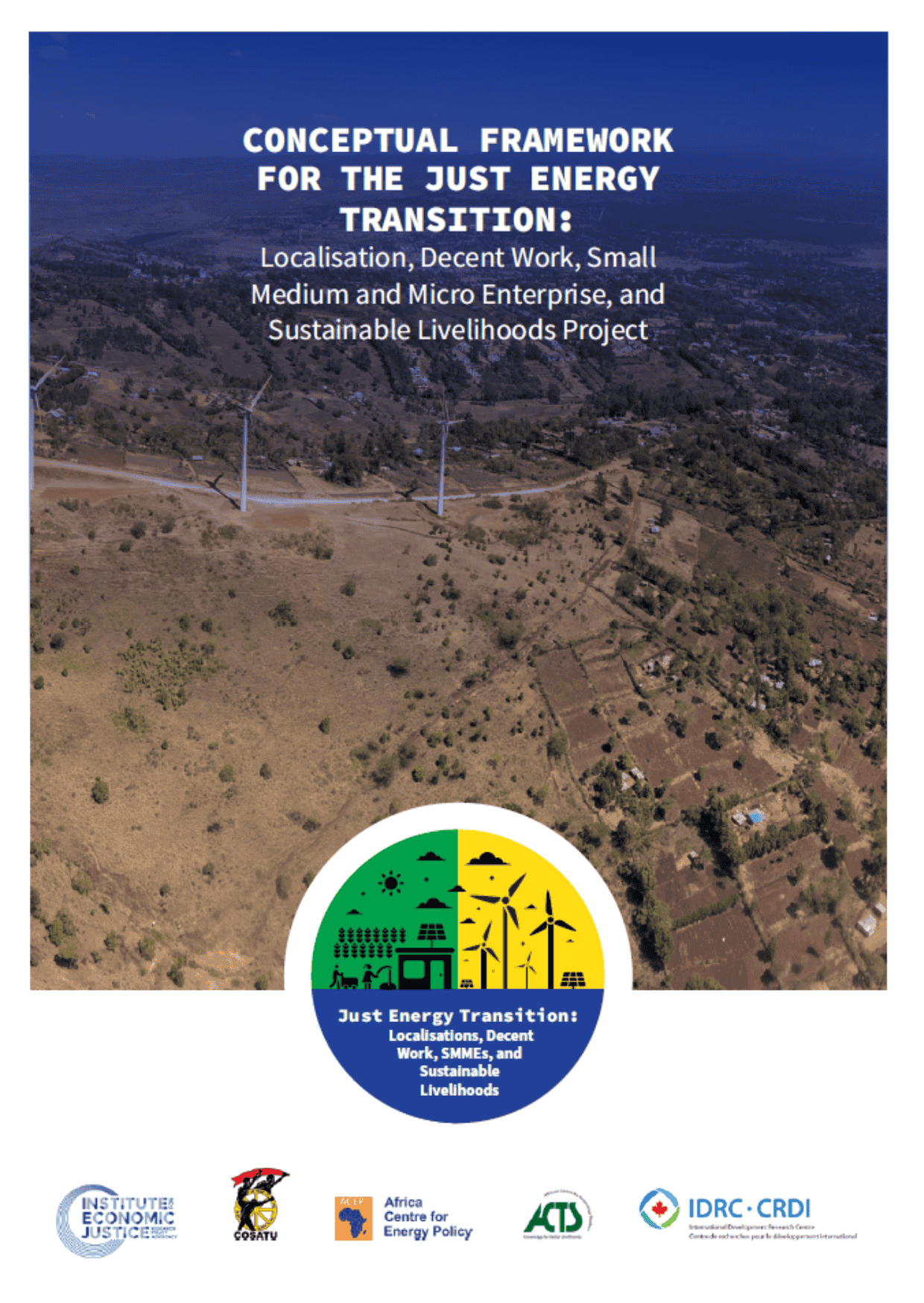
This conceptual framework underpins a multi-country research project examining how renewable energy industrialisation can advance a just energy transition in South Africa, Ghana, and Kenya.
At its core, the framework investigates whether, and under what conditions, the localisation of renewable energy technologies can drive both economic and social transformation.
What do we mean by localisation?
Localisation refers to strategies that:
-
Build local manufacturing and assembly capacity
-
Increase domestic ownership
-
Expand local employment
-
Use domestic resources to serve local markets
Rather than treating renewable energy deployment as a purely technical shift, the framework views localisation as a potential development pathway — one that can strengthen productive capacity while reshaping patterns of ownership, work, and livelihood.
From economic upgrading to social upgrading
A central concern of the framework is the relationship between economic upgrading and social upgrading.
Social upgrading refers to improvements in:
-
Wages and working conditions
-
Workers’ rights and ability to organise
-
Gender equity and racial justice
-
Broader household and community wellbeing
The framework situates paid work within the wider sphere of social reproduction, recognising that economic transformation is inseparable from unpaid care work, household labour, and community life. It asks not only how value is created, but who benefits, who is excluded, and how existing systems of inequality may be reproduced or disrupted within renewable energy sectors.
Particular attention is given to:
-
The role of small, medium and micro enterprises (SMMEs)
-
The quality of employment created
-
Capability development and technological learning
-
The distribution of gains across gender, race, age, disability, and other axes of inequality
Analytical approach
The framework draws on the Global Production Networks (GPN) perspective to analyse how renewable energy industries are shaped by interconnected global and domestic forces. This approach enables a structured examination of:
-
How value is created, captured, and enhanced across production networks
-
The power relations between firms, states, workers, households, and civil society
-
The embeddedness of renewable energy industries within broader social, political, and ecological systems
Importantly, the framework moves beyond a firm-centred analysis. It integrates insights from Marxist, feminist, and ecological political economy to understand how struggles over value, power, and distribution unfold across multiple sites, from global markets to local communities.
Operationalising the framework
To translate theory into practice, the project develops an assessment matrix. This tool operationalises key concepts, including value creation, value capture, social upgrading, and localisation, into a structured guide for empirical research.
The matrix supports systematic analysis of:
-
Employment creation and job quality
-
Capability development in local firms
-
Ownership patterns
-
Labour rights and organising
-
Links between industrial policy and sustainable livelihoods
Why this framework matters
The framework is designed to inform policy and practice by identifying development pathways that align renewable energy expansion with:
-
Decent work
-
Gender equity
-
Sustainable livelihoods
-
Strengthened domestic productive capacity
It provides both a theoretical foundation and practical tools for assessing whether renewable energy localisation can meaningfully contribute to a just transition, one that advances climate goals while transforming unequal economic structures.