Across the world, governments face interconnected ecological, social and economic crises. Climate change, widening inequality, debt distress and unstable global supply chains are increasing the urgency of building productive systems that are more resilient, inclusive and environmentally sustainable.
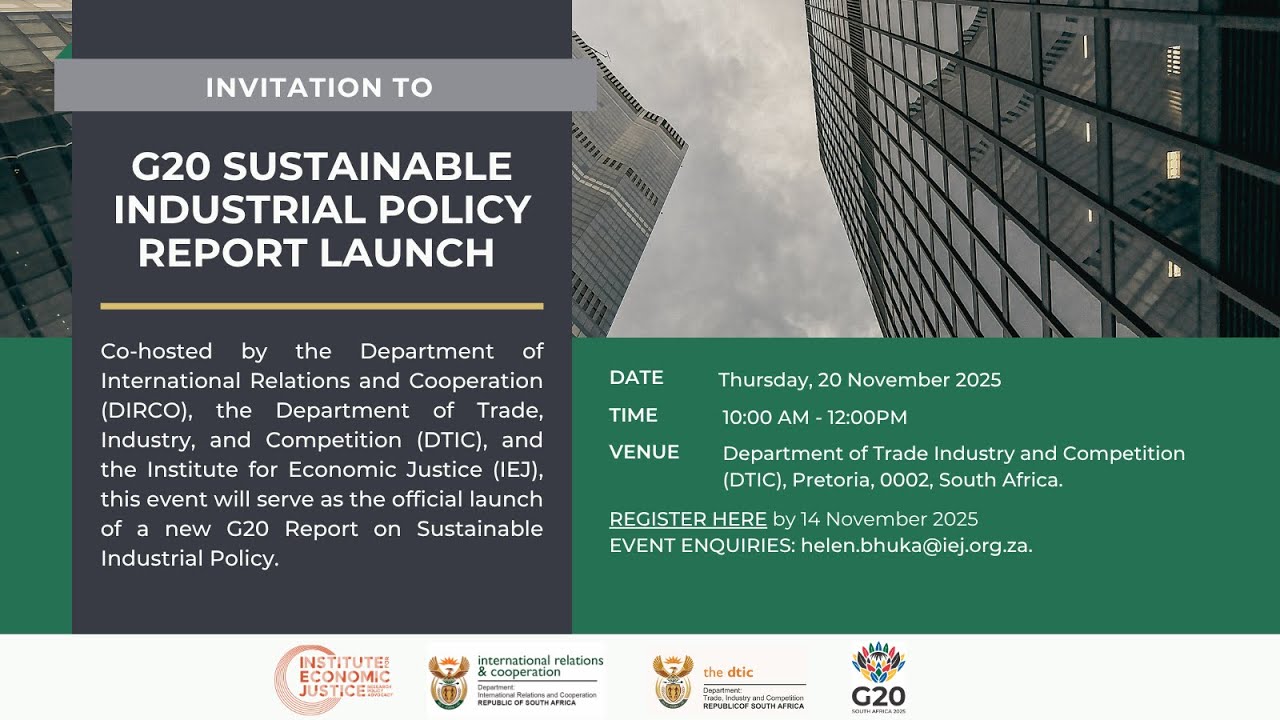
The Institute for Economic Justice (IEJ), the Department of International Relations and Cooperation (DIRCO), and the Department of Trade, Industry and Competition (the DTIC) co-hosted the official launch of the G20 report Removing International Obstacles to Sustainable Industrial Policy. The launch took place shortly before the G20 Leaders’ Summit and formed part of South Africa’s contribution to advancing sustainable industrial policy during its G20 Presidency.
The report brings together leading global experts to examine how international trade, investment, intellectual property and financial rules constrain the policy space available to developing countries. It argues that these obstacles make it harder for countries, particularly in Africa and the wider Global South, to diversify their economies, develop higher-value industries, create decent work and pursue a just transition.
Deputy Minister of Trade, Industry and Competition Zuko Godlimpi presided over the launch. Discussions highlighted the need for coordinated international action to ensure that developing countries have access to the finance, technology and policy tools required to build sustainable industrial ecosystems. Participants also emphasised that the transition must benefit workers and communities while supporting inclusive development and respecting planetary boundaries.
The event reinforced a central message of the report: sustainable industrial policy is essential, but countries cannot achieve it under unequal global rules or with inadequate access to resources.
Watch the report launch
Read the IEJ’s statement on the outcomes of South Africa’s G20 Presidency