for systemic change:
In 2018, the Institute for Economic Justice (IEJ), a progressive economic policy think tank, was launched by a group of South African academics, activists and former government policymakers. The IEJ’s founding vision was an economy anchored by the values of equality and social justice. In just three years, the IEJ has become a significant voice and thought leader in directing the movement for economic justice.
The formation of the IEJ broadened and institutionalised work successfully undertaken through the National Minimum Wage Research Initiative (NMW-RI) at the University of the Witwatersrand. The NMW-RI provided academic research which supported the carefully crafted national minimum wage proposal and contributed a much-needed progressive voice to the public debate. The research was drawn upon by stakeholders within Labour, social movements and others within the NEDLAC political process. The research was a tool for organisational education. The impact of the NMW-RI showed the value of academic research and its ability to guide policy. It is unlikely that the outcome of the negotiations would have been the same without the NMW-RI research. The Deputy President’s Expert Panel, amongst others, adopted its key arguments.
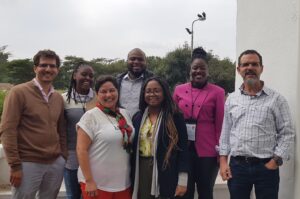
Following this, the co-founders (Gilad Isaacs and Neil Coleman) and a reference group of (mainly young) black intellectuals began laying the groundwork for the establishment of the IEJ. A scan of 38 existing research institutions in South Africa was undertaken, and consultations with over 50 academics, union and civil society activists, policymakers, and government officials were conducted. Leaders of this initiative already had a track record of undertaking high-quality, policy-relevant research.
- The deficiencies in existing social and economic policies, and the ideas and research upon which they rest. These policies are unable to address the deep economic and social crises that manifest in extreme levels of poverty, inequality and unemployment and, subsequently, undermine democracy and democratic institutions.
- The lack of coherent, viable economic alternatives and the failure of progressive social forces to organise a social consensus around such interventions.
- The need to build capacity for policy-relevant economic research that responds to the concerns of labour, community activism, civil society, and progressive politics, thus developing research and policy which directly contributes towards leveraging social change. Particular under-researched policy areas were identified.
- The lack of integration between economic research and policy proposals, and progressive social forces that can utilise those to bring change.
The IEJ was launched on 7 September 2018 with a public (televised) lecture on the Trajectory of economic thought in Africa and the implications for economic policy with the late Professor Thandika Mkandawire, together with Professor Jayati Ghosh, Oxfam South Africa’s Director Sipho Mthathi, IEJ Chairperson Zane Dangor and music and poetry by Xho-pera singer Mthwakazi Lenga and poet Noluthando Buthelezi.